
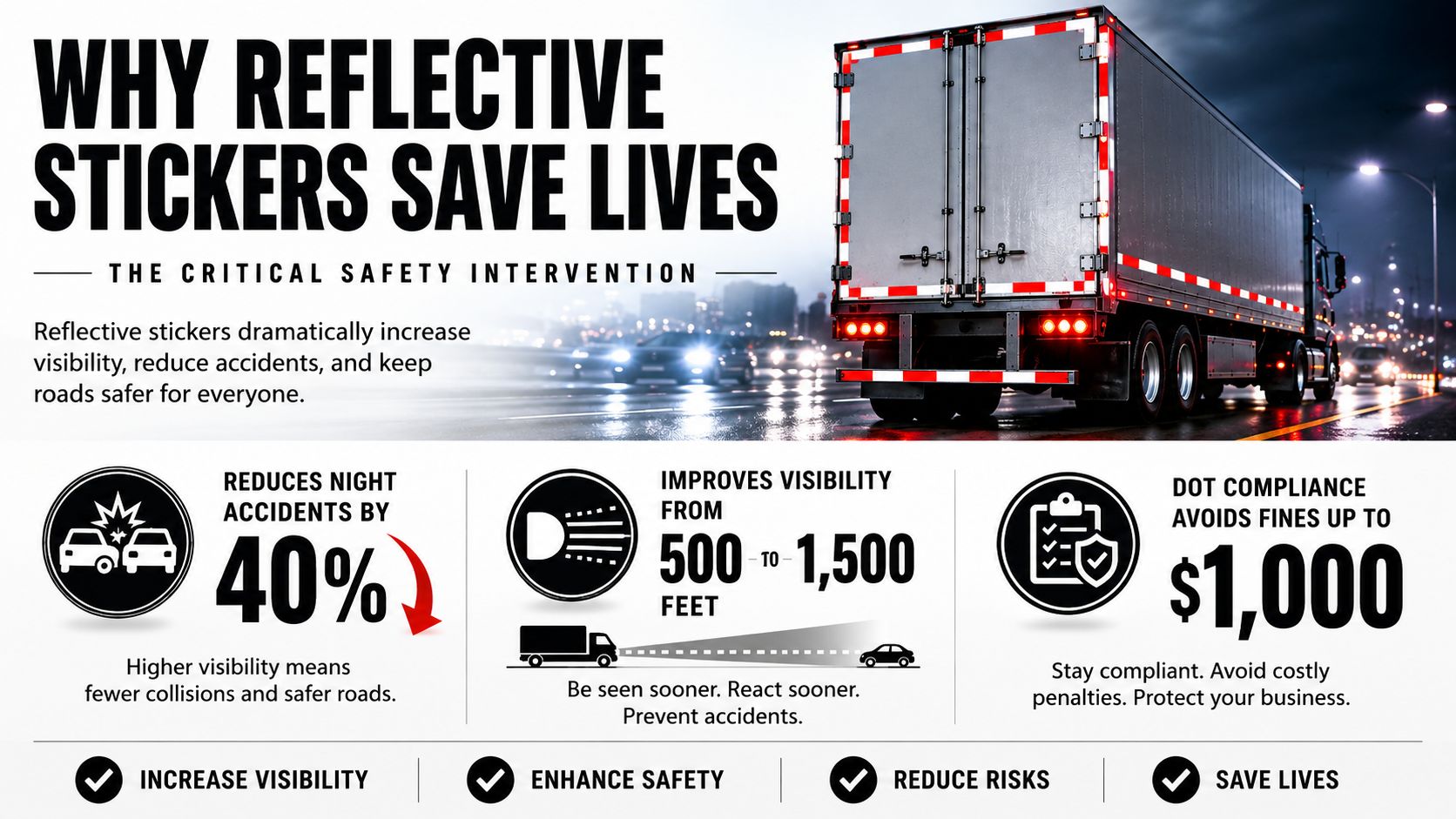
A lot of people treat truck reflective stickers like trim. The safety record says otherwise. In the U.S., NHTSA's analysis found that conspicuity markings on heavy trailers reduced side-and-rear impacts in dark conditions by 29% and reduced fatalities or injuries in those crashes by 44% (3M regulatory overview citing the NHTSA milestone).
That's the right way to think about this topic. You're not choosing between a cool decal and a boring strip of tape. You're deciding whether the next driver can recognize the size, shape, and position of your truck or trailer soon enough to react.
The biggest mistake I see is simple. Owners buy a reflective-looking decal online, assume it counts as DOT tape, and only learn the difference during an inspection or after a bad install starts peeling. Consumer reflective decals have their place. DOT-compliant conspicuity tape has a different job.
Why Truck Reflective Stickers Save Lives on the Road
The reason truck reflective stickers matter is simple. Visibility fails before braking fails. If another driver does not see the rear edge of a trailer, or reads a dark trailer as open road, they react late.
That safety point has been in the record for years. NHTSA's analysis tied trailer conspicuity markings to meaningful crash reduction in dark conditions, and the same research estimated that full implementation across the U.S. heavy-trailer fleet would prevent about 7,800 police-reported crashes per year, along with 191 to 350 fatalities and 3,100 to 5,000 injuries annually (3M regulatory overview).
What the material does
Good reflective material does not glow on its own. It uses retroreflection. Headlights hit the surface, and the structure inside the tape sends that light back toward the driver's eyes instead of scattering it away.
That matters most when the truck is parked, crossing traffic, backing, or running in low-light weather. A black trailer at night can disappear until a car gets too close. Add proper markings, and the vehicle outline becomes readable fast.
Practical rule: If the marking helps another driver understand “that's a trailer edge” instead of “that's just darkness,” it is doing real work.
Who benefits most
This is not only for interstate fleets.
- Commercial trailer operators: Compliance and nighttime recognition go together. The tape is required if the equipment falls under the rule.
- Owner-operators: You need material that survives road grime, wash cycles, and loading abuse without turning into a maintenance headache.
- Pickup owners towing trailers: Utility, car-hauler, equipment, and enclosed trailers all benefit from better rear and side visibility.
- Personal truck owners: Decorative reflective decals can improve visibility, but they do not automatically satisfy regulated conspicuity requirements.
If you are building your maintenance routine, add reflective markings to the same walkaround you already use for lamps, tires, and securement. A practical reference is this 2026 truck inspection checklist, especially if you want a structured reminder of what gets missed during rushed pre-trip checks.
Why adoption still gets missed
Even when the safety value is clear, usage can be uneven. In an 8-day Indian toll-plaza pilot, only 3.61% of vehicles received reflective stickering, and researchers noted that about 50% of trucks passing still lacked rear reflective stickering (PARIPEX field study summary).
That tells you something useful from the shop floor. People usually do not skip this because they reject safety. They skip it because they buy the wrong product, apply it badly, or assume any reflective sticker does the same job.
DOT Conspicuity Tape vs Consumer Reflective Decals
A lot of truck owners get tripped up here because both products reflect light, but they do different jobs. DOT-C2 conspicuity tape is a regulated safety material made for commercial marking. Consumer reflective decals are usually chosen for styling, identification, or extra visibility on a personal truck.
They are not the same thing, and they should not be treated that way.
Comparison: DOT-C2 Tape vs Consumer Decals
For regulated trucks and trailers in the U.S., DOT-C2 conspicuity tape uses prismatic reflective elements with a pressure-sensitive adhesive backing. The benchmark is minimum photometric performance of 250 cd/lx/m² for white and 60 cd/lx/m² for red at the specified observation angle (3M product bulletin).
That is why compliant tape throws back headlight beam so well at distance and at imperfect approach angles. A cheap reflective decal can look sharp in a catalog and still fall short on the road, especially when a driver is coming from a lane offset or rounding a curve.
If the listing does not clearly identify the product as DOT-C2, I treat it as decorative until it proves otherwise.
Who legally needs compliant tape
The plain-language rule is simple. Commercial trailers over 80 inches wide and over five tons need retroreflective tape on the sides and rear, while the truck itself has different rules and the tape must be placed in specific zones, including lower rear sections and upper rear corners (Seton overview of reflective tape regulations).
That is where a lot of owners miss the mark. They buy reflective striping, put it where it looks clean, and assume the job is done. Material matters, but placement carries the same weight.
If you are dealing with body hardware, rails, closures, and other add-ons that can interrupt tape runs, the HGV body fitting guide is a useful companion because it helps you think about the truck body as a system, not just a flat panel.
What works and what doesn't
Here is the practical trade-off.
- Works: Buy certified conspicuity tape for compliance zones, then use separate decals for branding or style in non-regulated areas.
- Doesn't work: Expect a flag decal, custom logo, or reflective bed graphic to satisfy regulated trailer requirements. For a styling example, see this custom muddy tire tread bedside graphic set, which belongs in the personalization category, not the compliance category.
- Works: Match the product to the surface. Flat aluminum doors and smooth painted panels usually bond well after proper prep.
- Doesn't work: Put bargain reflective film on textured plastic and expect fleet-grade durability.
For personal trucks, consumer reflective decals make sense if you want visibility and style together. For regulated trailers, they are the wrong tool.
Where to Place Reflective Stickers on Your Truck
Placement decides whether the material helps or just decorates. A bright strip in the wrong spot can look impressive in the driveway and do very little for a driver coming up behind you on a dark road.
For trucks and trailers under UN/ECE vehicle-marking rules, Class C retroreflective contour or strip marking is designed to make vehicles visible at up to 1,000 meters in low-light conditions, using 50 mm-wide white or yellow side markings and red rear markings arranged to create a recognizable outline (ORAFOL vehicle conspicuity catalogue). That principle applies even when you're not working under that specific rule. Outline beats random decoration.
Commercial trailer zones that matter
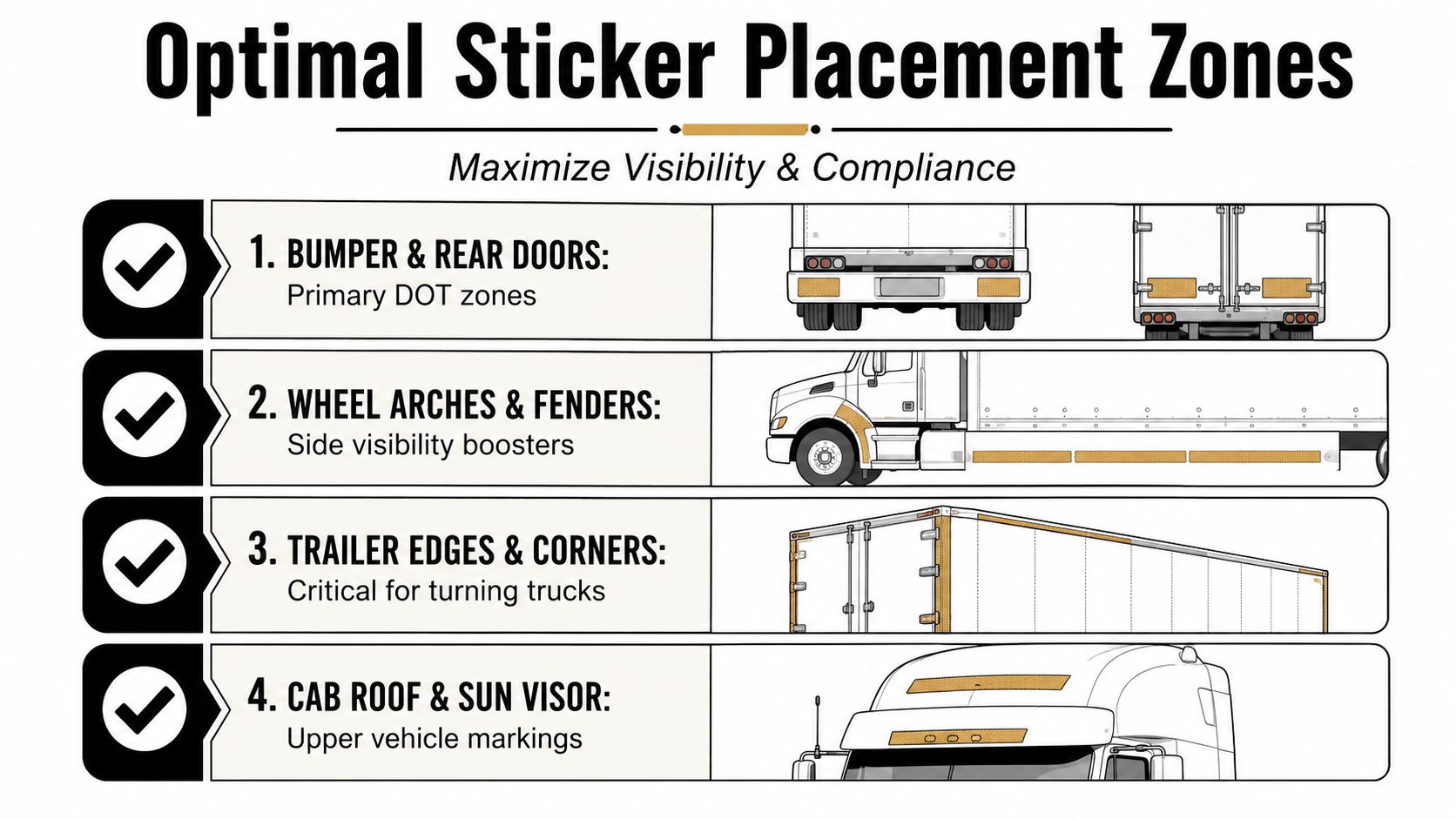
On regulated trailers, the useful mental model is this. You're marking the rear shape and enough of the side length for another driver to recognize that a large vehicle is there.
Focus on these areas:
- Lower rear sections: These catch headlights first and help define the trailer's width.
- Upper rear corners: These help drivers read the vehicle height and rear outline.
- Side runs: Long side markings help another driver judge trailer length during overtakes and crossings.
- Rear doors and fixed rear structure: Good spots when the surface is smooth, solid, and not interrupted by hardware.
Keep tape off moving parts where repeated flexing or rubbing will chew up the edges. Hinges, latches, rotten wood, rusty steel, and heavily corrugated surfaces all shorten service life.
Smart placement on personal trucks
Pickup owners have more freedom, but that doesn't mean every location is smart.
Good spots usually include:
- Rear bumper corners, where approaching headlights naturally hit.
- Bedside lower sections, if you want side visibility without cluttering the upper body line.
- Trailer fenders or rear frame members on utility and equipment trailers.
- Toolbox or rack uprights, when the surface is flat and the marking won't be hidden by gear.
One example of a style-first product for the bedside area is this truck muddy tire tread bedside graphic set of 2. That kind of graphic works when you want visual impact on a personal truck, but it should stay separate from any compliance decision.
A reflective sticker that disappears behind a spare tire, jack mount, mud flap, or swing-out rack is wasted material.
A quick visual demo helps if you're planning around a real vehicle shape and not a flat drawing.
Placement mistakes I'd avoid
Some errors show up over and over:
- Running decorative strips too high: They may look clean, but lower zones often do more work in headlights.
- Breaking the outline: Small isolated pieces don't communicate vehicle shape well.
- Covering problem surfaces: Textured plastic, oxidized paint, and chipped powder coat lead to edge lift.
- Blocking function: Don't interfere with tailgate seams, lighting, license plates, cameras, or access handles.
The goal is simple. Put the reflective material where another driver will read the truck's width, height, and path quickly.
How to Install and Maintain Reflective Stickers
A bad install ruins good material. Most failures I see aren't because the vinyl was defective. They start with dirty panels, cold metal, fresh paint, or rushed application over rivets and seams.
Practical guidance for reflective tape says to apply it to a clean, dry surface, ideally in roughly 40–85°F conditions, not on fresh paint, and to inspect it for fading, peeling, or reduced nighttime visibility over time (installation guidance summary).
Installation that holds up
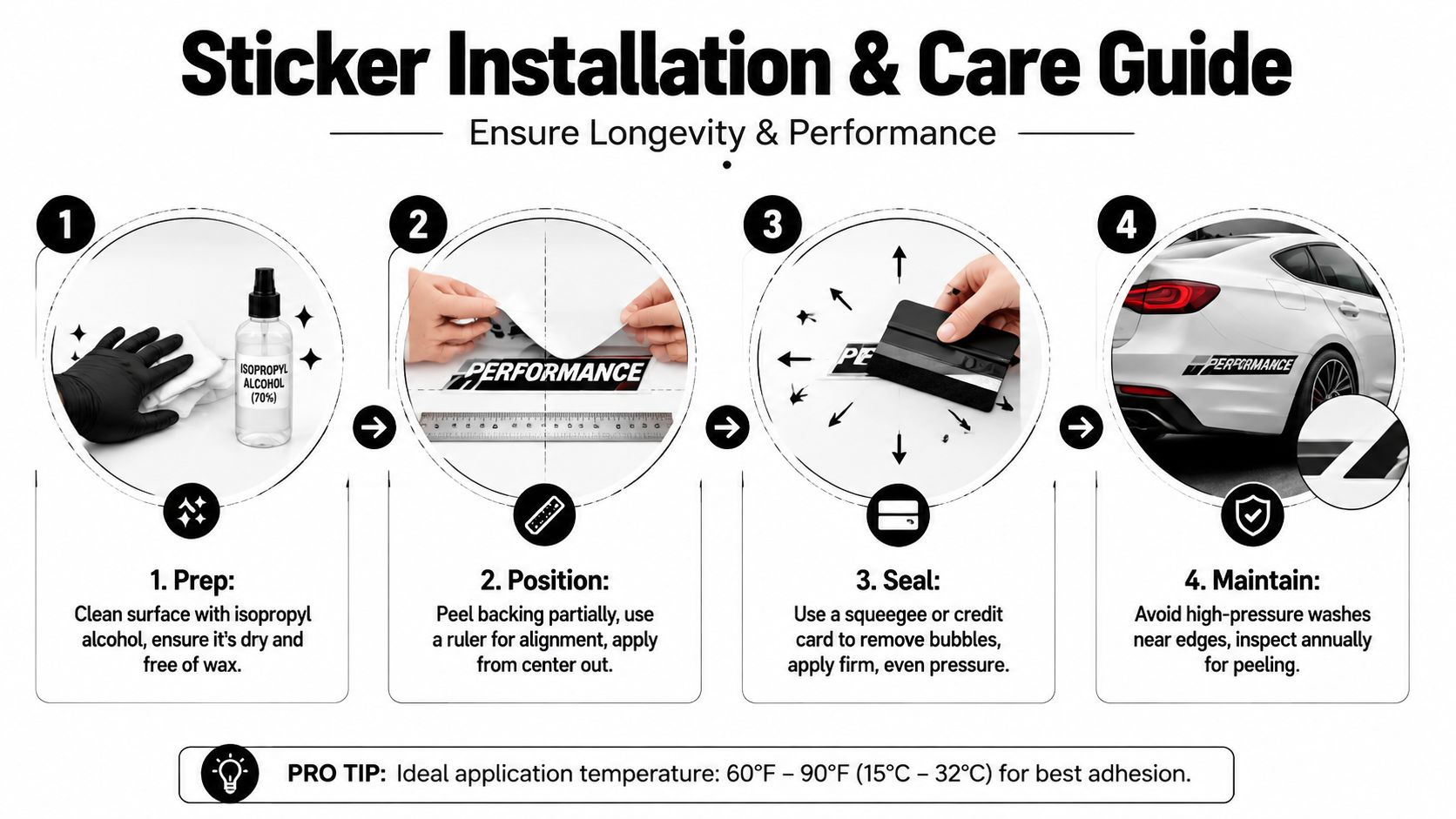
Here's the process I trust on trucks and trailers with decent paint or properly prepared metal.
- Wash first, then degrease. Soap removes dirt. Isopropyl alcohol removes the residue that soap leaves behind.
- Dry the panel completely. Moisture trapped at the edge is a common cause of lift.
- Measure before you peel. Use masking tape or a grease pencil for alignment marks on long runs.
- Peel a little backing at a time. Don't expose the whole adhesive face unless the piece is very short.
- Work from center outward. Use a squeegee or wrapped card to push air away from the centerline.
- Seal edges with firm pressure. Corners and cut ends are the first points to fail.
Surfaces that cause trouble
Not every truck panel is sticker-friendly.
- Fresh paint: Let it cure fully before applying any adhesive film.
- Waxed panels: Wax kills bond strength unless you strip it off first.
- Cold steel in winter: The adhesive won't wet out properly on a freezing panel.
- Deep texture: The film bridges peaks and valleys instead of bonding uniformly.
- Rust scale and oxidized aluminum: You're bonding to failure, not to the panel.
Shop-floor advice: If you can scrape chalky oxidation off with a fingernail, clean-up isn't finished yet.
Maintenance that keeps the material visible
Reflective products don't need babying, but they do need inspection.
Look for:
- Peeling edges
- Cracked faces
- Fading or dull return at night
- Damage from straps, pallets, fuel splash, or power washing
Clean with mild wash soap and a soft cloth. I avoid aggressive scraping and I keep the nozzle of a pressure washer away from exposed edges. Once the edge starts lifting, dirt and water work underneath fast.
If you're ordering custom lettering or accent graphics rather than compliance tape, transfer-taped products make alignment much easier on long windshield or body applications. A product like this custom text windshield banner decal stickers fits that use case, especially when you want straight placement across a wide span.
Customization Options and What to Expect When Ordering
A reflective decal order should start with purpose, not with artwork. On a working truck, the choice usually comes down to three goals, better night visibility, a cleaner custom look, or simple identification without committing to a full wrap.
From there, the design can go a lot of different directions. I see buyers choose hunting themes, military tributes, family graphics, windshield text, side graphics, and plain reflective accents for racks and toolboxes. The right setup depends on where the truck works, because a ranch truck, a show build, and a daily-driven tow rig do not need the same treatment.
What a good order process looks like
A good buying process should be straightforward.
You pick the design, confirm the size, make sure the material matches the panel, and receive a decal that is ready to install instead of forcing you to piece the spacing together yourself. Pre-spaced, transfer-taped graphics are easier to line up and usually look cleaner on the first install.
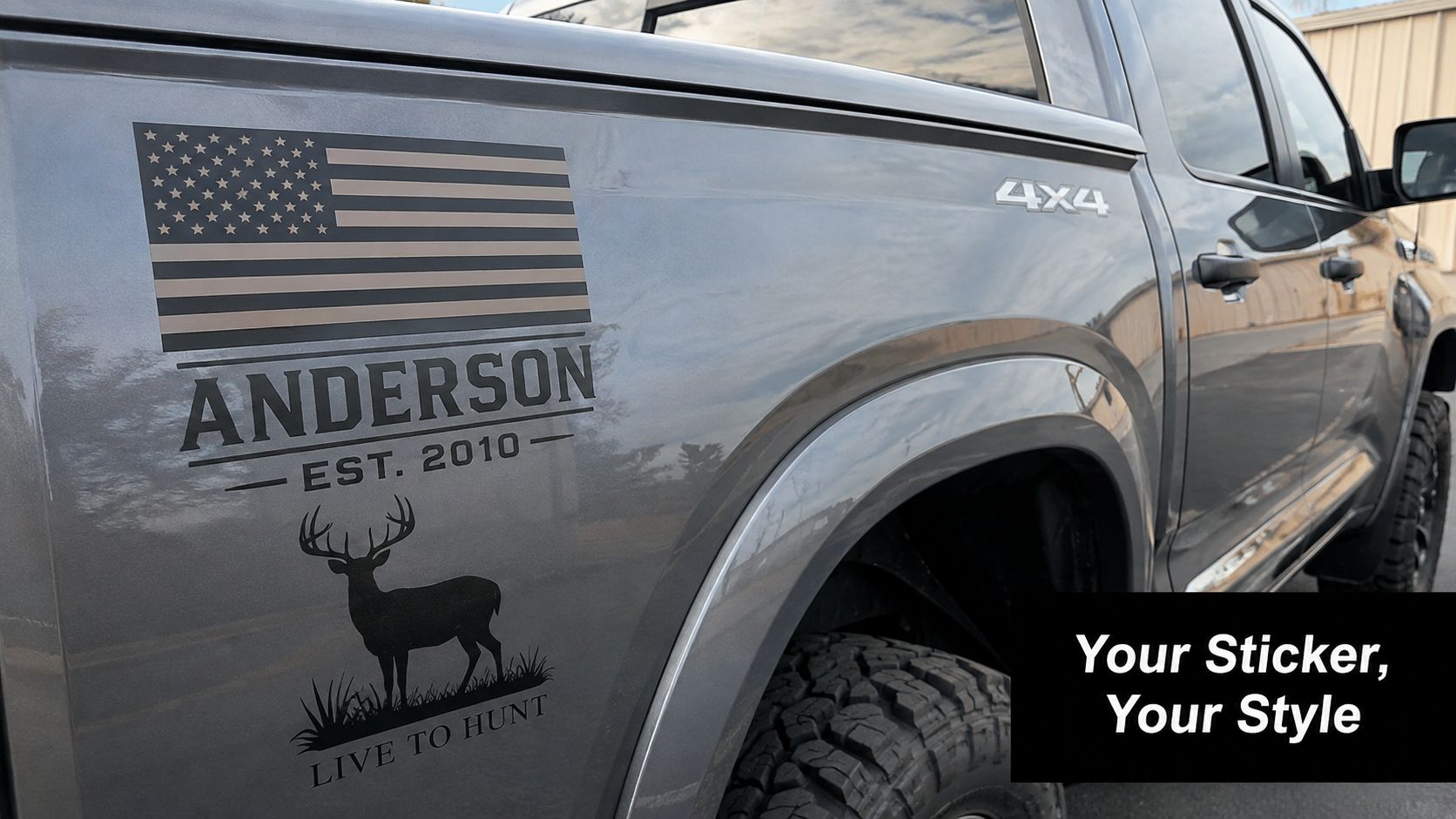
For buyers who need a specific layout instead of a stock graphic, a custom design service is a practical route. That matters on trucks with odd panel dimensions, aftermarket accessories, or a personal design that has to fit around body lines without crowding handles, fuel doors, or trim.
What to check before you buy
I look at four things before I place an order.
- Material quality: Ask what vinyl is being used and whether it is meant for outdoor vehicle exposure.
- Cut style: Pre-spaced lettering installs differently than a printed rectangle with a background.
- Intended use: Reflective decorative vinyl for a personal truck is not the same as DOT conspicuity tape.
- Panel compatibility: Curved fenders, textured plastics, and heavily crowned surfaces can change the result.
The publisher here, Custom Sticker Shop, states that it uses Oracal vinyl rated for up to 7 years outdoors, offers American-made decals, and ships orders that typically arrive in 5–8 days from order to door, with prices starting at $7.99 and free U.S. shipping on orders $25+ (publisher company details). Those details help set expectations on material choice, turnaround, and cost before the decal ever reaches the truck.
What usually goes wrong with custom orders
The problems are predictable.
People order too small because the on-screen mockup looks larger than the actual bedside. They choose a detailed design for a panel that already has handles, fuel doors, or body flares in the way. Some buy a reflective accent and expect it to behave like compliance-grade material, which leads to the wrong product being put on the truck for the wrong job.
The best custom truck reflective stickers are matched to the truck, the surface, and the actual purpose. Style calls for one kind of product. DOT use calls for another.
Key Takeaways and Common Questions About Truck Reflective Stickers
Truck reflective stickers do two very different jobs. One category is regulated conspicuity material for equipment that must meet placement and performance rules. The other is decorative or custom reflective vinyl for personal trucks, branding, and added visibility. Most buyer mistakes happen when those categories get mixed together.
Quick takeaways
- Buy for the job: Compliance tape for regulated zones. Custom reflective decals for personal styling and identification.
- Placement matters: A high-quality material in the wrong location can still underperform.
- Surface prep decides lifespan: Dirt, wax, cold panels, and fresh paint cause early failure.
- Inspect at night, not only in daylight: Some damage doesn't show up until headlights hit it.
The smartest setup is often a split approach. Use proper conspicuity tape where the law or safety demands it, then use separate custom graphics where you want personality.
Common questions
Are truck reflective stickers legal on personal vehicles
Yes, in general decorative reflective decals can be used on personal trucks, as long as they don't create other legal issues such as obscuring plates, lights, or required markings. The important point is that legal decorative use is not the same as DOT compliance.
Can any reflective decal pass for DOT tape
No. A reflective look is not enough. For regulated use, the product needs to be actual DOT-compliant conspicuity material and it needs to be placed correctly.
How long do reflective stickers last
That depends on material quality, weather exposure, panel condition, and how well the piece was installed. Higher-grade outdoor vinyl generally lasts longer than bargain material, and edge failure usually starts before the whole piece gives up.
Can you remove them without damaging paint
Usually yes, if the paint underneath is sound and fully cured. Heat helps. Old, baked-on film can leave adhesive behind, and weak repaint work can come off with the decal.
What if the sticker starts peeling
Replace it. Don't keep pressing down a contaminated edge and hoping it holds. Once dirt and moisture get under the film, the bond usually keeps degrading.
What if a truck fails inspection because of reflective markings
Fix the actual issue, not the appearance. Check whether the problem is the material, the location, or both. On regulated equipment, guessing is expensive and usually leads to doing the job twice.
If you want truck graphics for personal use, Custom Sticker Shop offers custom vinyl decals, windshield banners, bedside graphics, and made-to-order designs that fit real trucks and real install conditions. For owners who want style without confusing it with compliance tape, it's worth browsing Custom Sticker Shop and choosing a product that matches the job you need done.