
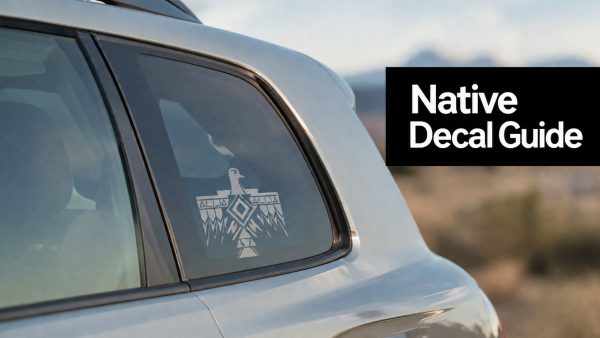
You're standing in front of a screen, scrolling through decal designs, and one keeps catching your eye. It has strong lines, rich symbolism, and a feeling that goes far beyond decoration. That pull is real, but so is the responsibility that comes with choosing a Native American decal.

Native peoples have lived in the Americas since at least 12,000 BCE, with migrations beginning around 25,000 years ago. The U.S. government only granted citizenship to all Indigenous people with the Indian Citizenship Act of 1924, which means the history behind these designs reaches far deeper than the modern vehicle sticker market and even deeper than the United States itself (historical overview). That timeline matters because a decal isn't just a graphic. It can be a sign of appreciation, identity, or support, and each of those choices carries context.
A respectful approach starts with a simple question, what does this design mean, and who does it serve? If the answer is just “it looks cool,” keep going and learn more. If the answer includes honoring a people, supporting an artist, or expressing your own heritage with care, you're already making a more thoughtful choice.
More Than Just a Sticker An Introduction
A Native American decal may be small on a window or tailgate, but the meaning behind it is often much larger than the object itself. For many people, these designs connect to family, tribal identity, memory, prayer, or place. For others, they are a way to show respect for Indigenous cultures, and that respect only carries weight when it is informed.
The first mistake many buyers make is treating all Native imagery as one style. That flattens a wide range of nations, histories, and artistic traditions into a single category. A better starting point is to recognize that the image on the decal is only the surface, while the culture behind it holds the deeper meaning.
Practical rule: if you cannot name the cultural source of a design, you are not ready to use it as a public symbol yet.
A Native American decal also exists in public view. It sits on a car, a truck, a laptop, or a window where other people can see it, so the choice deserves care. A simple comparison helps here. Wearing a symbol privately and displaying it openly are not the same act, because public display sends a message to everyone around you.
The best way to approach that message is to ask what the design communicates and who it represents. If the answer is only that it looks attractive, the choice needs more thought. If the answer includes honoring a people, supporting an artist, or expressing your own heritage with care, then the decal can be chosen with much greater respect.
Exploring Different Native American Art Styles

Native American art is not one visual language. It includes many regional traditions, each shaped by land, materials, ceremony, and community life. Once you start seeing those differences, it becomes much easier to recognize whether a decal feels rooted in a specific tradition or just loosely “tribal” in a generic way.
Southwest Region
Southwestern designs often emphasize geometric patterns, strong color relationships, and forms inspired by pottery, weaving, and desert life. Pueblo, Navajo, and Hopi traditions are often associated with this region, though each nation has its own visual vocabulary. In decal form, these patterns tend to feel structured, balanced, and rhythmic.
Plains Region
Plains art often carries a more narrative energy. Ledger art, beadwork, and quillwork can reflect daily life, ceremony, horses, animals, and spiritual meaning. Lakota and Cheyenne traditions are among the most recognized in this broad category, and many designs aim to tell a story, and their function is more than decoration.
Northwest Coast
The Northwest Coast is known for bold line work, formline design, masks, carved figures, and cedar-based traditions. Haida, Tlingit, and Kwakwaka'wakw art often uses strong visual confidence, with clear black outlines and shapes that feel alive in motion. On a decal, this style can be powerful, but it also demands accuracy because the style is so specific.
Eastern Woodlands
Eastern Woodlands traditions often include floral motifs, wampum belts, basket forms, and porcupine quillwork. Iroquois, Cherokee, and Ojibwe traditions are often mentioned here, though again, each nation has its own distinct language. These designs can look softer than Plains or Northwest Coast work, but they're no less meaningful.
If you're comparing styles, look for clues in line, color, and symbol choice. That's where the cultural home of a design often shows up first.
A careful eye can tell the difference between a genuine regional style and a loosely copied “Native-inspired” graphic.
Explore a memorial-inspired tribal design example can help you see how a single visual theme can still carry a distinct design identity when it's handled thoughtfully.
Appreciation vs Appropriation A Critical Guide
The difference between appreciation and appropriation comes down to relationship, permission, and benefit. Appreciation means you've taken time to learn the source, respect the meaning, and support the people or communities connected to the design. Appropriation happens when a symbol is taken out of context, stripped of its meaning, or used in a way that benefits the buyer more than the culture it came from.
That distinction matters because Native communities are not abstract design libraries. A 2022 study of rural Native American adults described ongoing issues around discrimination, safety, and lack of visibility in everyday life, which shows that cultural symbols are never only decorative for the people living with those realities (study on rural Native American adults). When a design is used carelessly, it can feel like another example of outsiders taking from a culture while ignoring the people inside it.
Questions to ask before buying
- Who made this design? If the artist or shop can't explain the source, treat that as a warning sign.
- Does the purchase support a Native artist or community? If not, the design may still be visually attractive, but it's harder to call it respectful.
- Is the symbol sacred, ceremonial, or restricted? Some imagery should stay within community or ceremonial use.
- Is the design tribal-specific or generic? A vague “tribal” look often erases real nations and real differences.
- Would I feel comfortable explaining this choice to someone from that community? If the answer is no, pause.
This framework shifts the question from “Can I buy it?” to “Should I wear it publicly, and in what form?” That's the right kind of caution. Respectful choices aren't about fear, they're about context.
A good decal choice can honor Native art without pretending every image is free for anyone to use. That balance is what separates thoughtfulness from costume.
Common Symbols and Their Meanings

Some Native symbols are widely recognized, but recognition doesn't mean unlimited freedom to use them however you want. Meanings shift by nation, context, and purpose. A symbol can be sacred in one setting, decorative in another, and restricted in a third.
The Eagle Feather
The eagle feather is often associated with honor, respect, wisdom, and courage. In many contexts, it carries ceremonial importance and isn't something to treat casually. If a decal uses it, ask whether the design is honoring that significance or turning it into generic decoration.
Dreamcatcher
The dreamcatcher originated with the Ojibwe and is widely understood as a protective object meant to let good thoughts through while catching harmful dreams. It's one of the most familiar Indigenous symbols in mainstream culture, which makes it especially important to research carefully before using it. Familiarity can create false confidence.
Thunderbird
The thunderbird is a powerful figure associated with storms, strength, and protection. It appears in multiple Indigenous traditions, but the exact meaning and visual form vary. On a decal, thunderbird imagery often signals power, but that power should be handled with respect, not just visual hype.
Bear Claw
The bear claw is commonly linked to strength, courage, leadership, and protection. It's often seen in jewelry and carved work, where the symbol can carry a sense of personal resilience. Even so, don't assume a bear-claw graphic is interchangeable across all Native traditions.
Turtle
The turtle often represents Mother Earth, longevity, health, and wisdom. It appears in many creation stories and is meaningful in several nations. That broad recognition is exactly why context matters, because a symbol this common can still have very specific meaning in the right setting.
For a deeper visual example, this embedded guide pairs well with a symbolic reading of designs and can help you spot motifs before you commit to a decal. A practical symbol reference is useful only if you pair it with research, not impulse.
Choosing the Right Decal Material and Size
A respectful design still needs the right physical build if you want it to last. For vehicle use, premium decals are typically made from cast PVC film, which is thinner, more dimensionally stable, and better at conforming to curves than calendared film. The same construction is usually paired with a permanent pressure-sensitive acrylic adhesive, which helps resist lifting and shrinkage over time.
Material matters more than people think
A lot of buyers focus on the image and ignore the substrate. That's a mistake. Cast film is the better choice for curved panels, fenders, bumpers, and other vehicle surfaces where movement and contour can stress the decal.
Rule of thumb: if the surface bends, curves, or sees a lot of weather, choose the more stable film rather than the cheapest option.
Here's a simple way to compare choices:
- Cast PVC film: better conformity, lower shrinkage, stronger fit for vehicle graphics.
- Calendared film: more suitable for simpler, flatter uses, but less forgiving on curves.
Size should follow the surface, not the ego
The decal should fit the panel it's going on. A small rear window needs a different scale than a hood or truck door, and a design that's too large can overpower the vehicle's lines. Measure the usable area first, then leave breathing room around the edges so the symbol doesn't feel cramped.
The guide below gives a practical way to think about scale, from subtle accents to bold statements. Small decals work well where visibility matters but space is limited. Larger decals make sense when the design needs room to breathe.
Before you order, compare the shape of the decal to the shape of the panel. A long horizontal design usually suits windows and side panels, while a compact circular or emblem-style graphic can sit neatly on smaller areas. If you're unsure, mock up the dimensions with painter's tape first.

How to Customize and Source Decals Responsibly
Ethical sourcing starts with the maker, not the checkout button. If you want a Native American decal that feels authentic, look first for Native-owned businesses, licensed artists, or creators who clearly explain their community ties. That keeps the money and recognition closer to the source.
A custom design can be a better choice than a pre-made one when you want something personal without borrowing sacred imagery. For example, a name, a clan reference, a place-based motif, or a community tribute can be commissioned in a way that reflects real connection. A good custom request asks for collaboration, not extraction.
What to avoid
- Official tribal seals or flags: these are sovereign identifiers, not generic decoration.
- Sacred or ceremonial imagery: if you don't know the rules around it, don't assume it's open for use.
- Copied internet art: reposted graphics often strip credit from the original maker.
- Blanket “tribal” styling: vague patterns erase the difference between nations.
If you're thinking about starting a small decal business yourself, the basics of product sourcing and customer trust matter just as much as design. A useful overview like Open a print on demand shop can help you understand the broader mechanics of selling custom products responsibly, even though the ethical question still comes down to who makes the art and who benefits from it.
For a custom request, clear communication is everything. Tell the artist where the decal will be used, what size you need, and what kind of symbolism you want to avoid. The strongest commissions come from specific, respectful briefs.
Start a custom design conversation here only after you've done the cultural homework. That order matters.
Proper Installation and Care for Your Decal
A decal does its job best when the surface is clean and the application is deliberate. Start with a wash, then wipe the area with rubbing alcohol to remove wax, oil, and residue. That prep step matters because even a high-quality adhesive can struggle on a contaminated surface.
Use the dry method for simpler layouts and the wet method only when the film and application size call for extra repositioning. Press from the center outward with a squeegee so air has somewhere to escape. If a bubble appears, don't rush it, work it out slowly instead of forcing the film.
Clean surface first. Smooth pressure second. Patience last.
For care, keep washing gentle and avoid directing a pressure sprayer straight at the decal's edges. Harsh cleaning can lift corners over time, especially on vehicle graphics that face sun, road grit, and frequent washing. That's the same general logic behind avoiding common art hanging mistakes, where surface prep and placement determine whether the piece stays put and looks right.
A decal that's installed carefully becomes part of the vehicle's visual identity, not a temporary add-on. If you're using it to honor a culture, that final step of careful application is part of the respect.
If you're ready to choose a Native American decal that reflects real respect instead of a quick aesthetic, start by checking the artist, the symbol, and the material, then explore the options at Custom Sticker Shop and choose a design you can explain with confidence.