
You are standing in the driveway with a fresh decal in your hand, a clean rear window in front of you, and one simple goal. Show service with pride without creating a mess, a misunderstanding, or a problem at the gate.
That is where a lot of military car sticker purchases go right or wrong. The reason behind the decal is usually solid. A veteran wants a branch insignia that looks sharp on the back glass. A spouse wants to recognize a deployment. A parent wants a memorial decal that carries weight without turning into noise. The hard part is choosing a design that is appropriate, placing it where it reads well, and making sure it holds up on paint or glass through heat, rain, road salt, and car washes.
Military decals ask for more care than standard automotive graphics. They represent service, sacrifice, family, memory, and identity. A good one needs to do three things at once. It needs to say the right thing, look clean on the vehicle, and stay put for the long haul.
There is also a point that gets skipped in lighter guides. Some decals can raise real questions on base, at installation gates, or under local vehicle rules, especially if they block visibility, crowd required stickers, or create confusion about rank, unit, or official status. Service members and veterans deserve better than generic advice here. The decal should honor the message and fit the rules of the places the vehicle operates.
That practical side is important; these decals are part of a significant market, not a tiny niche. Shops that produce and install vinyl see steady demand from veterans, active-duty families, and supporters who want something more personal than an off-the-shelf graphic. The market matters, but the job is still hands-on. Material choice, cut quality, adhesive strength, and placement discipline decide whether a decal looks professional six months from now or starts curling at the first bad wash.
Done right, a military car sticker looks respectful on day one and still looks right a year later. That is the standard.
More Than a Sticker a Symbol of Service
You pull into the commissary lot, shut the truck off, and catch the decal in the rear glass as you step out. To anyone else it may look like a small piece of vinyl. To the people who recognize it, it says exactly who served, who sacrificed, or who is being remembered.
For some owners, the message is direct. Army veteran. Marine family. Retired Navy chief. Gold Star parent. For others, it is quieter and more personal. A branch emblem in the corner of a rear window, a subdued flag on the tailgate, or a memorial decal for someone who did not make it home can carry just as much weight.
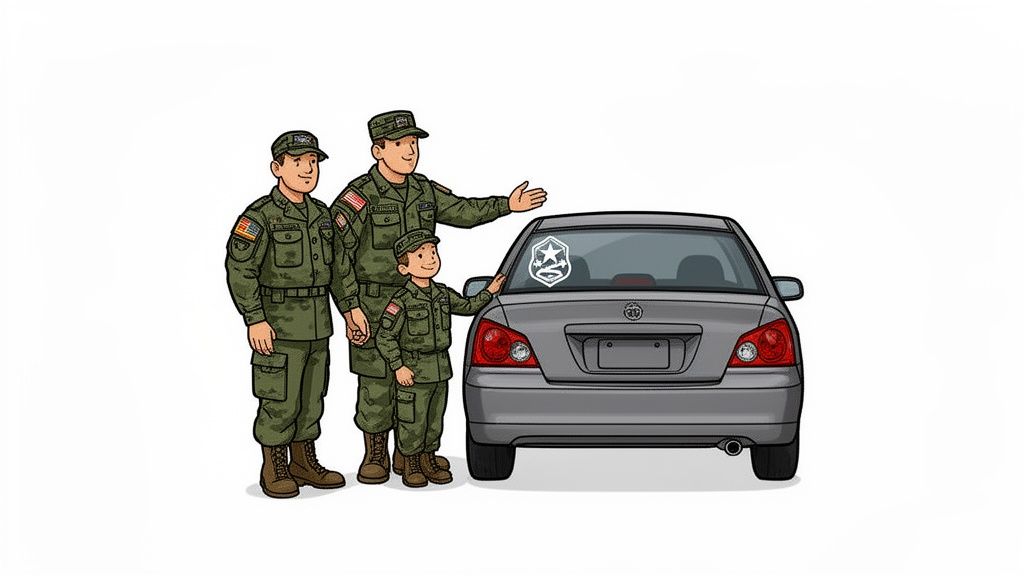
After years in the decal trade, the military stickers that hold up best, both visually and respectfully, are usually the simplest ones. A clean branch insignia, a unit mark with real meaning, a veteran identifier, or a memorial symbol reads clearly and ages better than a rear window crowded with unrelated graphics. If the goal is pride, clarity wins.
A good example is a clean Marines EGA Eagle Globe Anchor Semper Fi decal. It is recognizable, specific, and easy to place without overpowering the vehicle.
Why these decals matter
Military car stickers create recognition in a way few other vehicle graphics do. Another veteran notices the emblem at a stoplight and gives a nod. A military spouse sees a family decal in a parking lot and knows there is shared experience there. A memorial sticker can communicate loss without asking the owner to explain it.
That meaning also brings responsibility. The design should match the person displaying it. A branch decal is broad and usually safe. Unit insignia, rank references, memorial graphics, and official-looking seals call for more care because people on and off base may read them very differently.
Respect shows in the details
In my shop, respect shows up long before the backing paper comes off.
- Choose a design that reflects a real connection to service, family service, retirement, or remembrance.
- Keep the message clear so the decal looks deliberate instead of cluttered.
- Use a layout that fits the vehicle and does not compete with factory badging, wipers, or other stickers.
- Consider where the vehicle goes every week, especially if it enters military installations where local rules and gate scrutiny can matter.
A crooked decal, a cheap print that fades in one summer, or a symbol used without understanding can cheapen the message fast. Military stickers may be small, but they are not casual graphics. Done right, they honor service, read clean at a glance, and avoid the problems that come from using the wrong symbol in the wrong place.
Decoding the Designs Meanings and Etiquette
Some military car stickers are easy to read. Others are obvious only to the people who served around them. That is part of what makes them meaningful.
Branch symbols and what they say
The most common military decals are branch-based.
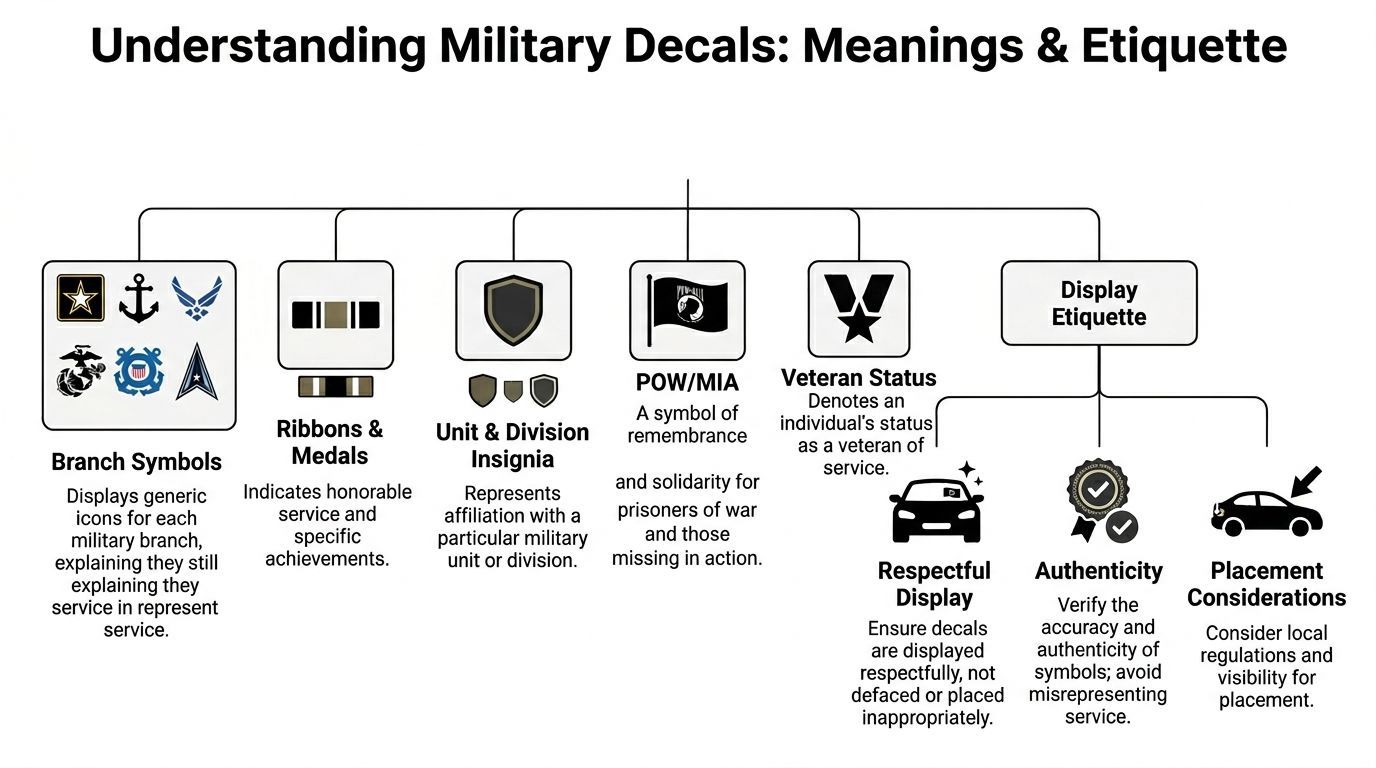
An Army star, Navy anchor, Air Force wings, Marine Corps emblem, Coast Guard shield, or Space Force delta tells people where the connection starts. These are broad identifiers. They work well for veterans, active-duty families, retirees, and supporters with a direct service tie.
Branch decals are also the safest choice if you want something respectful and widely understood. A Marine Corps EGA is a good example of a design that carries immediate recognition when kept clean and simple, such as this Marines EGA Eagle Globe Anchor Semper Fi decal.
Unit and specialty insignia
Unit decals speak to a narrower audience, but they often mean more to the owner.
A division patch, airborne identifier, cavalry mark, or MOS-related symbol usually says, “I was there,” not just, “I support the branch.” These can be powerful, especially for people who want to represent a specific chapter of service rather than a whole career in one symbol.
They also call for more caution. The more specific the symbol, the more likely people around you will recognize whether it is accurate.
Memorial and recognition decals
Some decals are less about identity and more about remembrance.
Common examples include:
- POW MIA symbols that honor prisoners of war and the missing.
- Gold Star family decals that recognize loss tied to service.
- Veteran decals that identify status without implying a current role.
- Ribbon and medal themed graphics that refer to honorable service and achievement.
These should be displayed carefully. Avoid mixing memorial decals into a random collage of off-road badges, brand stickers, and novelty graphics. A tribute decal needs visual breathing room.
The etiquette matters
Military sticker etiquette is mostly common sense, but it helps to say it plainly.
Do not display insignia that imply service, rank, qualification, or earned recognition you did not personally hold or directly represent through family remembrance. People often use the phrase “stolen valor” loosely, but the basic principle is simple. If a symbol suggests a claim, make sure that claim is true.
A few practical rules help:
- Be accurate: If you are honoring a relative, use wording or layout that makes that relationship clear.
- Keep it respectful: Do not place branch insignia next to crude slogans or offensive graphics.
- Do not mimic official markings casually: Some seals and official-looking graphics create confusion, especially on or near installations.
- Know local gate rules: Confusion around DoD Instruction 1344.10 and commander-level restrictions is common, and some drivers run into problems because local installation rules can be stricter than what they assumed, as noted in this discussion of military branch decal compliance and base-specific confusion.
If a decal could make a gate guard wonder whether it is official, political, or improperly imitating a seal, treat that as a warning sign and verify the local rule before you apply it.
What works best
The best military car stickers do three things well. They are authentic, readable at a glance, and placed with intention.
What does not work is overbuilding the message. Too many decals fight each other. Oversized graphics can look less like a tribute and more like campaign signage. Symbols with no real connection invite the wrong kind of attention.
A single well-chosen military decal usually carries more authority than a whole back window full of noise.
Choosing the Right Material for Lasting Pride
Not all military car stickers are built the same. Some are made to survive weather and washing. Others are made to sell cheaply and look decent for a short time.
That difference shows up fast on a daily driver.
Vinyl beats paper-backed bargain stickers
A professional vehicle decal is usually die-cut vinyl or a full-vinyl graphic with transfer tape. A cheap bumper sticker is usually a printed piece with a rectangular border and a shorter useful life on a vehicle.
For military graphics, vinyl is usually the better fit because it looks cleaner and lasts longer in real automotive conditions.
| Attribute | Die-Cut Vinyl Decal (e.g., Oracal) | Printed Bumper Sticker |
|---|---|---|
| Appearance | Clean cut lines with no extra background | Usually rectangular with visible border |
| Look on glass and paint | More integrated, closer to factory-style graphic | More like an add-on label |
| Durability | Better for long-term outdoor use | Better for short-term messaging |
| Curves and contours | Conforms better when chosen correctly | Can lift sooner on edges and curves |
| Typical use | Branch insignia, unit marks, memorial decals, hood graphics | Slogans, temporary messages, novelty use |
| Removal look | Cleaner aesthetic while installed | More obvious sticker footprint |
Calendared versus cast
If you shop decals long enough, you will hear both terms.
Calendared vinyl is a solid everyday choice for many flat or slightly curved vehicle surfaces. Cast vinyl is the premium option when the surface has stronger curves, recesses, or you want the highest conformity and stability.
A simple comparison:
- Calendared vinyl is like a sturdy sheet material shaped for general use.
- Cast vinyl starts out more refined for demanding contours and long-term shape stability.
For many military car stickers placed on rear windows, tailgates, and flatter body panels, quality calendared vinyl performs well. For more complex areas, cast becomes the smarter pick.
Why Oracal matters
Material brand matters because consistency matters. In this category, Oracal is widely recognized in the sign and decal trade. The verified product information behind this article notes Oracal vinyl rated for long-term outdoor use in military decal applications, which is why many shops use it for vehicle tributes and branch graphics.
That outdoor rating does not mean every install will look perfect forever. It means the material itself is built for real exposure when the surface is prepped properly and the decal is applied correctly.
Finish choices change the look
Finish is not just cosmetic.
Gloss vinyl usually looks sharper on glass and painted panels because it picks up light and feels familiar on modern vehicles. Matte vinyl looks more subdued and often works well for memorial decals, blackout branch symbols, and tactical-style builds.
Choose finish based on the vehicle and message:
- Gloss works well for daily drivers, cleaner factory-style looks, and flag designs.
- Matte suits muted tribute builds and less reflective layouts.
- High contrast colors improve readability from a distance.
- Overly busy printed textures often age poorly compared with simple cut vinyl.
Cheap material usually fails at the edges first. That is where you see lifting, dirt lines, and cracking. Good vinyl buys you time. Good prep and placement make that time count.
Strategic Placement on Your Car Jeep or Truck
Placement changes everything. The same military decal can look sharp, restrained, bold, or awkward depending on where you put it.
A good location balances visibility, proportion, and respect for the vehicle’s lines.
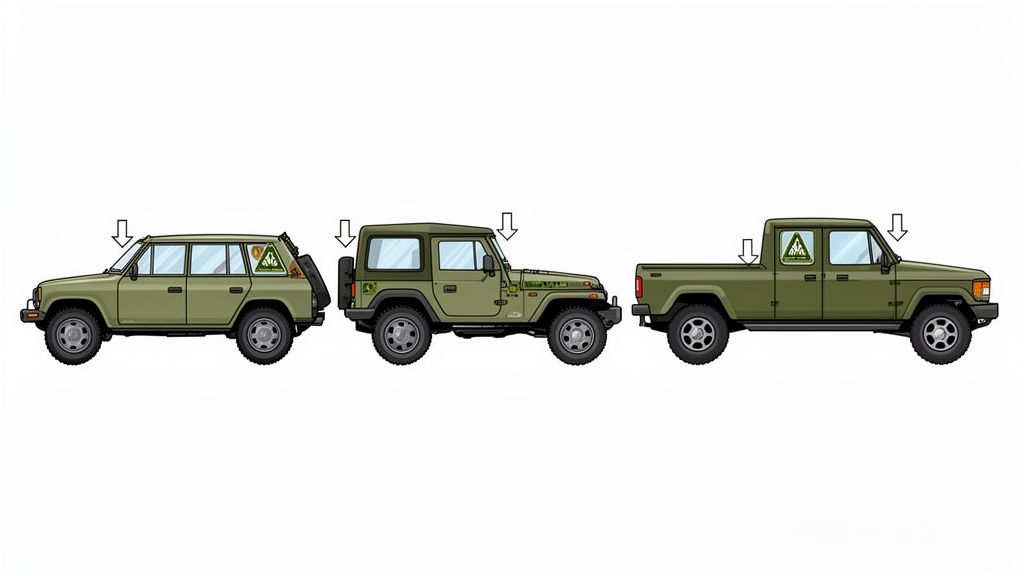
Best spots for cars
Cars do not give you much room for error. A decal that is too large will crowd the rear glass or look pasted on.
The cleanest spots are usually:
- Upper rear window corner for a branch insignia or veteran mark.
- Lower rear window edge if the design is wider and low-profile.
- C-pillar or quarter glass for compact decals.
- Small bumper placement only if the surface is smooth and the decal is not the kind that should sit near road grime all year.
For most sedans and coupes, subtle wins. One well-sized decal often looks better than two competing placements.
Best spots for Jeeps
Jeeps are different. They can carry military car stickers in a more rugged way because the vehicle styling already supports visible graphics.
Popular placements include:
- Hood sides for star graphics, branch marks, or military-inspired symbols.
- Rear quarter panels for unit or veteran decals.
- Hardtop rear glass for branch insignia or memorial decals.
- Spare tire area nearby if the layout stays balanced.
A hood or side placement needs the right scale. An undersized decal gets lost. An oversized one takes over the whole build. If you want a larger military-style panel graphic, a purpose-made design such as a USA American flag military door or hood star vinyl decal sticker fits that use better than trying to enlarge a small rear-window emblem.
Best spots for trucks
Trucks give you room, but they also make bad layout decisions more obvious.
The strongest placements are usually:
- Back window center or corner for branch logos and veteran identifiers.
- Tailgate section for larger tributes if the truck is a statement build.
- Bedside rear panel for unit insignia or memorial layouts.
- Hood edge or side only when the truck already carries a graphic style that supports it.
A pickup can handle a larger decal than a sedan, but proportion still matters. Match the decal to the panel, not to your enthusiasm.
Placement rules people overlook
Legal and practical placement matter too. DoD policy under AFI 51-902 permits political stickers on private vehicles up to a certain size and requires non-political military decals to meet high conduct standards, while state transportation guidance may place service medal decals on the left side or bottom of a license plate so they do not block key information, as outlined in this Air Force discussion of bumper stickers as extensions of communication.
That tells you two things. First, visibility can cross into noncompliance if you block important vehicle information. Second, a military decal is not just decoration when people can read it in public.
Installation and Care for a Flawless Finish
A good decal can be ruined in ten minutes by bad prep.
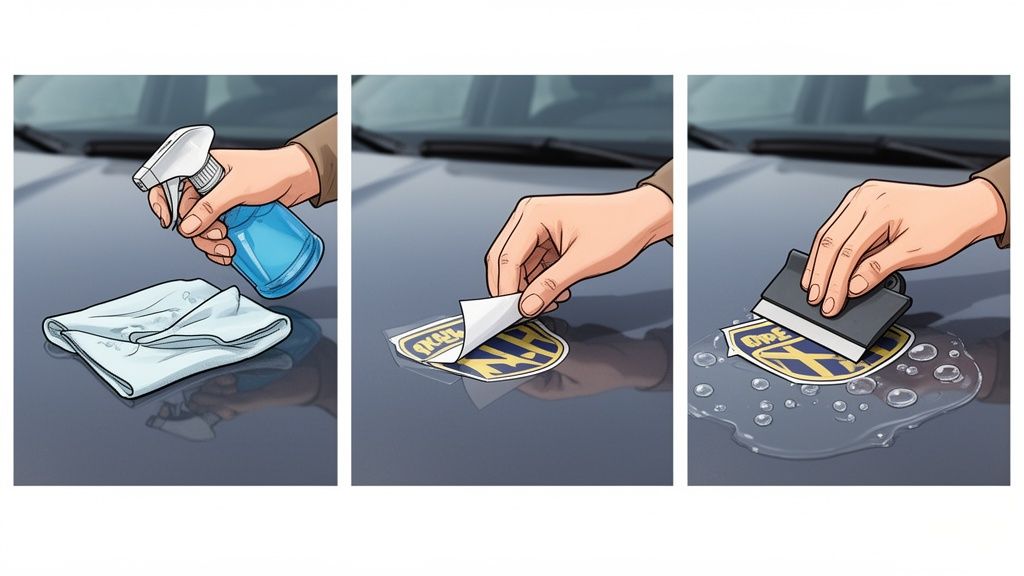
Most installation failures are not material failures. They come from wax on the panel, rushed alignment, cold surfaces, or peeling transfer tape too aggressively.
Prep the surface first
Before the decal comes anywhere near the vehicle, get the surface right.
Use this order:
- Wash the area to remove dust and road film.
- Dry it fully with a clean lint-free towel.
- Wipe with rubbing alcohol to strip residue, wax, and oils.
- Check temperature and moisture so you are not applying onto a cold, damp, or sun-hot panel.
Glass is usually the easiest surface. Freshly waxed paint is where people get into trouble.
Use the hinge method
For most military car stickers with transfer tape, the hinge method gives the cleanest alignment.
Step-by-step install
- Test fit the decal with the backing paper still on.
- Tape the top edge or center line in place with painter’s tape to create a hinge.
- Lift one side, peel the backing paper away, and cut or fold it clear.
- Squeegee from the center outward using firm, even strokes.
- Repeat on the other side if you used a center hinge.
- Let the adhesive set briefly, then peel the transfer tape back slowly at a sharp angle.
Small bubbles can happen. Most tiny ones settle with time, especially on quality vinyl. Bigger trapped pockets usually mean the decal was laid too fast or the surface was contaminated.
Peel transfer tape low and slow. If you yank it upward, you can pull thin parts of letters or fine linework back off the vehicle.
Watch a full install in motion
A visual walkthrough helps if this is your first time applying a pre-spaced decal.
Caring for the decal after install
Leave the decal alone for a short settling period after installation. Do not scrub it immediately.
Good habits after that:
- Hand wash first if possible instead of hitting the new decal with aggressive brushes.
- Avoid picking at edges even if you see a tiny corner line from transfer-tape pressure.
- Use normal car-wash soap, not harsh solvents.
- Dry with a soft towel, especially on edges and fine details.
Removing an old decal cleanly
Even a well-loved military decal may need to come off eventually.
Warm the vinyl gently, lift an edge with a fingernail or plastic tool, and peel slowly. If adhesive remains, use a paint-safe remover approved for automotive surfaces. Rushing removal is what damages old paint, not the decal itself.
A sharp install and simple maintenance keep military car stickers looking like a tribute instead of a worn-out afterthought.
Navigating On-Base Rules and Regulations
This is the part most decal guides skip, and it matters.
A military decal that is perfectly acceptable on public roads can still raise questions on base. The reason is history, policy, and local command authority all layered together.
Why official base decals disappeared
For years, base access decals were normal. The old registration decal system identified privately owned vehicles authorized for installation access.
That changed branch by branch. The Air Force ended them in 2007, the Army in 2011, the Navy in 2013, and the Marine Corps in 2016, making the Marine Corps the last branch to eliminate mandatory vehicle decals for base access, according to Marine Corps Times coverage of the policy change.
The reason was not cosmetic. It was security. Those decals could identify service members and families as potential targets. Once that risk outweighed their value, the old system became a liability.
What replaced them
Modern gate security does not depend on windshield or bumper registration marks the way it once did.
Automated systems and ID-based access checks made the old vehicle decal less useful. That shift also changed what military-related graphics mean on personal vehicles. A branch decal today is usually expressive, not functional.
That is an important distinction. Your Eagle, Globe, and Anchor on the rear glass is not an access credential. Your veteran decal on the tailgate is not official identification. Treating personal tribute decals as personal expression keeps you on the right side of most common-sense interpretations.
The rule that catches people
The problem area is not usually a plain veteran tribute. The problem is anything that looks official, imitates a seal, creates confusion, or conflicts with local installation rules.
DoD-wide guidance and service-level policy may permit broad categories of personal expression on private vehicles, but individual base commanders can still enforce tighter standards at the gate. That is why one installation may ignore a unit-themed decal while another may question it.
A practical checklist helps:
- Avoid official-looking seals unless you know they are appropriate for personal display.
- Skip political graphics near the edge of what policy allows if you regularly drive onto base.
- Do not assume online advice applies everywhere. Local command policy controls the gate.
- Ask the installation directly if you have any doubt about a specific design.
The safest military vehicle decal for regular base access is usually a straightforward branch, veteran, or memorial design that does not imitate credentials, awards, or government markings.
What military families should do
If you are active-duty, a spouse, or a family member who goes on base often, think in terms of friction reduction.
Choose decals that clearly read as personal tribute rather than official insignia or endorsement. Keep them clean, moderate in size, and away from anything that could be interpreted as obstructive or provocative. If you use specialty unit graphics, double-check local expectations before installation.
This is one of the biggest trade-offs in military car stickers. The more specific and official-looking the graphic, the more personal meaning it may carry. It may also create more scrutiny in controlled environments.
A good tribute decal should communicate pride. It should not create avoidable problems at the gate.
Customization and Ordering Your Perfect Decal
The best custom military decal usually starts with one honest question. What exactly are you trying to honor?
For some people, the answer is branch pride. For others, it is a deployment, a unit, a memorial, a retirement, or a family connection. Once that is clear, the design choices get easier.
Good customization ideas
Strong custom military car stickers tend to combine just a few elements well.
Examples that usually work:
- Branch plus service dates for a clean veteran tribute
- Unit identifier plus veteran text if the unit connection is the main point
- Memorial wording with a restrained symbol for remembrance
- Custom windshield banner text when the message matters more than an emblem
What usually does not work is trying to fit everything into one decal. Branch emblem, rank, unit, motto, dates, weapon silhouette, and flag all in one layout often turns into visual clutter.
Match the design to the use
A rear window decal needs readability. A hood graphic needs scale and stronger linework. A memorial decal should favor simplicity over effects. Ordering from a real decal shop helps more than grabbing a random marketplace listing. You want the right size, the right vinyl, and a layout that fits the panel you plan to use.
The shift away from official registration decals helped drive demand for expressive personal graphics. As noted in this Army discussion of vehicle decals becoming a thing of the past, service members and veterans moved from functional gate decals toward durable custom vinyl tributes built for personal vehicles.
If you are comparing providers in your area, it can help to look through directories of local vinyl sign and decal businesses so you can see who handles automotive vinyl work rather than general print-only stickers.
Ordering details that matter
When you order, check these basics before clicking buy:
- Material type: Make sure it is vehicle-grade vinyl, not just a novelty sticker.
- Application format: Pre-spaced, transfer-taped decals are easier to install cleanly.
- Surface plan: Know whether it is going on glass, painted metal, or a curved panel.
- Text proofing: Double-check spelling, dates, and abbreviations.
- Size selection: Measure the actual panel first.
For custom text applications, a purpose-built option like these custom text windshield banner decal stickers makes sense when you want a personal message rather than a branch emblem.
One practical example from the publisher side is worth noting because it is factual and relevant. Custom Sticker Shop produces military tribute decals in American-made Oracal vinyl with outdoor durability rated up to 7 years, and its published ordering details note prices starting at $7.99, free U.S. shipping on orders over $25, and typical delivery in 5 to 8 days from order to door based on the publisher information provided.
Display Your Service with Pride and Confidence
Military car stickers work best when they are chosen with care and displayed with purpose.
The design should mean something real. The material should belong on a vehicle, not a notebook. The placement should fit the panel and the vehicle. The install should be clean. If you drive on base, the decal should stay well clear of anything that could create confusion or unnecessary scrutiny.
That combination is what separates a tribute from a random accessory.
A good military decal does not need to shout. A branch emblem in the right corner of the glass, a respectful memorial mark on a tailgate, or a properly sized unit tribute on a Jeep can say plenty. It tells people you know what the symbol means and why it belongs there.
Respect is visible in small decisions. Accurate symbol. Clean vinyl. Straight install. Sensible placement. Awareness of the rules. Those details matter because service matters.
If you are going to put military car stickers on your vehicle, do it in a way that honors the people and traditions behind them. That is the standard worth keeping.
If you want a military decal that looks clean on the vehicle and holds up in real driving conditions, browse the options at Custom Sticker Shop. Choose a design that reflects your service, family connection, or tribute, measure your panel first, and order the size and vinyl format that match where it will be installed.