
You're probably looking at your vehicle right now and thinking one of two things. It needs a little personality, or it needs something specific that actually means something. That could be a last-name windshield banner, a military tribute on the rear glass, a Jeep hood graphic, or a subtle side decal that doesn't look cheap after one summer.
That's where buying custom car decals online makes sense. You can personalize a daily driver, trail rig, tuner build, or family SUV without committing to paint, bodywork, or a full wrap. It's one of the simplest upgrades you can make, but only if you choose the right material, the right size, and a seller that understands automotive use instead of treating every decal like a laptop sticker.
The interest is real, too. The market for vehicle decal personalization reached $4.8 billion in 2023, and 62% of U.S. car owners reported personalizing their vehicles with decals, with the category growing at a 28% CAGR from 2018 to 2023 according to Grand View Research. That tells me two things. First, you're not overthinking this. Second, the gap between a good decal and a bad one matters more than ever because the market is crowded.
Your Guide to Buying Custom Car Decals Online
A good decal should look like it belongs on the vehicle. It shouldn't fight the body line, wrinkle around a curve, or start shrinking at the edges after the first hard stretch of weather. The online part makes customization easy, but it also makes it easier to buy the wrong thing if the listing hides the material, doesn't explain sizing, or uses mockups that don't match real-world fit.
Most buyers start with style. The better approach is to start with use. Ask where the decal is going, how long you want it to last, and whether you want clean single-color vinyl lettering or a printed graphic with multiple colors and detail. Those choices affect everything that comes after, from price to installation.
If you're building your own design, a simple online customizer can save time. A tool like make your own custom sticker for your car is useful when you already know the text, size range, and placement you want. What matters is that the ordering flow lets you control the details that influence the final result.
What matters before you click buy
- Know the surface: A flat rear window corner is forgiving. A hood edge, textured panel, or strongly curved bedside is not.
- Choose the decal type first: Single-color die-cut vinyl gives the cleanest “painted on” look. Printed decals handle gradients, photos, and multicolor artwork.
- Think about distance: A windshield banner reads from farther away than a small quarter-window decal. Fine detail that looks great on screen can disappear on the vehicle.
Practical rule: If a listing doesn't clearly tell you what vinyl is being used, assume you're taking a gamble on longevity.
What a confident purchase looks like
You should be able to answer four questions before ordering. What material is it made from? What exact size are you buying? How is it supplied for install? And is the artwork suited to the location you chose?
That's the difference between a decal that looks custom and one that looks temporary.
Understanding Vinyl Types for Lasting Decals
Material decides whether your decal still looks sharp years from now or starts cracking while the design still feels new. This is the part most buyers skip, and it's usually the reason they end up ordering the same graphic twice.
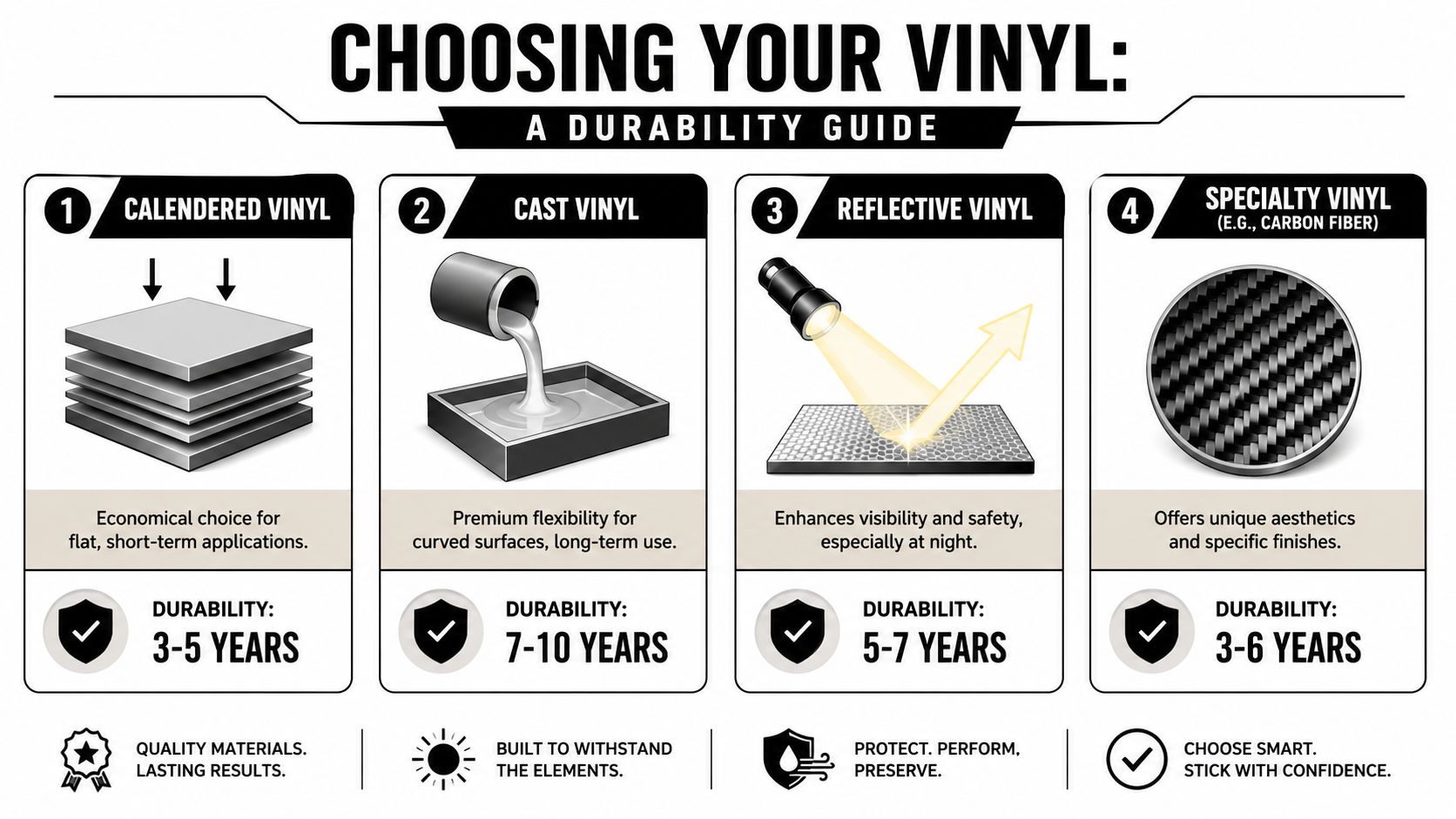
A simple way to think about vinyl is to compare it to exterior paint. There's economy paint, there's the solid dependable middle tier, and there's premium coating made for hard surfaces and tougher shapes. For most car and truck decals, intermediate calendered vinyl is the practical sweet spot.
Professional-grade Oracal 651 offers a 6 to 7 year outdoor life on vertical surfaces, while cheaper films often fail in 1 to 2 years because plasticizer migration leads to cracking, according to CorelDRAW's decal material overview. That's why two decals can look similar in a product photo but behave very differently on the road.
Die-cut vinyl versus printed decals
The first fork in the road is format.
Die-cut vinyl decals are cut from solid-color vinyl. Think lettering, silhouettes, military insignia shapes, Jeep mountain scenes, and clean logos. These usually last well and look crisp because there's no printed ink layer involved.
Printed decals are better when you need multiple colors, fades, texture effects, or a detailed illustration. They can look excellent, but they depend more heavily on proper print prep, ink handling, and often lamination.
Comparing Common Vinyl Decal Materials
| Material Type | Outdoor Durability | Best For | Relative Cost |
|---|---|---|---|
| Calendered Vinyl | Moderate to long-term | Doors, windows, tailgates, flatter panels | Lower |
| Cast Vinyl | Long-term | Deep curves, compound curves, demanding contours | Higher |
| Reflective Vinyl | Mid to long-term | Safety-oriented markings, visibility-focused designs | Higher |
| Specialty Vinyl | Varies by finish | Texture and visual effect | Moderate to higher |
What works and what doesn't
Calendered vinyl works well for a lot of online decal orders because many vehicle placements are flatter than people think. Rear windows, tailgates, bedside panels, and windshield banners usually don't require the extra cost of cast vinyl unless the panel shape is difficult or you want maximum conformability.
Cast vinyl earns its keep on stronger curves and more demanding surfaces. If a decal has to lay into shape changes without tension fighting the adhesive, cast is the safer choice.
What usually disappoints buyers is bargain vinyl with no clear material spec. It may look fine out of the envelope. Then edge curl starts, color dulls, or the film gets brittle.
Buy for the panel, not just the picture. A rear glass memorial decal and a hood stripe don't ask the same thing from the vinyl.
A practical buying filter
When I'm evaluating a decal listing, I want three things spelled out:
- Material name: If the seller mentions Oracal 651 or another known automotive-suitable film, that's useful.
- Intended application: Exterior glass and painted panels are different from novelty indoor stickers.
- How it arrives: Pre-spaced lettering on transfer tape installs very differently than loose cut pieces.
If those details are missing, the low price usually stops being a bargain once replacement time comes.
Nailing the Perfect Size and Placement
Most sizing mistakes happen because people measure the space they notice first, not the space the decal will occupy once the body lines, trim, hinges, and glass borders come into play. A design can be technically the right width and still look wrong on the vehicle.
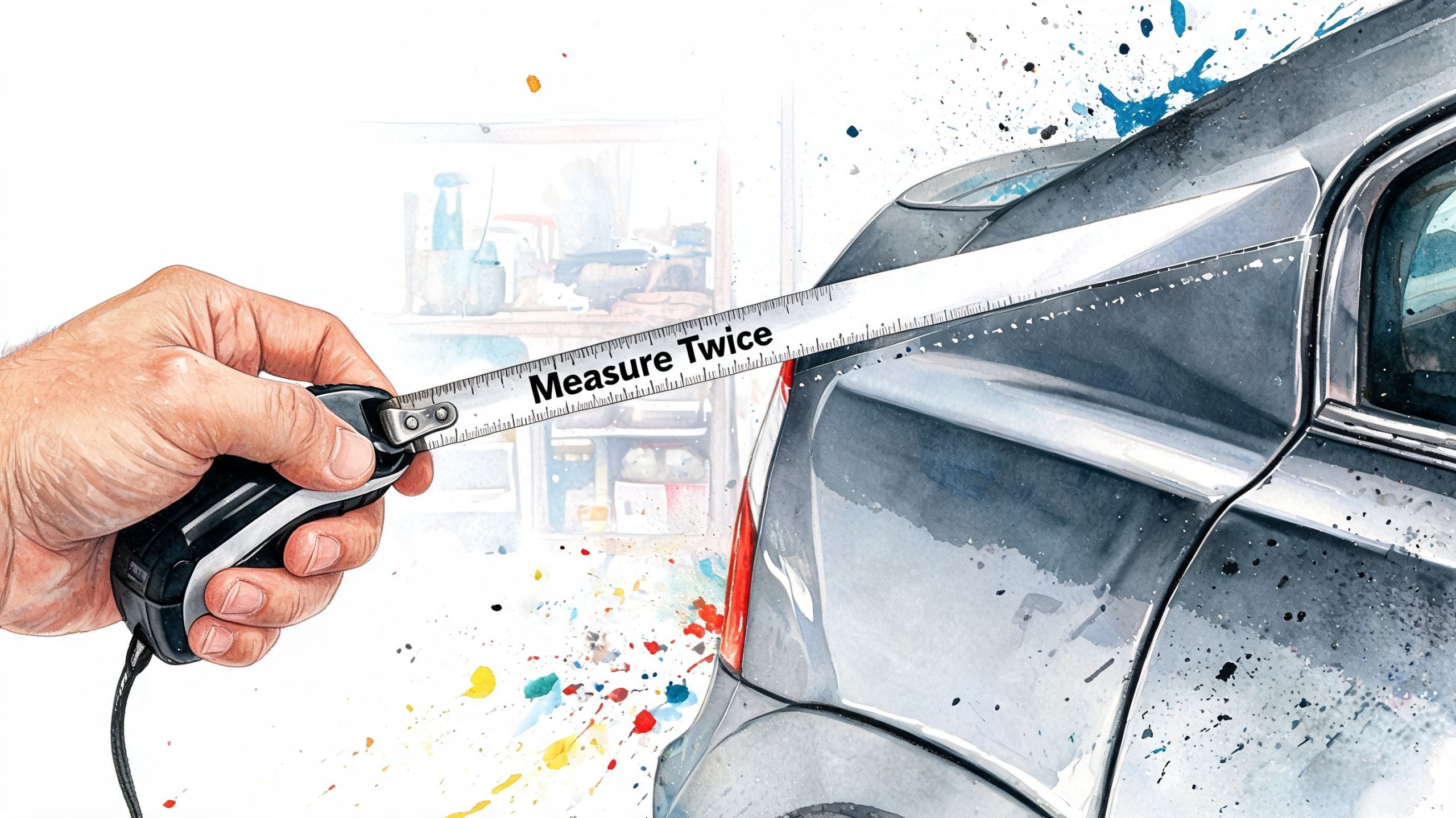
Professionals avoid that by templating. They photograph the vehicle, trace the panel contours in vector software, and keep aspect ratios locked, which can reduce distortion risk by up to 90% compared with freehand design. For DIY measuring, aiming for 1/8-inch tolerances is a solid benchmark for a clean fit, according to Square Signs' car decal guide.
Measure the panel, not the guess
Start with painter's tape and a tape measure. Mark the top, bottom, left, and right boundaries where the decal could reasonably sit without crowding trim or weather stripping. Then step back several feet and look at the taped rectangle from normal viewing distance.
That step matters. A windshield banner can feel oversized from two feet away and look balanced from the curb. A quarter-window decal can feel tiny on the screen and end up exactly right once installed.
If you're ordering custom lettering, seeing a fixed-width option like this 22-inch custom text window decal can help you compare your measured space to a real product format before committing.
Placement trade-offs that buyers should know
- Rear window corners: Easiest place for a first decal. Great for names, small logos, and memorial graphics. Lower risk, clean visibility.
- Windshield banner area: High visual impact. It needs disciplined sizing because too tall looks clumsy fast.
- Hood graphics: Great when the design suits the body shape. Poor measuring stands out immediately because the hood is a focal point.
- Tailgate decals: Easy to read and usually friendly to straight layouts, especially on trucks and SUVs.
- Bedside or door panels: Strong look on off-road and work-truck builds, but alignment has to respect panel breaks and handles.
A simple test before ordering
Tape printer paper together to the rough size of your decal and hold it in place. You'll learn more from that five-minute mockup than from staring at a digital rendering for half an hour.
If the panel has a strong curve, leave more breathing room around the design. Tight margins make small alignment errors look bigger.
Designing Artwork and Finding Your Theme
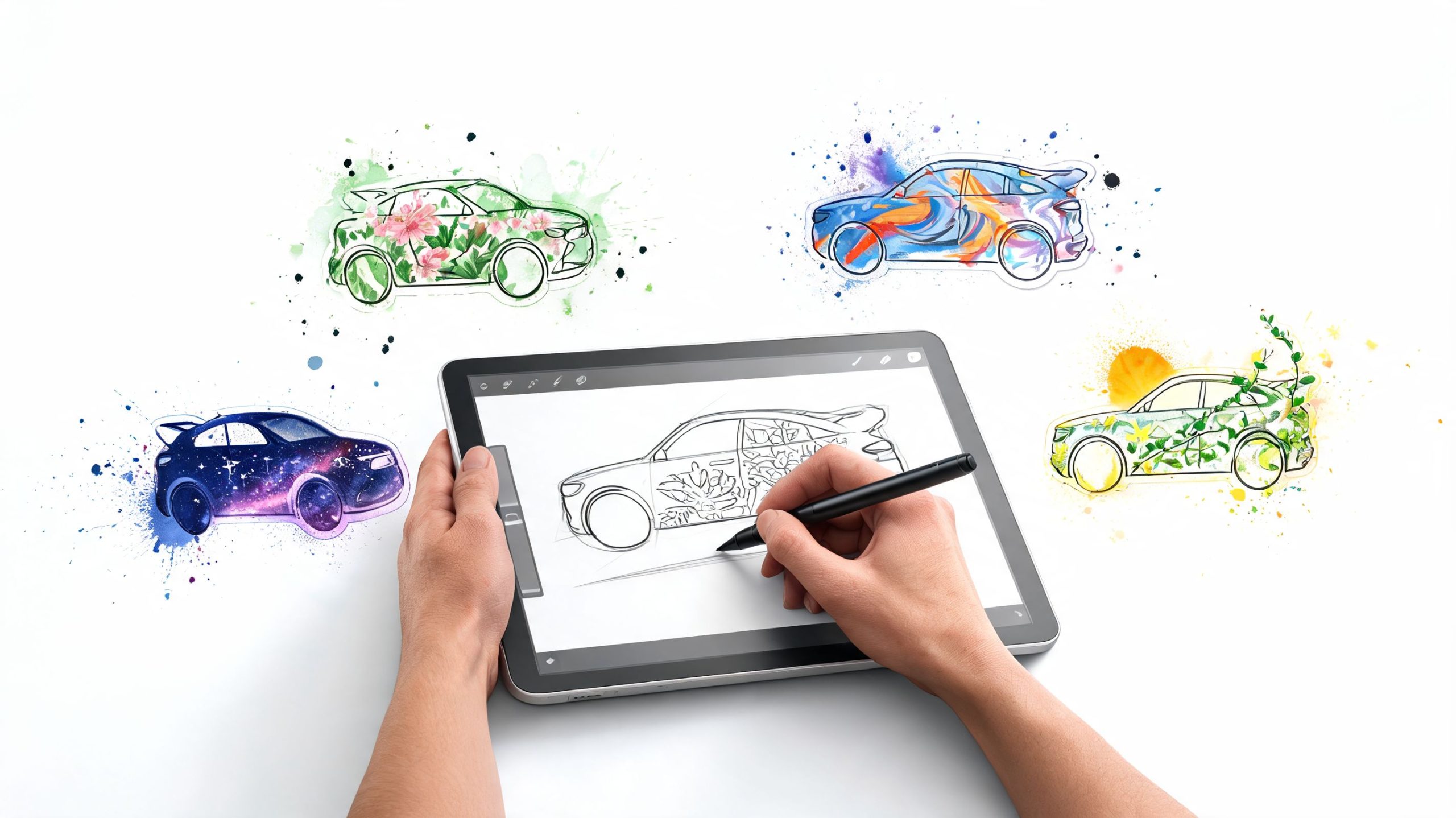
Some people come in with finished art. Most don't. They have an idea, a phrase, a branch of service, a trail identity, a tuner style, or a family nickname they want on the glass. Both are workable, but they follow different paths.
If you already have artwork, clean vector files are the easiest route for crisp cuts. Lines need to be intentional, and small details need enough thickness to survive both cutting and real-world viewing. A design that looks intricate on a phone screen can turn into visual noise once it's scaled for a quarter window.
When custom artwork works best
Use your own artwork if the design is brand-specific, unit-specific, or part of a build theme that needs to match other visual elements on the vehicle. That's common with shop logos, race team graphics, club names, and tribute decals that include dates, mottos, or rank details.
For buyer-supplied art, three things usually make or break the result:
- Line weight: Extremely thin strokes can disappear or become hard to weed cleanly.
- Negative space: Tiny cutouts may look sharp in theory but become fragile in production.
- Scalability: A good decal design still reads well when it's sized for the actual panel.
Theme-driven decals people actually use
Customization trends show that 72% of buyers want personalized text or niche themes. In specialized decal shops, military tribute decals account for 24% of sales, and Jeep and off-road graphics remain a major category, with some sellers offering more than 240 unique designs, according to Custom Sticker Shop's military decal overview.
That lines up with what works on real vehicles. The strongest themes aren't random decoration. They signal identity.
Military and veteran tribute designs
These usually work best when they stay respectful and restrained. Branch insignias, unit references, service dates, or memorial phrasing fit well on rear windows, tailgates, and side glass. Overcomplicating them with too many decorative elements can weaken the impact.
Jeep and off-road graphics
Trail rigs can carry bolder graphics because the vehicle already has an aggressive stance and visual accessories. Hood graphics, side graphics, mountain silhouettes, topo-inspired layouts, and trail-name text all fit naturally. Placement matters more than complexity here. A strong simple graphic beats a crowded one.
JDM and tuner styling
Tuner decals work when they feel intentional, not copied from five unrelated references. A windshield banner, a subtle quarter-window script, or a clean brand-inspired silhouette often ages better than a collage of small graphics spread across every panel.
Family, hobby, and lifestyle decals
These are often the most personal orders. Family stick figures, pet names, hunting and fishing themes, and custom last-name text can look great when the font and scale match the vehicle. The mistake is usually going too ornate. Readability wins.
The best theme is the one that still feels right six months later. Trendy and personal aren't always the same thing.
One design habit that saves a lot of regret
Don't design in isolation. Match the decal to the vehicle color, body style, and use case. A matte black 4×4 can carry stronger contrast than a silver commuter sedan. A family SUV may need cleaner, friendlier typography than a trail Jeep. The decal should feel integrated, not pasted on as an afterthought.
Navigating the Online Ordering Process
A clean online ordering process should remove uncertainty, not create it. You shouldn't have to guess whether the decal arrives as separate letters, one solid sticker, or something in between.
For straightforward text decals and banners, the best stores let you choose wording, size, and color without making you email back and forth. A dedicated product builder such as a custom text windshield banner decal makes sense when your job is simple and visibility matters more than graphic complexity.
What good ordering pages tell you
Look for clear answers to these points before checkout:
- How the decal is constructed: “Pre-spaced” means the letters or design elements are aligned and ready to apply together.
- Whether transfer tape is included: That's the top application layer that helps move the design from backing paper to the vehicle in one piece.
- Material and intended use: Exterior automotive use should be stated plainly.
- Checkout options: Secure payment methods matter, especially for custom work.
A seller that explains these details usually understands production. A seller that avoids them is often reselling generic vinyl products with limited support if something goes wrong.
How to think about ordering in context
A lot of buyers personalize in stages. They buy the decal now, then later add lighting, trim pieces, or other bolt-on upgrades. If you're planning that kind of project, it helps to find reliable aftermarket car components from a source that explains fitment and quality clearly, because your decal placement can be affected by future accessories.
One practical example is ordering a tailgate or windshield decal before adding deflectors, body armor, or protective trim. If another part is going to occupy the same visual space, plan around it now instead of trimming the decal later.
Green flags and red flags
Green flags
- Material is named
- Sizing options are specific
- The seller explains transfer tape and application style
- Proofing or clear previews are available for custom work
Red flags
- No mention of vinyl type
- Mockups only, with no product detail
- No explanation of install method
- A custom item page that reads like a generic sticker listing
Ordering online should feel simple, but never vague.
How to Install, Care For, and Remove Your Decal
Installation is where a good decal either looks professional or looks rushed. The reassuring part is that most car and truck decals are very manageable if you slow down and treat positioning as a separate step from adhesion.
The wet method for beginners
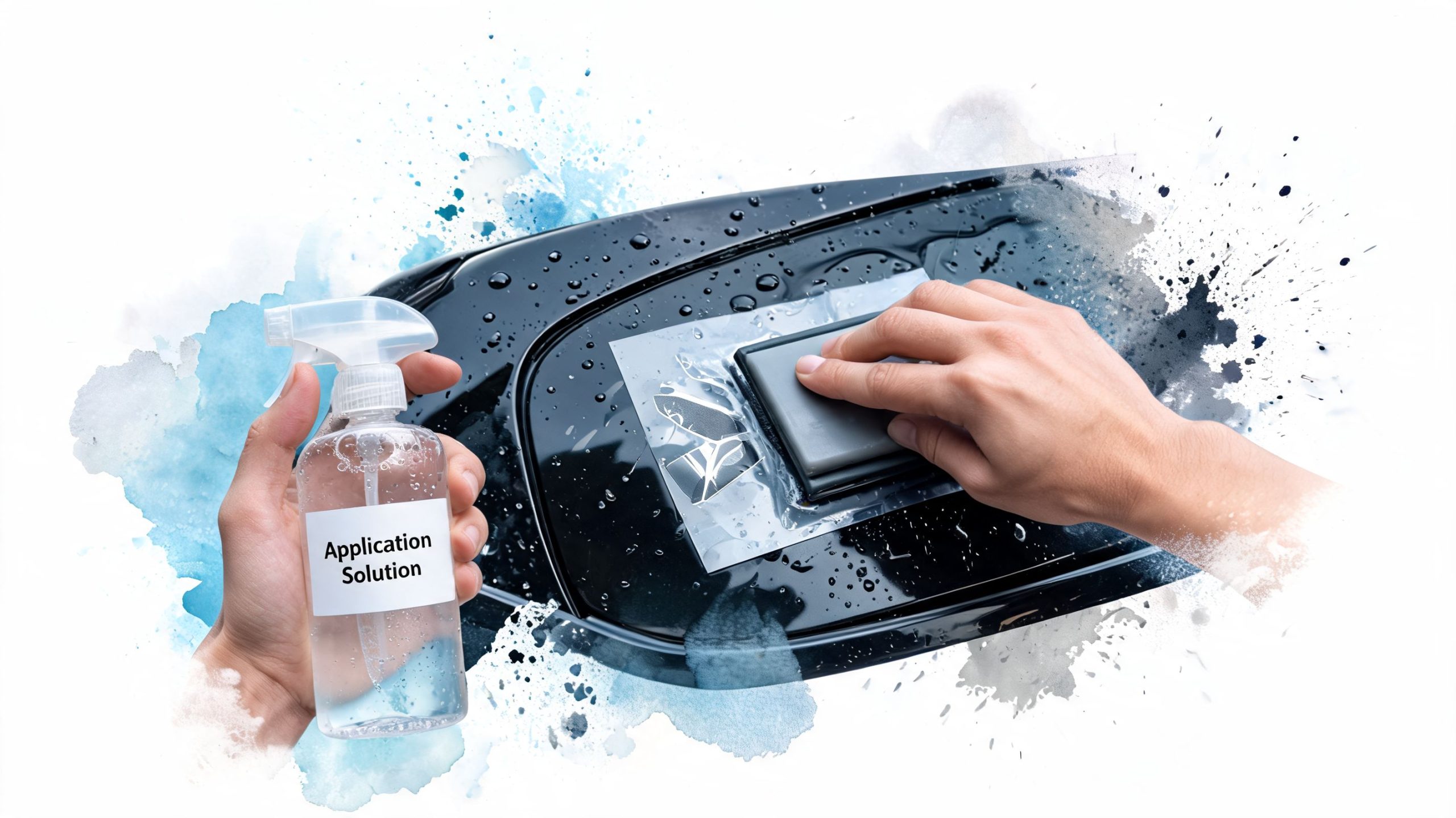
For many installs, especially larger lettering or anything you want a little adjustment room with, the wet method is forgiving. Lightly mist the application surface, position the decal, then squeegee the fluid out from the center toward the edges. That gives you a chance to correct alignment before the adhesive fully sets.
Clean the panel first. Not “looks clean” clean. Thoroughly remove dust, wax residue, and road film. If the edge of the vinyl lands on contamination, that's where failure usually starts.
A practical install sequence
- Prep the surface: Wash and dry the area completely.
- Test position: Use small pieces of masking tape to mark alignment.
- Check the angle: Step back and view the decal from both sides of the vehicle if possible.
- Apply with patience: Use a squeegee with firm, even pressure.
- Peel carefully: Remove transfer tape slowly and watch for lifted edges.
The short video below shows the flow of a proper application.
Shop-floor advice: Most bubbles come from rushing the first contact point. Get the top edge straight, and the rest of the install gets easier.
Caring for the decal after installation
Once the decal is on, treat it like part of the finish. Hand washing is easiest on edges. If you use a pressure washer, keep aggressive spray away from the edge of the vinyl rather than driving water directly into it.
Avoid harsh scraping at the edges and don't attack the graphic with abrasive pads. A quality decal should hold up well, but edge abuse is still edge abuse.
Removing an old decal without making a mess
Removal gets easier with gentle heat. Warm the vinyl, lift a corner, and peel slowly. The goal is to soften the adhesive, not cook the panel.
If adhesive remains, remove the residue with a paint-safe adhesive cleaner and a soft cloth. Don't dig at it with anything that can scratch the finish. Good vinyl should come off far more cleanly than bargain material that has gone brittle with age.
Answers to Your Top Car Decal Questions
Can I apply a decal over ceramic coating or PPF
You can, but it deserves caution. Automotive coatings are changing the conversation because ceramic-pro and PPF are now on 25% of new vehicles, and search interest for “car decals on ceramic paint” rose 150% in the last 12 months, according to eSigns' car decal discussion. In practice, adhesion depends on the specific coating, its condition, and the decal type. If the vehicle has ceramic coating or paint protection film, ask the seller whether the vinyl is suited to that surface before ordering.
What if my design has tiny details
Simplify it. Intricate art can be beautiful, but not every detail survives cutting, transfer, and distance viewing. A cleaner version usually looks better on the vehicle and installs with less risk.
Are custom decals returnable
Custom work is usually treated differently from off-the-shelf products because it's made to your text, size, or artwork. That means accuracy before ordering matters more than hoping to fix it after delivery. Double-check spelling, dimensions, and orientation.
Is a bigger decal always better
No. Bigger often reads better, but only when the body panel supports it. On a vehicle, scale has to match the lines of the panel. An oversized decal can make a good design look awkward fast.
What's the safest choice for a first-time buyer
A simple single-color decal on a flat or lightly curved surface. Rear glass, tailgates, and straightforward windshield text are usually the least stressful places to start.
If you want a practical place to start, Custom Sticker Shop offers automotive vinyl decals for windows, windshields, hoods, and body panels, including custom text, military tribute designs, Jeep graphics, and family-themed options. The useful part for buyers is the straightforward format: named automotive-focused materials, pre-spaced and transfer-taped decals, and clear fit-focused product choices that make ordering online easier to get right the first time.