
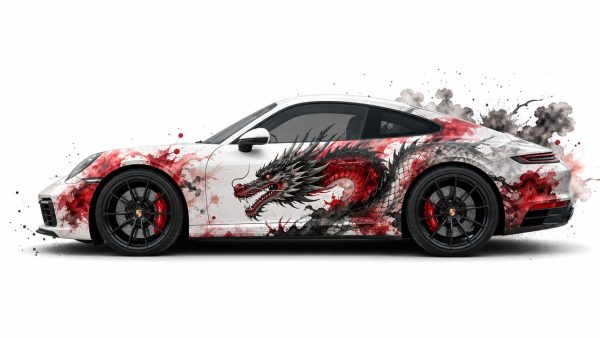
You're probably looking at your vehicle right now and thinking the same thing a lot of customers think when they call a decal shop. The paint is fine. The wheels are fine. The ride just doesn't feel like yours yet.
That's where a dragon graphic earns its keep. A good dragon decal isn't random decoration. It gives the vehicle a point of view. Sharp and minimal. Loud and aggressive. Clean and traditional. A stock door, quarter panel, or rear glass can go from anonymous to memorable with one well-chosen piece of vinyl.
Unleash Your Ride's Personality with a Dragon Decal
An auto dragon decal works because dragons carry attitude without needing explanation. Even people who know nothing about cars understand the signal. A coiled dragon feels disciplined. A clawing dragon feels wild. A long side graphic feels fast, even when the vehicle is parked.
That connection between vehicles and personal expression has deep roots. Modern bumper stickers and vehicle decals trace back to the 1940s, when Forrest P. Gill combined adhesive-backed paper and fluorescent paint to create modern bumper stickers, helping turn vehicle graphics into a mass-market form of self-expression, travel memory, and messaging over the decades, according to AAA's history of bumper stickers.
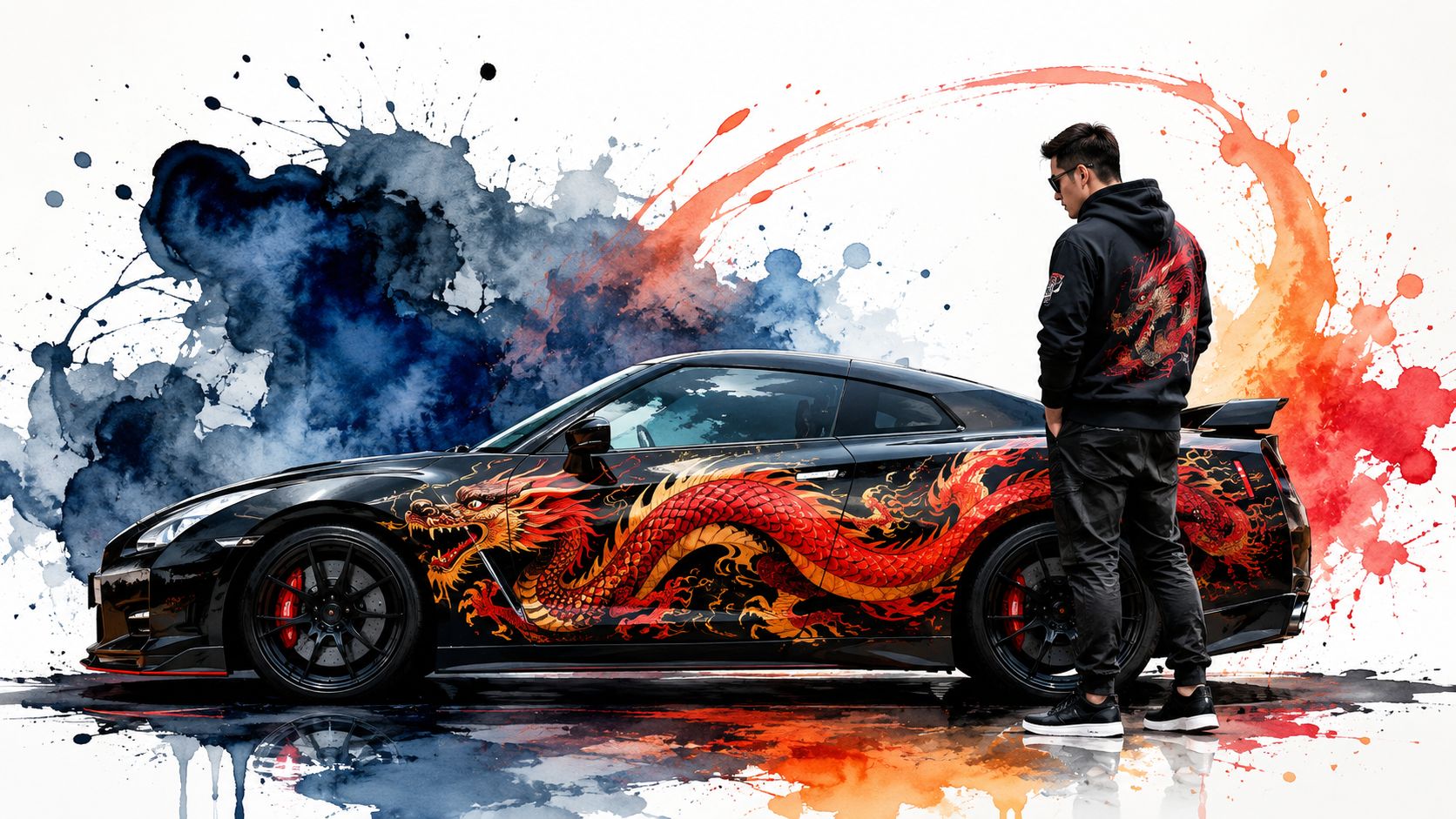
Why dragon decals stand out
Some graphics are trendy for a season. Dragon artwork has lasted because it's flexible.
- For sport compact builds: It can look sleek and technical.
- For trucks and Jeeps: It can look rugged and forceful.
- For daily drivers: It can add personality without turning the whole vehicle into a theme project.
The key is intention. A dragon decal should match the lines of the vehicle and the personality of the owner. When it does, the graphic looks integrated instead of stuck on.
Practical rule: The best decal choice isn't the most complicated one. It's the one that looks like it belongs on the vehicle from ten feet away.
What separates a smart buy from a regret buy
Most decal mistakes happen before installation. People pick the wrong size, the wrong material, or the wrong placement zone. Then they blame the vinyl.
A better approach is simple. Choose the material for the surface. Choose the scale for the message. Choose the placement for the body lines. Do that, and auto dragon decals stop being impulse buys and start looking like custom styling.
Decoding Decal Quality with Materials and Durability
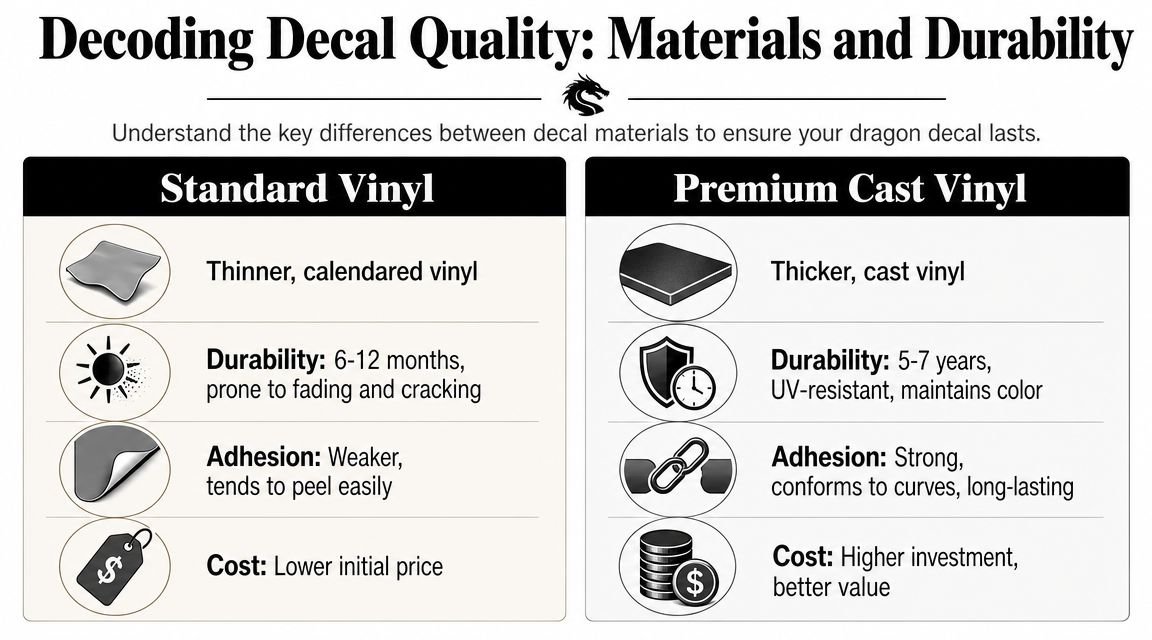
Most problems people blame on “bad luck” are material problems. Peeling corners, stiff vinyl that won't settle into a curved panel, fading that kills the design. Those issues usually start with using the wrong film for the job.
Here's a quick visual before we get into the details.
What quality vinyl actually changes
Premium dragon auto decals are commonly made from Oracal 651 high-performance calendared vinyl at about 2.5 mil thickness, with reported outdoor durability of roughly 6 years, as described on Xtreme Digital Graphix's dragon side decal product page. That detail matters for one reason above all others. Thin, stable film handles curved vehicle surfaces better than thick bargain-bin vinyl.
A curved door or rear quarter panel exposes weak vinyl fast. Thick, cheap material fights the surface. It wants to stay flat. That tension shows up later as edge lift, shrinkage, or wrinkles around compound curves.
By contrast, a thinner professional-grade film conforms more naturally. It lays down cleaner and keeps the shape the designer intended.
Why thickness matters on a car door
People hear “thin” and assume fragile. In decals, that's often backwards.
A heavy craft-style film can feel tough in your hand, but that stiffness makes it harder to install cleanly on body panels. A film around 2.5 mil has enough strength for side graphics while still bending where the car bends. That balance is what you want on:
- Doors with crown and contour
- Fenders with changing curves
- Hoods with raised center sections
- Rear glass with gentle arc
If the vinyl can't relax into those shapes, the adhesive has to do too much work. Adhesive should secure the film, not wrestle it flat.
Here's a useful demo on decal application and material behavior in practice:
Cheap vinyl costs more later
The initial price of low-grade vinyl is attractive. I understand why people buy it. But if the graphic starts looking tired long before the rest of the vehicle does, you pay twice. Once to install it. Again to remove and replace it.
Use this quick comparison when shopping:
| Material question | What you want | Why it matters |
|---|---|---|
| Film feel | Supple, not stiff | Better fit on curves |
| Intended use | Outdoor automotive use | Better resistance to weather |
| Construction | Professional sign-grade vinyl | Cleaner cutting and longer service |
| Thickness | A thin film suited to vehicle panels | Better conformability |
Good-looking auto dragon decals don't come from flashy artwork alone. They come from artwork cut on vinyl that behaves properly on sheet metal.
Sizing and Placing Your Dragon Decal for Impact
A dragon decal can be beautifully cut and still look wrong if the scale is off. Many otherwise solid builds go sideways because of this common misstep. The owner buys a design they love, but the graphic is either too timid for the panel or so oversized that it swallows the vehicle's shape.
The fix is simple. Treat the vehicle like a composition, not a blank wall.
Read the body lines before you buy
Every vehicle already has motion built into it. Beltlines, rocker panels, hood creases, glass angles. A dragon should follow that motion or deliberately contrast with it.
A few examples make this easier:
- Sports car door: Long, low dragons work well because they echo speed.
- Truck bed side: Broader, heavier artwork fits the taller panel.
- Jeep or SUV quarter panel: Compact designs often work better because of hinges, handles, and trim interruptions.
- Rear window: Simpler silhouettes read better than dense artwork.
What doesn't work is forcing a design into a space full of obstacles. Door handles, fuel doors, body moldings, and flares all interrupt the visual flow. If the dragon gets chopped in awkward places, the finished look feels accidental.
Use the tape method before peeling anything
You don't need software to make a smart placement decision. You need a tape measure, masking tape, and a few minutes of patience.
- Measure the panel first. Get the usable width and height, not just the overall door size.
- Mark a rough box with masking tape. This gives you a visible footprint.
- Step back. Look from driveway distance, not nose-to-panel distance.
- Check alignment against body features. Make sure the design relates to the door seam, beltline, or window edge.
- Sit on it for a day if you're unsure. Good decal choices survive a second look.
For drivers who want lettering to complement a dragon graphic, a custom text window decal option can help tie the whole look together without crowding the main design.
Scale communicates attitude
Size isn't just fit. It's tone.
A smaller dragon says the owner likes detail and restraint. It rewards people who notice it up close. A large side graphic says the vehicle is meant to make an entrance. Neither is better. They just communicate different personalities.
Use this rule of thumb:
| Style goal | Better decal scale | Visual effect |
|---|---|---|
| Subtle and refined | Smaller to medium | Personal touch, not overpowering |
| Sporty and directional | Medium to long | Adds motion and flow |
| Aggressive show look | Large | Creates a dominant focal point |
Measure twice, apply once. Most placement mistakes happen because the owner judged size from a product photo instead of from their own panel lines.
Best placement zones by purpose
Some zones are naturally easier to make look good.
- Doors: Best for visibility and storytelling. Great for long dragons.
- Hood: Strong for centered, symmetrical artwork.
- Fenders and quarter panels: Good for movement and accent graphics.
- Rear glass: Best for cleaner shapes and simpler messages.
- Tailgate: Works well on trucks where the graphic needs a broad, flat stage.
When auto dragon decals look factory-clean, it's usually because the installer respected the vehicle's shape instead of fighting it.
Customizing Your Design from Color to Style
Once the size and location are settled, the fun part starts. At this point, a dragon decal stops being a stock design and begins to feel customized for the vehicle.
The smartest custom choices usually come down to restraint. Color, direction, and artwork style should support each other. If all three are shouting, the vehicle ends up looking busy.
Use contrast on purpose
Color matters because a decal has to read at a glance. A black dragon on a white truck is sharp and immediate. A silver dragon on dark paint feels more premium and understated. Red can look powerful, but it also pulls a lot of attention, so it needs room around it.
A few combinations consistently work well:
- Black on light paint: Clean, strong, easy to read
- White on dark paint: Crisp, high contrast, especially on tinted glass
- Silver or gray on black: More refined, less harsh than white
- Red as an accent: Great for energy, but better when used selectively
If you want something built around your own sketch, phrase, or layout idea, a make-your-own car decal page is a practical way to translate a loose idea into a cut-ready design.
Why mirrored pairs look better on side graphics
This is one of those details that separates a decent setup from a polished one. On large side graphics, mirrored pairs usually look more intentional because both dragons can face forward.
Forward-facing art suggests movement. It makes the vehicle feel like it's pushing ahead rather than dragging a design behind it. If both sides face the same literal direction without mirroring, one side often looks backward.
That's especially noticeable on trucks, coupes, and Jeeps with long body sides.
Choose a story, not just a shape
Different dragon styles tell different stories.
A full-body dragon wraps motion through the panel. It's dramatic and works best where there's enough uninterrupted space to let the body curve and tail breathe. A dragon head, claws, or partial silhouette is more compact and often better for windows, tailgates, and tighter door layouts.
Decal placement mirrors tattoo placement. Full compositions need room. Symbols need precision.
A great decal design doesn't just fill space. It uses space. Negative area around the dragon is part of the final look.
Finding Your Style With Dragon Decals for Every Driver
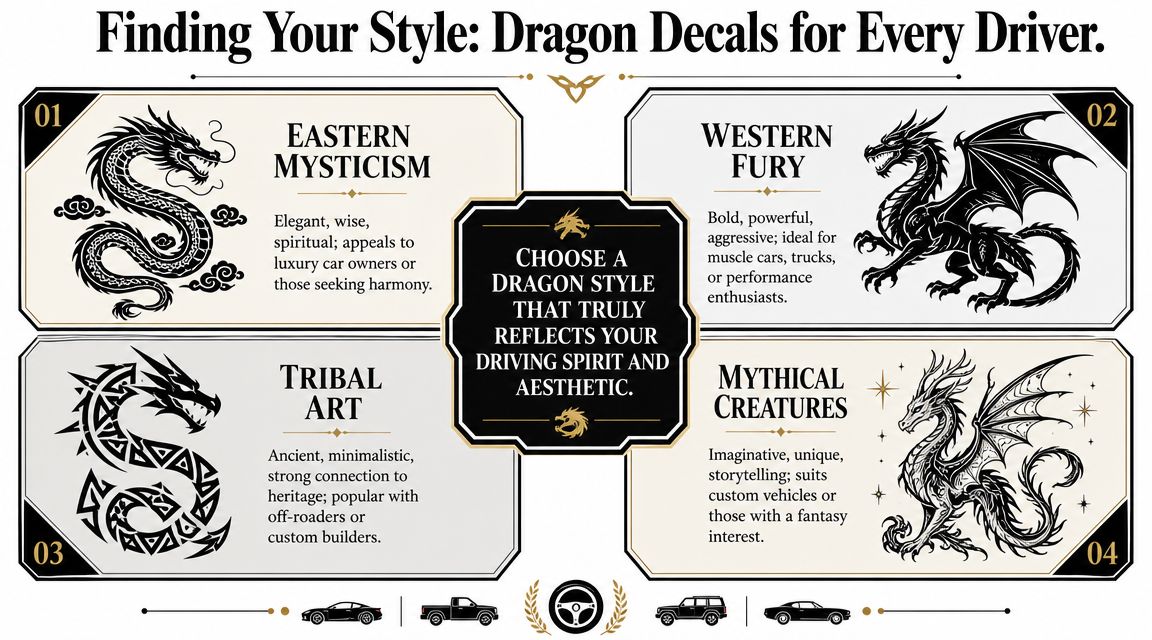
Dragon decals don't belong to one crowd. That's part of their staying power. The same basic subject can feel elegant on a luxury sedan, menacing on a lifted truck, or playful on a family SUV depending on the art style and placement.
The tuner crowd and the clean-line dragon
The import and tuner owner usually doesn't want random bulk. They want flow. On that kind of build, eastern or tribal-inspired dragons tend to work because they follow the body rather than overpower it.
A long, narrow dragon on the lower door or quarter panel can complement side skirts, wheel fitment, and window tint. It feels intentional when the lines stay clean and the color palette stays tight. Black, white, silver, and carefully chosen red accents usually outperform a rainbow of effects.
For this driver, less often lands harder.
The Jeep and off-road driver who wants edge
The off-road owner usually has a different goal. They want personality with toughness. Boxier vehicles can handle bolder shapes, sharper claws, thicker linework, and more aggressive western dragon styles.
These decals often work best on flatter areas where the graphic can stay readable around hinges, handles, and fender hardware. The design doesn't need to be elegant. It needs to look like it belongs on a machine built for dirt, brush, and trail photos.
That's why tribal and heavy-outline dragon graphics have held up so well in that crowd. They can take visual punishment and still read clearly.
The enthusiast who wants a badge of experience
Some decals mean more than style. They mark a place, a trip, or a driving milestone.
One of the clearest examples is the famous red dragon marker for the Tail of the Dragon. As Hemmings notes in its look at commemorative vehicle decals, that decal signifies completion of the 11-mile stretch of US 129 between North Carolina and Tennessee, a road known for 318 curves and bucket-list status among car and motorcycle enthusiasts. That kind of decal works because it carries a real story.
The same principle applies to custom dragon graphics. The strongest designs usually connect to something personal. Your build style. Your travel history. Your background. Your sense of humor.
The family driver and the playful dragon
Not every dragon has to snarl. Some owners want a lighter touch, especially on family vehicles, tailgate glass, or smaller side windows. A character-style dragon, peeking dragon, or fantasy-inspired silhouette can add charm without making the vehicle feel overdone.
A fun example is a Toothless-style peeking window decal for cars and trucks, which shows how dragon imagery can lean friendly instead of fierce.
Here's a simple style match table:
| Driver type | Dragon style that fits | Why it works |
|---|---|---|
| JDM or tuner owner | Eastern, tribal, flowing linework | Supports sleek body lines |
| Truck or muscle enthusiast | Western, bold, aggressive | Adds visual strength |
| Jeep or off-road driver | Thick-line tribal or claw motifs | Reads well on rugged shapes |
| Family or casual driver | Playful or fantasy-inspired | Adds personality without harshness |
A Flawless Finish with Installation and Care for Your Decal
A lot of people get nervous about installing a dragon decal, especially a larger one. A clean install usually comes down to preparation more than talent. If the panel is clean, the decal is aligned correctly, and you don't rush, the process is manageable.
For fitment, dragon decals are often supplied as die-cut, no-background vinyl and pre-masked or pre-spaced for transfer application, which helps reduce alignment error and trapped air during placement, especially on longer graphics, according to Decalboy's dragon decal listing. That transfer layer does a lot of the heavy lifting by keeping the design spaced correctly while you apply it.
The dry install approach that works
Start with a washed vehicle, then clean the exact application area again so you're not laying vinyl over wax, dust, or road film. Dry the panel completely. If there's grit on the surface, the decal will show it.
Then use a hinge method with masking tape.
- Position first: Tape the decal in place and confirm sight lines.
- Create a hinge: Run masking tape across the top or center so the decal stays registered.
- Peel the backing slowly: Don't let the vinyl fold onto itself.
- Squeegee from the center outward: Work air away as you go.
- Remove transfer tape carefully: Pull it back slowly at a low angle.
If you ever need to remove old graphics before installing a fresh set, many of the same principles carry over from marine surfaces. This guide to effective boat decal removal strategies is useful because it walks through careful heat, slow peeling, and residue cleanup without turning removal into a paint-damaging mess.
Care habits that protect the edges
Once the decal is on, the edges are the vulnerable part. Most damage starts there.
Use common sense care:
- Wash gently: Mild soap and a soft mitt are your friends.
- Avoid picking at corners: Even a well-installed edge can be lifted by fingernails.
- Be cautious with pressure washers: Don't aim hard spray directly at the decal edge.
- Watch harsh chemicals: Strong solvents can dull or weaken vinyl.
Clean installs last longer because the owner respects the edges. The face of the decal gets the attention, but the edges do the real work.
Your Dragon Decal Questions Answered
Most auto dragon decals are legal if you place them sensibly. The biggest issue isn't the artwork. It's visibility. Don't block the driver's view through the windshield, side glass, or other critical sight lines, and check local rules if you're putting anything on glass.
Pricing varies with size, detail, and material quality. A small window decal is a very different product than a large side graphic. My advice is to judge value by cut quality, material, transfer prep, and how well the design suits the vehicle. The cheapest option often costs more once replacement and removal enter the picture.
If you're worried about messing up installation, start smaller or choose a design that suits a flatter panel. Large door graphics demand more patience than a rear window piece. Either way, careful prep matters more than fancy tools.
A dragon decal is a smart upgrade when the design fits the vehicle, the material fits the job, and the placement fits the body lines. Get those three right, and the result looks custom instead of temporary.
If you're ready to put that idea on your car, truck, Jeep, or rear glass, Custom Sticker Shop is worth a look. They've been making premium American-made vinyl decals since 2001, with a huge range of automotive graphics, custom text options, and pre-spaced transfer-taped designs that make installation easier for everyday drivers.