
You’re probably looking at a vehicle that feels close, but not finished. The truck runs right, the Jeep sits right, the car is clean, but the windshield, quarter glass, hood, or tailgate still looks blank. That’s usually when people start searching what is a decals, and what they really mean is, “What kind of graphic will look sharp, last outside, and not turn into a peeling mess a month from now?”
The short answer is simple. A decal is not just a decoration. A good one is a precision-cut vinyl graphic built to transfer cleanly onto a surface so it looks painted on, not slapped on.
More Than a Sticker How Decals Define Your Ride
A decal changes how a vehicle reads from ten feet away. A plain rear window becomes a family SUV with names and stick figures. A work truck picks up a fireman tribute or hunting graphic. A Jeep gets a trail badge, military-style star, or windshield banner that makes it feel like its owner built it for a purpose.
That’s why a decal matters more than the usual “sticker versus decal” definition. On a vehicle, it’s identity. It tells people what you’re into, who you support, what you drive for, or just what style you like. If you’ve ever browsed a make your own custom car decal option and started visualizing it on your own glass or paint, you already understand that part.
Where the word came from
The word decal comes from decalcomania, a term that originated in 1864 from the French décalcomanie, and the transfer technique itself goes back to around 1750, when French engraver Simon François Ravenet developed a method for transferring engravings to pottery, according to the word history for decal at Etymonline.
By the late nineteenth century, that process had turned into a real decal craze. What started as an art and craft transfer method became the foundation for the modern vinyl graphics now used on vehicles, windows, gear, and signs.
Practical rule: A decal has always been about transfer. The whole point is getting a design from its backing onto another surface cleanly and accurately.
Why vehicle owners care
Decals are not acquired for the purpose of a vocabulary lesson, but rather for a cleaner aesthetic than a printed square sticker offers. The desire is for lettering without a background box, graphics that follow the body line, and a deliberate-looking result.
That’s where the craft side starts. A high-quality decal is engineered for a clean transfer, a sharp edge, and outdoor use. The difference shows up fast on cars, trucks, and Jeeps.
The Anatomy of a High-Quality Vinyl Decal
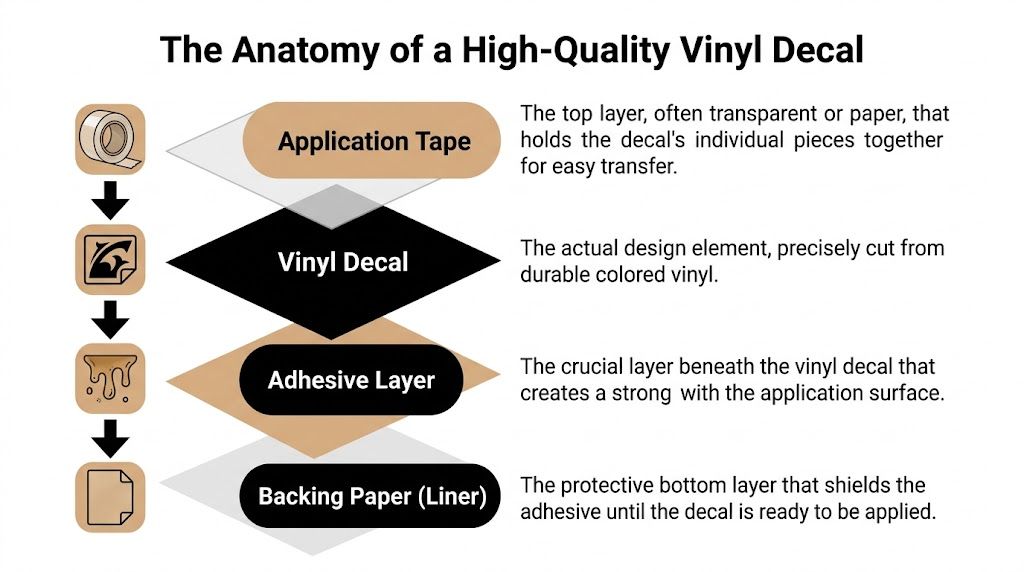
A premium vinyl decal works like a three-part stack with one job. Keep the design aligned until it lands on the vehicle exactly where it belongs.
The decal sandwich
Think of it as a decal sandwich.
| Layer | What it does | Why it matters |
|---|---|---|
| Transfer tape | Holds all the cut pieces in position | Keeps letters and fine elements aligned during install |
| Vinyl graphic | The actual shape, logo, text, or art | Creates the finished no-background look |
| Backing paper | Protects the adhesive until application | Lets the decal ship, store, and peel properly |
On some graphics, especially text, military tributes, family decals, and windshield banners, the transfer tape is the part that saves the install. Without it, every letter becomes a separate placement problem.
Precision starts in the art file
A lot of people think the machine does all the hard work. It doesn’t. The design has to be cuttable first.
For premium vinyl decals, lines and gaps between shapes need a minimum thickness of 0.09 inches so the graphic holds together during cutting and weeding, according to StickerGenius decal requirements. If a line is too thin or two shapes are too tight, the vinyl can tear, lift, or distort before it ever reaches your vehicle.
That one detail explains why some graphics look crisp and some look fragile.
Thin script fonts, tiny serifs, and packed-in detail may look good on a screen. On vinyl, they can become a production problem fast.
What separates a pro decal from a cheap one
A professional decal is pre-spaced. That means all the individual parts are already arranged the way they should appear on the glass or paint. You don’t have to guess spacing between letters or try to eyeball a level install one piece at a time.
That’s especially important for:
- Windshield banners where crooked spacing is obvious
- Custom names on side glass or tailgates
- Layered tribute graphics with stars, flags, or insignia
- Jeep and off-road text that needs to read clean from a distance
The best decals look simple after they’re installed. Getting them to that point takes exact spacing, clean cuts, and enough material strength to survive the weeding table.
Not All Vinyl Is Created Equal
Material choice decides whether a decal still looks sharp down the road or starts shrinking, fading, and cracking. That’s the part many buyers never see until it’s too late.
Cast vinyl versus cheaper film
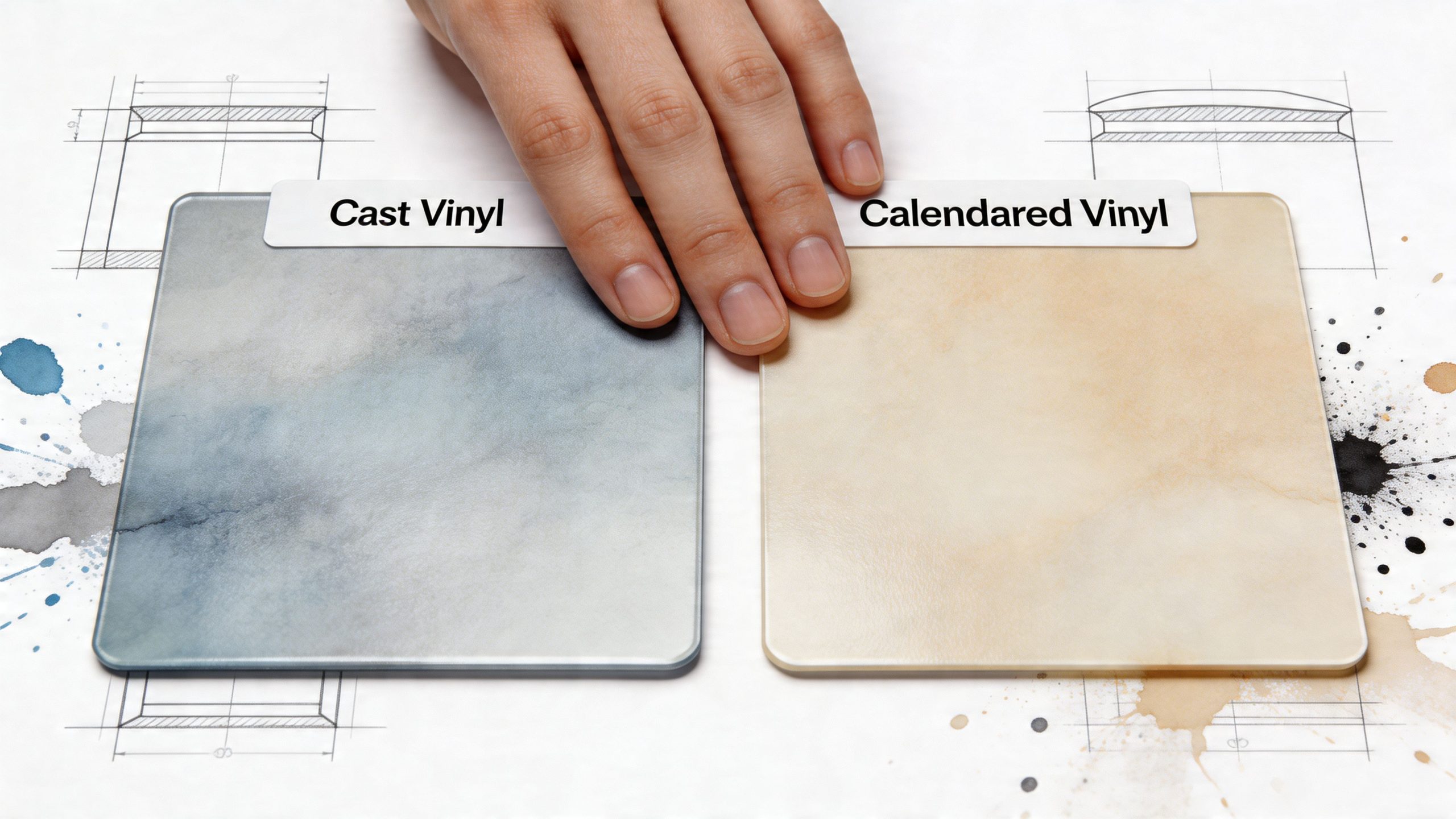
For automotive work, cast vinyl is the premium choice. It conforms better, stays more stable, and holds up longer outdoors than the kind of material often used for throwaway stickers or short-term graphics.
According to this breakdown of decal material specs, premium decals made with cast vinyl last 7 to 10 years, while typical stickers are often in the 1 to 2 year range. The same source notes that cast vinyl uses microscopic air-egress channels that help eliminate bubbles during installation, and UV-stabilized laminates help maintain 95% opacity after long sun exposure on a car or truck.
What that means on a real vehicle
Here’s the practical difference.
A lower-grade film may look fine the day it goes on. Then it starts telling on itself. Edges pull in. The material gets stiff. Curves and compound surfaces become the first failure points. On a hood, windshield edge, or contoured body panel, that matters.
Cast vinyl handles those locations better because it isn’t fighting the shape of the vehicle as hard.
A good example is a vinyl windshield banner for a Corvette. That kind of placement needs material that can sit clean across a curved glass line without looking stressed or lifting at the ends.
What works and what doesn’t
- Works well: Cast vinyl on windows, smooth painted panels, hoods, and body lines with mild curves
- Usually disappoints: Cheap printed stickers where the background edge stays visible and the film ages quickly
- Worth paying for: Material with bubble-control features for larger installs
- Usually a mistake: Choosing by price alone when the decal is going on a daily driver parked outdoors
A decal is only as good as the film it’s cut from. Nice artwork on weak vinyl is still weak vinyl.
If you care about how a graphic looks after seasons of sun, washing, and road grime, the material is the job.
Popular Decal Uses for Your Vehicle and Beyond
The best way to understand a decal is to look at where people use them. On vehicles, decals aren’t one style. They’re a whole language.

Decals became iconic in the US hot rod scene of the 1950s and 1960s, and automotive personalization remains huge today. The US vehicle customization market reaches $40 billion yearly, and 70% of truck owners add graphics, according to the decal overview on Wikipedia. That’s why you see them everywhere from tuner cars to work trucks to off-road rigs.
Common styles that make sense on vehicles
Some decals are all about visibility. Others are personal.
- Windshield banners suit sports cars, JDM builds, and muscle cars. Done right, they sharpen the top edge of the glass and tie the front of the vehicle together.
- Military tributes fit rear windows, bed sides, and tailgates on trucks and Jeeps. These usually work best as clean die-cut graphics rather than printed rectangles.
- Family and pet decals are popular on SUVs and daily drivers because they add personality without taking over the whole vehicle.
- Fireman, hunting, and fishing themes often look strongest on rear glass or toolboxes where the silhouette reads clearly.
- Trail and off-road graphics belong on Jeeps, side glass, or hood areas where they complement the vehicle’s shape instead of fighting it.
What a good decal does visually
A good decal should look like it belongs there. Not like an afterthought.
That’s why die-cut transfer decals are so popular. There’s no big printed background. You just get the design itself. On tinted glass, matte paint, or a clean truck door, that difference is obvious.
Business owners use the same logic. A simple QR code decal can turn a side window or trailer panel into something useful without looking cluttered. If you’ve seen a rounded-corner QR code decal on a vehicle or storefront, you’ve seen how a functional graphic can still look tidy.
Here’s a quick look at vehicle-friendly placements:
| Placement | Best use | What to avoid |
|---|---|---|
| Rear window | Family, military, fireman, hunting themes | Overly dense detail that gets lost at distance |
| Windshield top edge | Banners, club names, bold text | Tiny lettering that won’t read |
| Hood or body panel | Off-road graphics, larger accent art | Weak vinyl on curved surfaces |
| Quarter glass | Small logos, names, tuner graphics | Designs that are too tall for the available space |
For a visual of how these kinds of graphics are used on real vehicles, this example helps:
Beyond the vehicle
The same no-background style also works on toolboxes, garage cabinets, helmets, coolers, and shop windows. If the surface is smooth and the design is cut properly, a decal gives a cleaner finish than most peel-and-stick printed labels.
That’s why people start with one for the truck and end up ordering more for the trailer, laptop, shop fridge, or gear case.
How to Install a Decal Without Bubbles or Wrinkles
Most first-time buyers aren’t worried about the design. They’re worried about ruining it during install.
That concern is fair. Loose vinyl is easy to misalign. Individual letters are even worse. The reason pre-spaced decals exist is to remove that headache. According to this installation-focused source on transfer-taped decals, pre-spaced, transfer-taped decals can deliver a 98%+ first-pass success rate on properly cleaned surfaces.
The four-part install that works
The basic process is simple:
Clean the surface
Dirt, wax, dust, and film residue cause more failures than people expect. Glass and smooth paint need to feel clean, not just look clean.Position the decal first
Hold it in place and check spacing before peeling the liner. On text decals, a small crooked angle is easy to spot once it’s on.Squeegee with steady pressure
Work from the center outward so the adhesive lays down evenly and trapped air has somewhere to go.Peel the transfer tape slowly
Don’t rip it off. Roll it back carefully and watch that the vinyl stays on the vehicle.
Why transfer tape matters so much
Transfer tape keeps every piece in registration. That’s the whole advantage. If you’re applying a family decal with multiple names, a military insignia, or a long windshield banner, the tape turns a tricky install into one placement instead of many.
If a decal is fighting you during install, stop and check surface prep, temperature, and squeegee pressure. Forcing it usually makes it worse.
Common mistakes
- Applying over contamination such as dust, polish residue, or road film
- Rushing alignment because the graphic “looks close enough”
- Peeling transfer tape too aggressively before the vinyl has bonded
- Starting with a very detailed design when you’ve never installed one before
A well-made decal should help the installer, not punish them. Good spacing, stable vinyl, and clean transfer tape make a bigger difference than most buyers realize.
Keeping Your Vehicle Decals Looking Great for Years
Once the decal is on, maintenance is straightforward. The trick is treating the edges with a little respect.
Simple habits that help
Wash the vehicle normally, but don’t aim aggressive high-pressure water directly at decal edges for long periods. If you’re cleaning around corners or tips of lettering, use a softer touch instead of trying to blast grime out from under the edge.
In winter, be careful when scraping ice near glass decals. The vinyl can handle outdoor exposure, but a hard scraper edge can catch a corner if you get careless.
What to avoid
Don’t pick at a lifting edge. If one starts to fail, fingernails usually make it worse. Avoid abrasive pads on the graphic itself, and don’t assume every harsh cleaner is safe just because it’s fine on paint.
For premium cast vinyl, outdoor life in the 7-year range is realistic when the decal is made from the right material and installed well. Simple washing and edge awareness go a long way toward getting the full life out of it.
Why a Premium Decal Is the Right Choice
A premium decal costs more than a throwaway sticker for a reason. You’re paying for cleaner design work, stronger film, better cutting, proper spacing, and an install that doesn’t feel like a gamble.
What you’re really buying
You’re not just buying vinyl. You’re buying a result.
That result includes:
- A no-background look that reads cleaner on glass and paint
- Material built for outdoor use instead of short-term novelty use
- Cut accuracy that keeps details from looking ragged
- Transfer-ready layout so the graphic goes on as one composition
Cheap decals usually fail in familiar ways. They look bulky, the spacing feels off, or the material starts showing stress too early. A better decal disappears into the vehicle visually. That’s the standard most owners want.
Why craftsmanship still matters
Family-run shops and trade-focused makers usually understand something mass marketplaces often miss. Vehicle graphics aren’t generic. A Jeep windshield strip, a military rear-window tribute, and a family name decal all ask different things from the material and cut file.
That’s also why it helps to explore our range of custom products from Custom Mark if you want to compare how custom graphics and specialty marking products are built for different use cases. Looking at adjacent custom product work makes it easier to spot the difference between commodity vinyl and work made with production discipline.
The best decal doesn’t need excuses after install. It sits flat, reads clean, and keeps doing its job.
If you came here asking what is a decals, the practical answer is this. It’s a transfer-cut vinyl graphic that gives your vehicle a sharper, more personal look. And when it’s made with the right material, designed within real cutting limits, and applied with transfer tape, it looks professional from day one and stays that way.
If you’re ready to put that blank glass or paint to work, Custom Sticker Shop is a solid place to start. They’re a veteran-friendly, family-run shop in Topeka, Kansas that has delivered over a million decals worldwide since 2001, with more than 1,200 designs for cars, trucks, Jeeps, military tributes, family graphics, and custom text. Their decals are made from professional-grade Oracal vinyl rated for up to 7 years outdoors, arrive pre-spaced and transfer-taped for easy installation, and include value perks like prices starting at $7.99, free US shipping on orders over $25, and an unlimited Buy 2 Get 1 Free offer.