
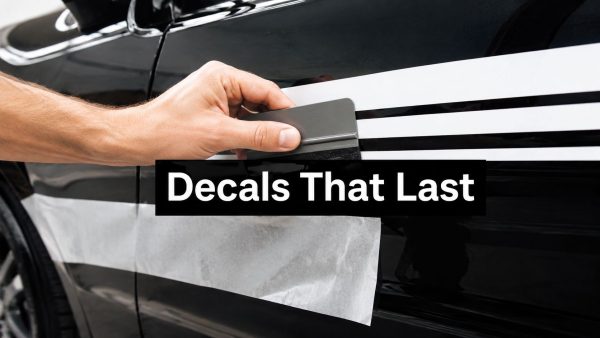
You're standing in the driveway with your phone in one hand and a tape measure in the other, trying to decide whether your car needs a clean twin stripe, a full side graphic, or something that looks closer to a small race team's contingency setup. That's the street racing decals decision many drivers face, not whether they're building a track car, but whether the graphic will look sharp, hold up on a daily driver, and stay out of trouble on public roads.
The phrase street racing decals gets used loosely, but the style itself sits inside a much older automotive visual tradition. NHRA notes that decals first came into the United States in 1860, were not printed in the U.S. until 1894, and that decorative design options grew from about 300 in 1875 to 10,000 by 1877. In racing, markings started as a way to tell similar-looking cars apart at speed, and the 1965 Ford Mustang GT350 is widely cited as the first road car to use racing stripes in a production context, which is why today's graphics feel borrowed from motorsport even when they're purely cosmetic.
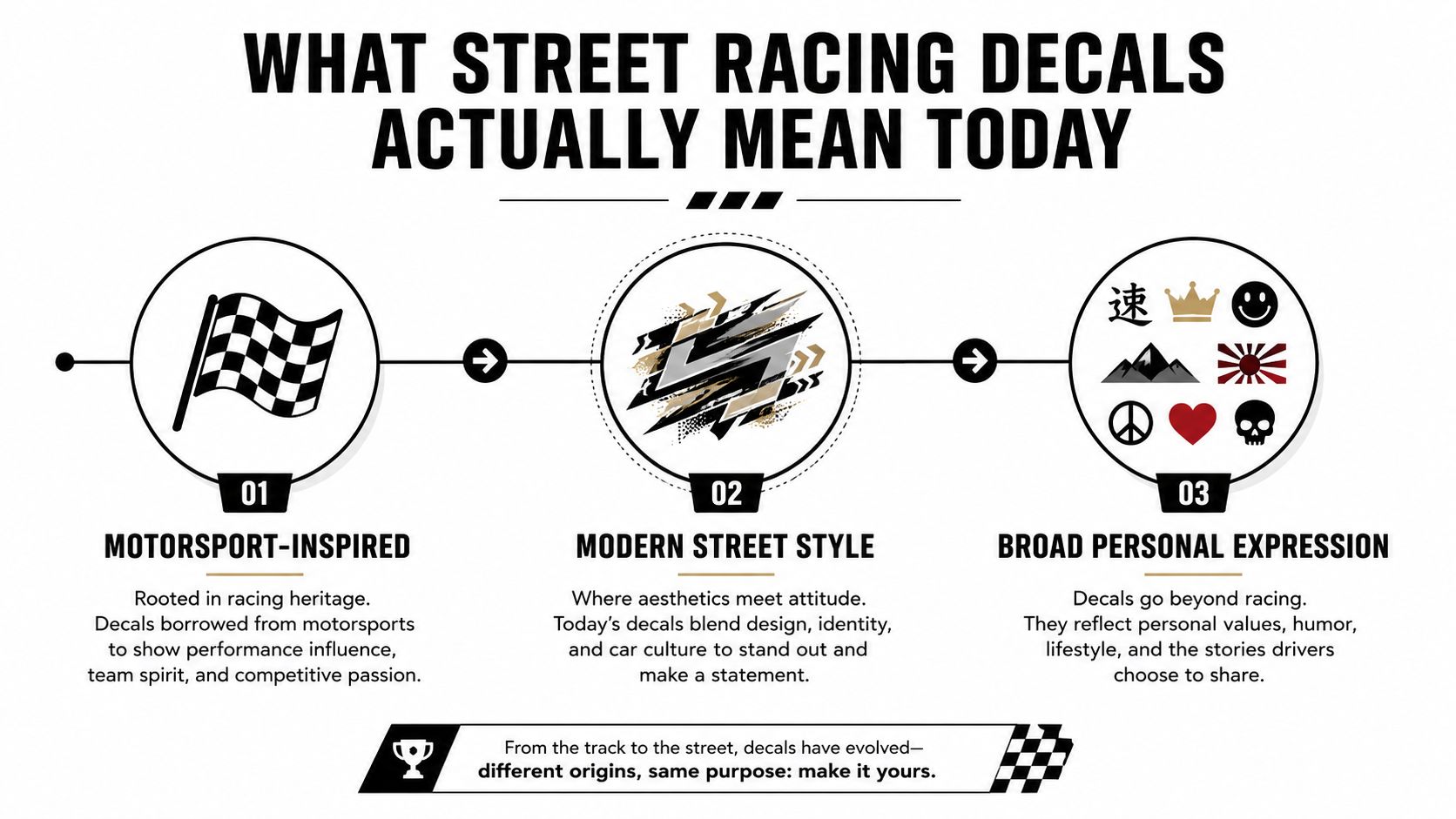
What Street Racing Decals Actually Mean Today
A first-time buyer usually starts by scrolling through a dozen looks and calling all of them “race style,” but the category is broader than that. The look can lean toward drag-strip heritage, tuner identity, muscle-car stripes, or a more personal street build that borrows the energy of motorsport without copying a real class marking.
What the term covers
A good way to think about it is this. Some decals are about speed cues, some are about brand cues, and some are just about attitude. The same visual language can signal a weekend cruiser, a track-inspired show car, or a daily driver with a little edge.
That distinction matters because the style survived long after the original street-racing scene became a public-safety concern. A NHTSA analysis of U.S. fatal crashes from 1998 to 2001 found 315 street-racing-related fatal crashes out of 149,451 total fatal crashes, and those crashes caused 399 fatalities. That history is part of why the graphic language still carries a motorsport feel, even when the car itself never leaves pavement.
Where the visual language comes from
The strongest examples pull from older traditions, not just modern internet aesthetics. Think of racing stripes, contingency-style decals, JDM-inspired lettering, and compact sponsor marks that resemble what you'd see on a drag car or grudge-race build. On the street, those elements usually work best when they're used as styling, not as a fake imitation of an actual sanctioned class car.
One useful thing to keep in mind is that decal culture has always been tied to identity as much as identification. In real-world car culture, the car says something about the driver before the engine does, and that's exactly why these graphics still sell.
Practical rule: if the decal looks like it belongs on a car that's moving fast, it should still make sense when the car is parked outside a coffee shop.
What matters next is simple. Pick the style that fits the body lines, choose a material that can survive daily driving, and make sure the size and placement don't fight the car's shape or the law.
The Main Street Racing Decal Styles Worth Knowing
A shopper browsing racing graphics usually runs into the same core styles, even if the storefront names them differently. Custom Sticker Shop's catalog spans 1,200+ car and truck designs, so the choice is less about finding “a decal” and more about picking the right visual language for the vehicle.
Striping and panel graphics
Classic dual racing stripes work best on coupes, pony cars, and anything with a long hood. They read fast without getting loud, and they're the safest choice if you want a motorsport look that doesn't take over the body. The pitfall is scale, because stripes that look crisp on a Mustang can look skinny and unintentional on a full-size truck.
Full-width side stripes suit longer bodies, especially sedans, hatchbacks, and trucks with a clean beltline. They create movement across the profile and make a vehicle feel lower than it is. The mistake is letting the stripe get too busy near wheel openings, where the body already has a lot happening visually.
Sponsor-style and tuner-inspired graphics
Sponsor-style logos and contingency marks borrow from drag racing and circle-track culture. They work on street cars when they're used sparingly, with enough negative space to keep the look believable. Put too many on one side and the car starts reading like a mock race car instead of a clean street build.
JDM kanji and tuner graphics suit smaller cars, hatchbacks, and builds that already lean into Japanese styling cues. These decals signal affinity more than aggression. The main risk is cultural mismatch, where the graphic looks pasted on rather than chosen to match the vehicle's proportions and theme.
Muscle and wrap-style looks
Hood and scoop stripes are strong on muscle cars because they reinforce the centerline of the car. They can also make a stock hood look more purposeful without turning the whole vehicle into a rolling billboard. Modern wrap-style patterns are the wild card, they work when the car has enough visual mass to carry them, but they fail fast when overlaid on a body with too many creases or trim breaks.
If you want the quickest filter, start with two questions. Does the vehicle already have a long, clean shape. And does the graphic make the car look faster without making it look cluttered.
Cast Vinyl vs Calendared Vinyl and Why the Rating Matters
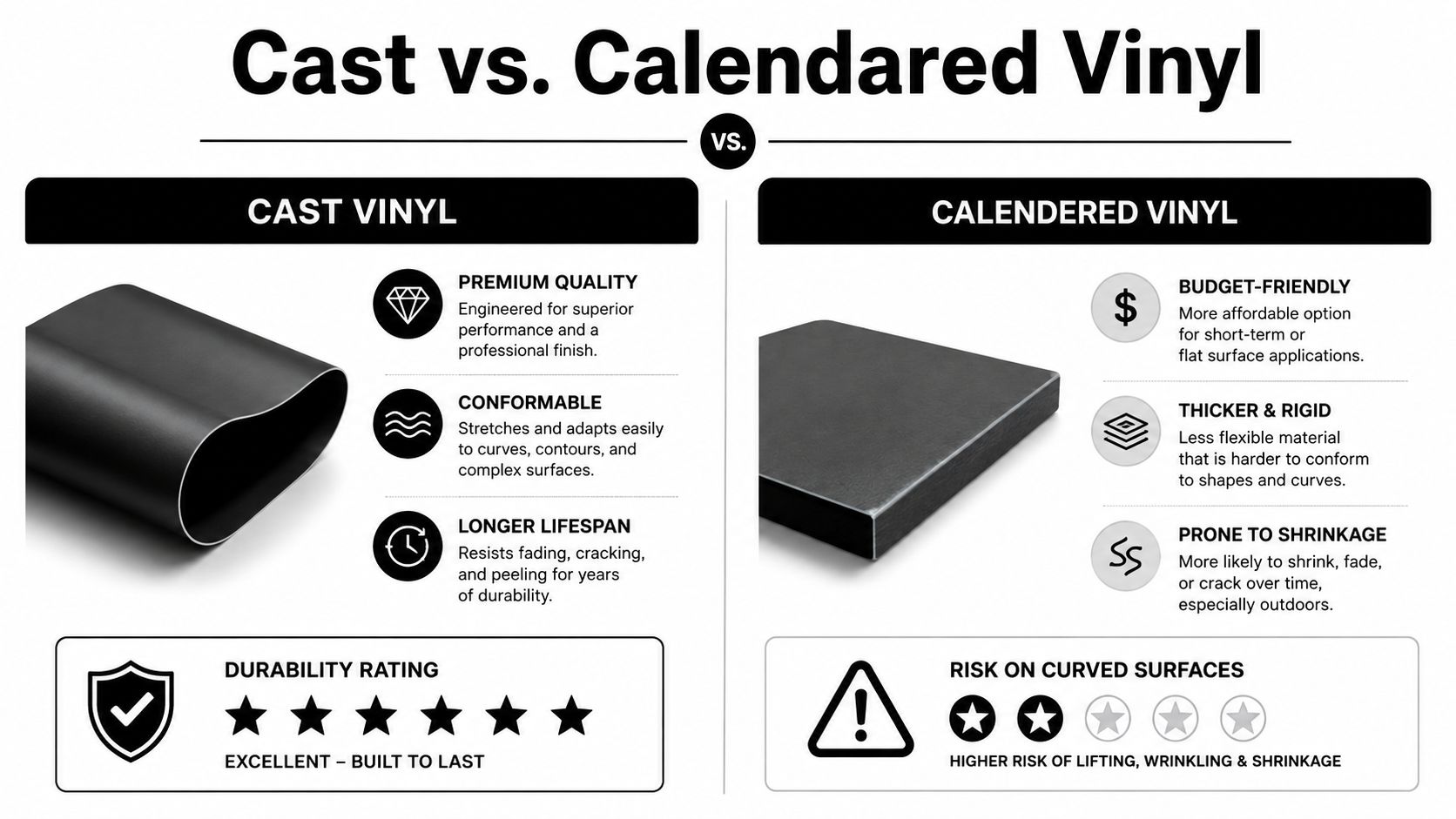
The material choice decides whether a decal still looks tight after heat cycles, washing, and sun exposure. For street-racing-style graphics on a daily-driven car, cast vinyl is the serious option, while calendared vinyl is the budget option that's better suited to flatter, shorter-term uses.
Why cast vinyl holds up better
Cast film is thinner and conforms better to curves, which matters on quarter panels, mirrors, hoods, and scooped surfaces. Calendared film is thicker and more prone to shrinkage, so it can look fine on a flat panel and then start pulling at the edges once the car sees real use. That edge movement is what turns a clean decal into a worn one.
Street Race Graphics says its automotive vinyl is rated for 5 to 7 years and uses Avery 500 and Metamark M7 for cut vinyls, with Metamark air-release for printed laminated graphics. It also notes that aging can show up after 3 to 4 years under real vehicle wear, which is why the rated life and the practical life are not the same thing. Street Race Graphics FAQ
Why air-release adhesive matters
Air-release adhesive helps trapped air escape during install, which makes a big difference on curved surfaces. That's not a minor convenience, it's the difference between a graphic that lays down clean and one that leaves bubbles that keep growing after the install is done.
Good install material doesn't just look sharper on day one, it tolerates the mistakes that happen during real-world application.
If you're buying for a car that lives outside, gets washed often, and sees highway speed, the rule is straightforward. Ask for cast, air-release, UV-stable vinyl rated for at least 5 years outdoors. If a seller can't tell you that, you're probably looking at a sign-grade shortcut.
For a window-banner format that needs the same kind of clean, pre-spaced presentation, the product listing at Custom Sticker Shop's windshield banner page shows the kind of application-specific option buyers usually want when they're matching style to body shape.
Sizing and Placement That Actually Look Right
Sizing goes wrong when people buy by eye instead of by the car's actual surface area. Motorsport gives a useful anchor here. NHRA contingency decals must match the approved sponsor decal size and design, with a 36-square-inch maximum, and in Pro Stockers they're placed on each side of the front fender in front of the front tire or on the hood scoop, while identification decals in some classes are restricted to rear quarter windows only. NHRA rulebook
A street-car sizing map
For everyday cars, the same logic applies in looser form. A pair of accent stripes usually looks right at 2 to 4 inches wide on most vehicles, because it follows the body without overwhelming it. Side stripes should scale with the car's length, while hood graphics and trunk graphics can carry more visual weight because those surfaces are meant to be seen from a distance.
A smaller decal can disappear fast if you place it on a large door or a big truck bedside. A large graphic can look forced if you try to squeeze it into a narrow quarter window. That's why the size and the panel have to be chosen together.
Where common placements work best
- Windshield banner: best for compact, high-contrast text, but it should stay out of the driver's visibility zone.
- Rear window: good for larger text or a race-inspired slogan, especially when the glass has enough width to carry it.
- Quarter panel: works for sponsor-style marks, class-style graphics, or subtle identity decals.
- Fender: ideal for compact logos or narrow strips that follow the wheel opening.
- Hood: handles centered stripes and symmetrical graphics well.
- Rocker panel: good for long, low graphics that visually stretch the vehicle.
Hoosier's customer decal dimensions range from 1.75" x 6" small decals to 4" x 14" Euro-plate decals, which is a useful reminder that racing identity graphics are often compact by design. NHRA rulebook
For a practical custom text format that works well when you need to test placement on glass or a long flat panel, the 22-inch wide custom text window decal sticker is the kind of sizing reference that helps you tape out a plan before you buy.
Measure the panel, not your opinion of the panel. A tape measure beats a guess every time.
Where Style Crosses Into Safety and Legal Trouble
A decal can look clean on a street car and still create problems if it interferes with visibility, lights, or how other drivers read the vehicle. In the shop, I treat that line seriously, because once a graphic starts covering useful glass or mimicking official markings, the conversation stops being about style.
Street racing has a real public-safety context behind it. Analysts at the NHTSA analysis linked street-racing fatal crashes to crashes, injuries, and a rising share of deadly incidents over the study period. That matters for decal placement because the same car cues that look aggressive in a parking lot can draw a different reaction on the road.
In practice, the safest rule is simple. Keep graphics out of the driver's line of sight, avoid covering lights or reflectors, and do not use markings that could be mistaken for law-enforcement or emergency equipment. Windshield banners need extra caution because a banner that sits too low can run into visibility or inspection trouble even if the vinyl itself is applied well.
Problem-oriented policing research has tied street racing to more than speed alone, including noise, vandalism, litter, property damage, and other public-order problems, which helps explain why local enforcement can be stricter than casual car culture expects. The academic literature has also described street racing as a Problem-oriented policing and research gap, so some of the edge cases around decals, visibility, and intent are not covered as clearly as builders would like.
State rules can shift the line again. The Florida street racing legal definitions resource is useful because it shows how legal language can treat racing behavior, and by extension racing-themed presentation, differently from a simple “it is just a sticker” assumption.
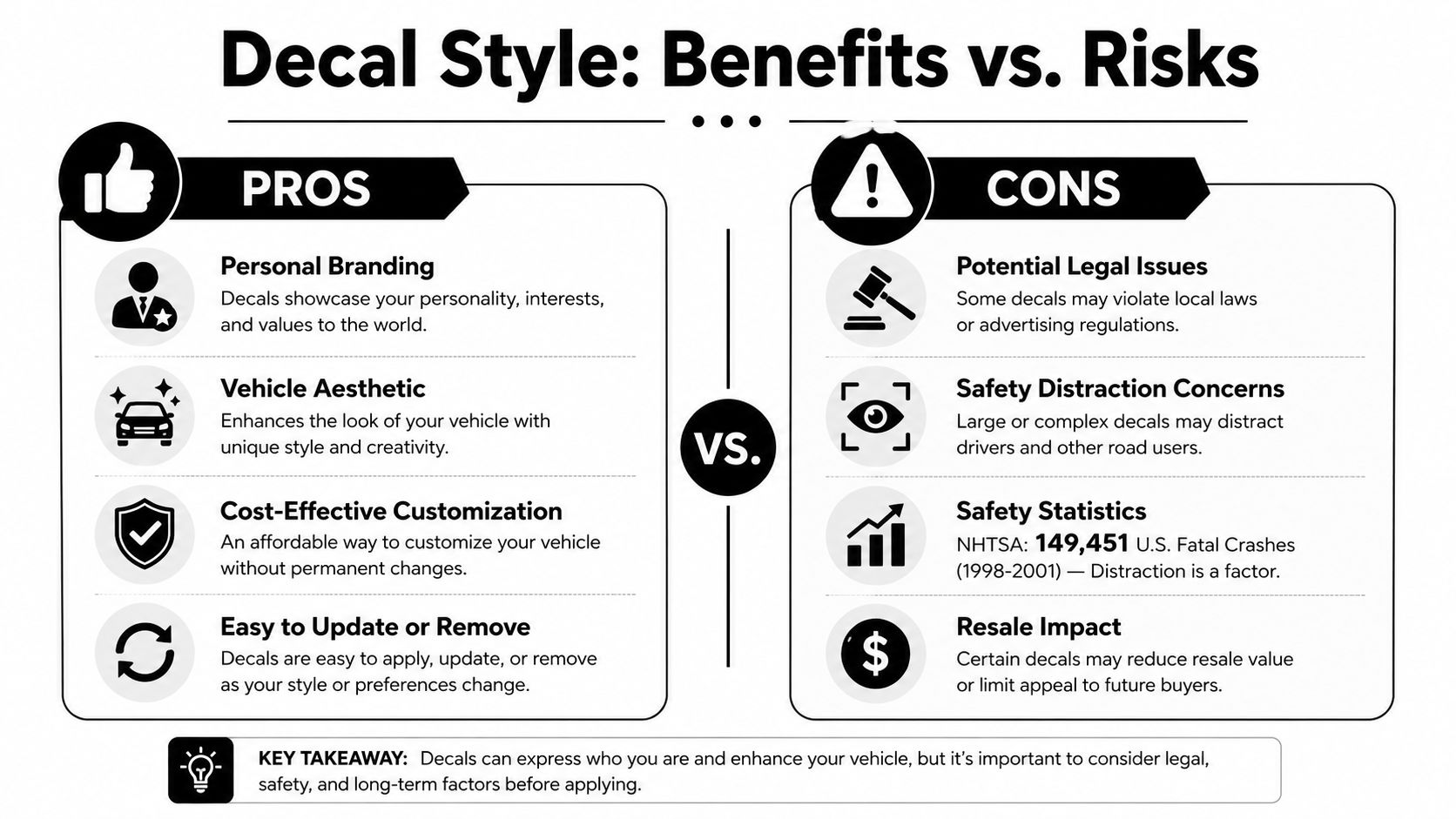
A practical shop rule is to separate street styling from race-spec thinking. NHRA-style contingency graphics and sponsor placement follow their own sizing and visibility expectations, while everyday street decals have to survive highway spray, wash chemicals, and the judgment of local officers at a stoplight. The cleanest builds respect both realities, sharp enough to read at speed, restrained enough to stay out of trouble.
Installing Street Racing Decals Without Bubbles or Edge Lift
A clean install starts before the backing paper comes off. Wash the panel, clay-bar it if needed, wipe it with isopropyl alcohol, and don't apply wax within 24 hours of install. Dirt and residue are what cause most of the little failures people blame on “bad vinyl.”
The basic install sequence
For large graphics, use the hinge method. Tape the top edge in place, peel the backing halfway, and squeegee from the center outward before repeating on the lower half. Smaller accent decals can usually go on with one steady pass, but the goal is still the same, keep pressure even and push air out as you go.
When you remove transfer tape, pull it back at a sharp angle instead of flat. That keeps the vinyl from lifting with the tape. A heat gun or hairdryer helps on curved surfaces, especially mirrors, bumper corners, and rounded quarter panels where the film needs a little persuasion to settle.
The tool kit that actually gets used
- Microfiber towel for the final wipe.
- Isopropyl alcohol for the last surface prep.
- Squeegee or credit card for pressure.
- Heat gun or hairdryer for curves.
- Pin for popping a trapped bubble after install.
A small bubble isn't a disaster if you catch it early. A lifted edge on a highway car becomes a bigger problem fast because airflow and washing work against it every time the vehicle moves or gets cleaned.
Let the decal cure before you treat it like finished trim. A full 24-hour wait before car washes or hard highway use keeps the adhesive from fighting the first real test.
Customizing and Ordering From Custom Sticker Shop
The simplest order path is the one that prevents a remake. Start with the vehicle, pick the style, choose the panel, and then match size and color to the exact space you measured. That's the point where a lot of buyers save money by not guessing.
Custom Sticker Shop's catalog covers 1,200+ pre-made designs, including 295+ military tributes, 240+ Jeep graphics, and 165+ family options, plus JDM and tuner themes for buyers who want something more specific. Orders can be placed with PayPal, Venmo, Apple Pay, or card, then shipped pre-spaced and transfer-taped through USPS or UPS, with typical arrival in 5 to 8 days from order to door. Custom Sticker Shop custom text windshield banner
Custom Sticker Shop at a Glance
| Detail | Value |
|---|---|
| Product range | 1,200+ car and truck designs |
| Theme depth | 295+ military tributes, 240+ Jeep graphics, 165+ family options |
| Materials | Professional-grade Oracal vinyl rated for up to 7 years outdoors |
| Checkout options | PayPal, Venmo, Apple Pay, card |
| Shipping | USPS or UPS, typically 5 to 8 days |
| Entry price | Starts at $7.99 |
| Shipping threshold | Free U.S. shipping at $25+ |
| Cart offer | Unlimited Buy 2 Get 1 Free |
There's also a value angle that matters if you're trying to outfit more than one vehicle or mixing sizes. Prices start at $7.99, free U.S. shipping applies at $25+, and the unlimited Buy 2 Get 1 Free offer helps when you're testing a few looks at once. The company also says it has delivered over one million decals worldwide, and it runs as a veteran-friendly, family-run operation in Topeka, Kansas.
For buyers who want to sketch the final placement before ordering, masking tape on the vehicle is still the smartest move. It shows you immediately whether the graphic follows the body or fights it.
Putting It All Together for This Weekend
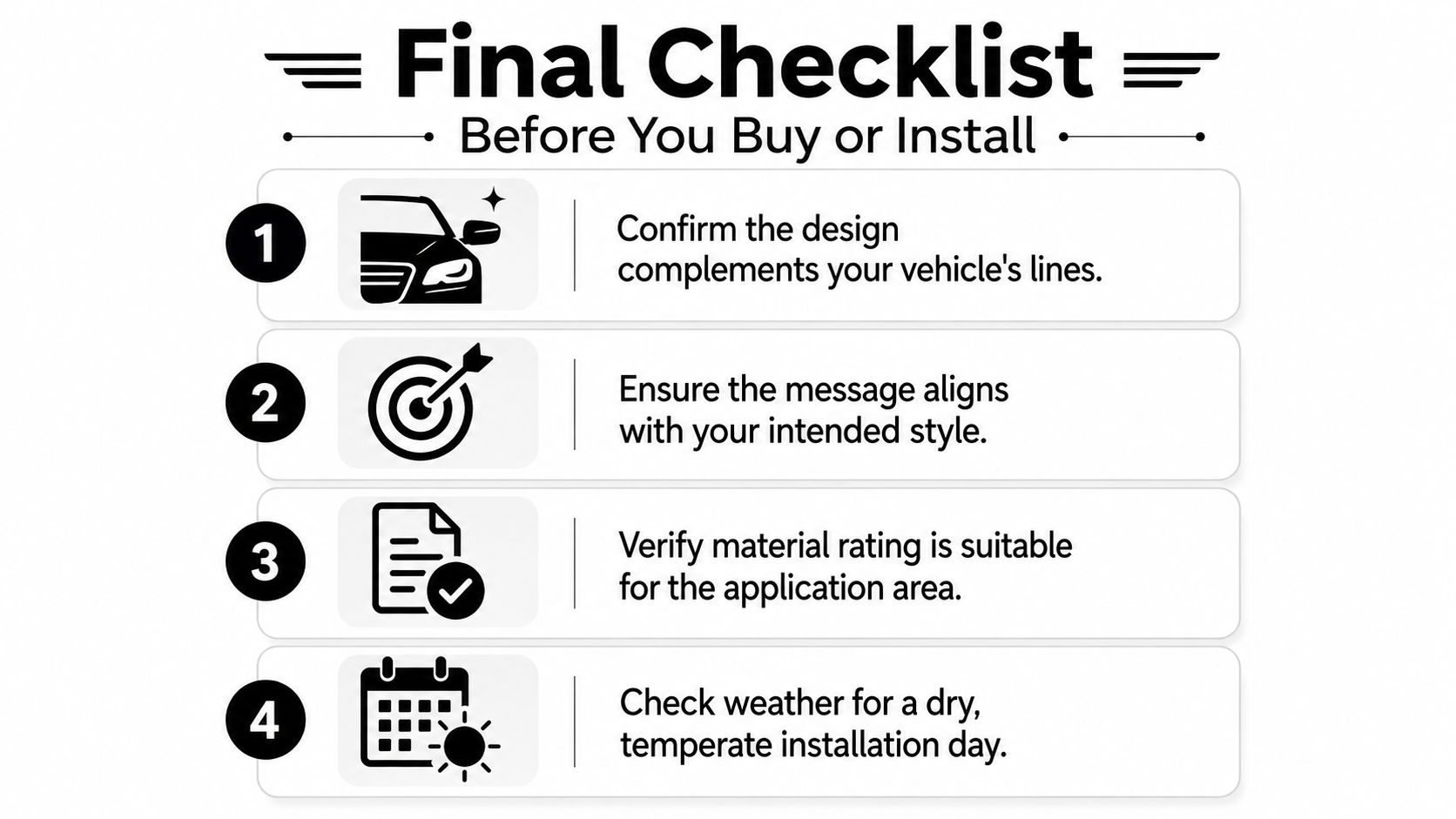
Pick the style that matches the car's lines, choose cast Oracal vinyl rated for at least 5 years outdoors, and tape off the size before you buy so the graphic doesn't crowd glass, lights, or body breaks. Check local visibility and tint rules, then install on a clean alcohol-wiped panel with the hinge method if the decal is large. Order the right color, size, and quantity so you can take advantage of free shipping at $25 and the unlimited Buy 2 Get 1 Free offer.
A well-made decal on the right surface, in the right size, in the right place, outlasts three sets of cheap ones and a roadside conversation they didn't need.
If you're ready to turn that taped-off mockup into a finished look, Custom Sticker Shop has the materials, sizing options, and pre-spaced decals that fit this kind of build. Visit Custom Sticker Shop to choose a street-racing-inspired graphic that matches your vehicle, your budget, and the way you drive.