

You're probably looking at a blank wall right now. Maybe it's above a crib, over a kid's bed, behind a desk, or in that entryway that still feels unfinished. You want something personal, but you don't want to paint a mural, hang a heavy sign, or commit to decor that will feel dated the next time the room changes.
That's where personalized name wall decals make so much sense. They give you a custom look without the mess of paint, and the better ones go on cleanly, sit flat, and come off when life changes. That matters more than most product pages admit. A decal isn't just about the design. It has to match the wall, the paint, and the way you live in the room.
Transform Your Space with a Personal Touch
You stand back after setting up the crib or finally clearing the desk, and the room still feels unfinished. One name on the wall can fix that faster than a gallery wall, a painted mural, or a shelf full of decor. It gives the room identity without adding weight, holes, or a weekend project you may regret later.
That simplicity is why personalized name wall decals have stayed popular. They work in nurseries, kids' rooms, offices, entryways, and family spaces because they add something specific to the room without locking you into a permanent design choice. A child outgrows a theme. A nursery becomes a big-kid room. A surname decal in the entry can stay for years, while a first-name decal over a bed may need to come down cleanly when the room changes.
From a shop perspective, the best part is not just customization. It is how adaptable the format is across different homes and wall conditions. Smooth builder-grade paint usually gives you the easiest install. Light texture can still work, but the font, size, and vinyl choice matter more. Fresh low-VOC paint often needs extra curing time before anything adhesive goes on the wall, and that is one of the first details I tell customers to check if they want the decal to stay put and still remove without trouble later.
That practical side gets overlooked. Buyers often focus on the name, color, and font first, then run into avoidable issues because no one asked what kind of wall the decal is going on. A decal that looks beautiful in the product photo can behave very differently on orange-peel texture, heavily rolled paint, or a wall that was painted last week.
Placement matters too. A decal can be perfectly made and still look awkward if it is squeezed between furniture, hung too high, or competing with a headboard, shelf, or curtain rod. If you want a helpful read on how placement changes the whole room, Colorado Art Services has a smart piece on transforming your space with art.
A personalized decal works best when it feels like it belongs on that wall, in that room, with that paint finish and that stage of life.
Understanding Decal Quality and Materials
Not all decals behave the same on the wall. Some look smooth and paint-like. Others fight you from the minute you unroll them, wrinkle at the edges, or leave you nervous about removal before they're even installed.
That difference usually starts with the material.
What separates vinyl decals from flimsy stickers
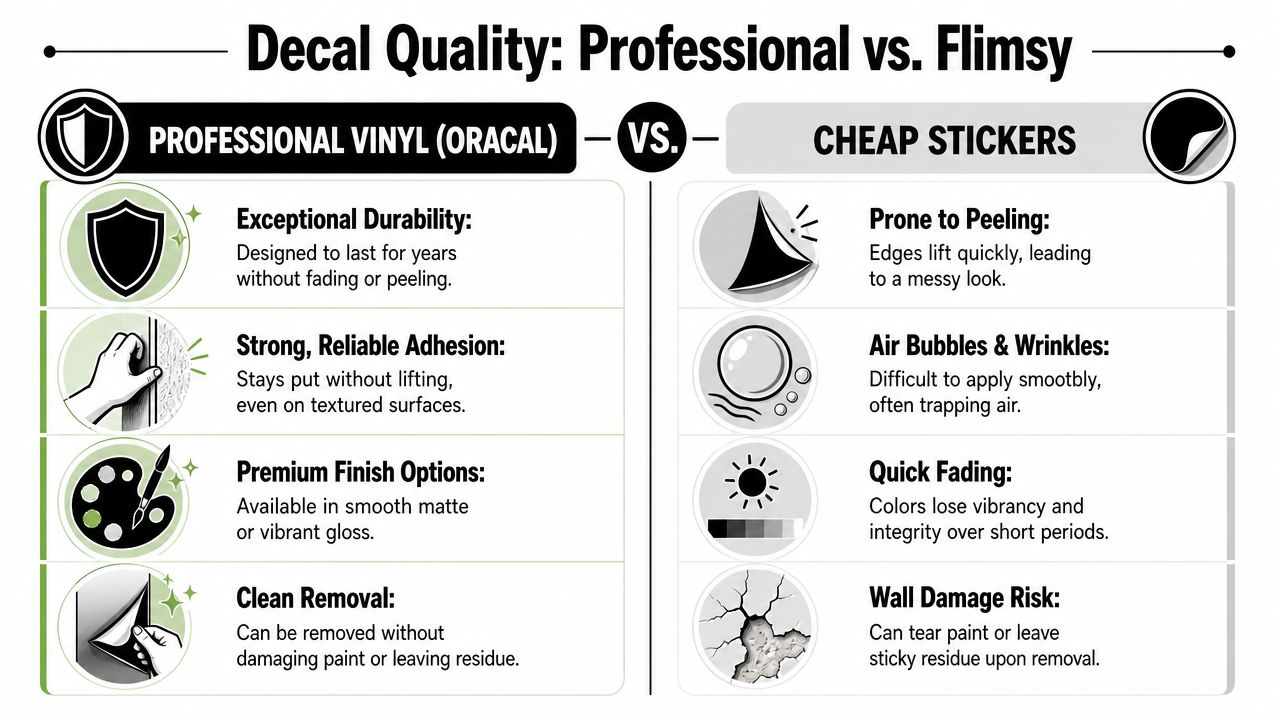
A proper wall decal is cut from sign-grade vinyl, not printed on cheap paper stock with a weak adhesive. In shop terms, that means cleaner edges, better hold, and a finish that doesn't scream “sticker” from across the room. Professional vinyl also tends to handle transfer tape better, which matters a lot on script fonts and thin lettering.
Many experienced decal makers prefer Oracal vinyl because it weeds cleanly, holds fine detail, and gives a finish that looks closer to painted lettering than a glossy toy sticker. Matte options are especially forgiving in rooms with lamps, window light, or overhead fixtures because they don't bounce glare the way slick surfaces do.
The wall surface matters more than most listings admit
This is the part too many shops glide past. They'll tell you a decal is “easy to apply” or “removable,” but that doesn't answer the essential question. Will it work on your wall?
One independent fabric decal listing makes the issue plain. It says the decal is designed for a range of painted walls, but heavily textured walls can reduce performance, which points to a bigger gap in the market. Buyers still don't get a clear rule for whether a name decal will stick well, stay flat, and come off cleanly on different finishes (fabric wall decal surface note).
Here's the practical version:
| Wall type | What usually works | What often goes wrong |
|---|---|---|
| Smooth painted drywall | Best overall surface for vinyl decals | Dust, grease, or uncured paint can still cause failure |
| Light texture | Often workable with good vinyl and firm application | Fine edges may lift if the texture is sharper than it looks |
| Heavy texture | Risky for detailed names and thin script | Air gaps form under the vinyl, causing lifting |
| Fresh paint | Sometimes looks dry before it's ready | Adhesive can bond unpredictably or fail to grip |
| Low-VOC or stain-resistant paint | Can work, but test first | Some finishes feel slick and don't give consistent bite |
What to watch for on low-VOC paint
Low-VOC paint is popular for good reason, especially in nurseries and kids' rooms. But some low-odor, stain-resistant, or scrubbable finishes can be a little trickier for decals. The wall may feel smooth, but the coating can reduce how firmly the adhesive grabs.
That doesn't mean decals won't work. It means you should avoid blind confidence. Ask what material is being used, whether the decal is meant for painted drywall, and whether a small test cut is available if your wall finish is unusual. If indoor air quality is part of your buying decision, Ocodile has a useful explainer on Ocodile's GREENGUARD Gold guide that helps make sense of certification language you'll see around children's decor.
Practical rule: Smooth wall plus fully cured paint plus quality vinyl is the safest combination. Every step away from that setup adds some risk.
Designing Your Perfect Name Decal
The design stage often leads to either creating something that looks custom, or accidentally ordering something that feels generic. The best name decals fit the room's mood, wall color, and furniture scale. They don't just spell a name correctly.
A good starting point is to think about the room first and the font second. Too many buyers do it the other way around.

Match the font to the room's personality
Script fonts feel soft, decorative, and personal. They're a natural fit for nurseries, girls' rooms, floral themes, and spaces with rounded furniture or softer textiles. The trade-off is readability. A very swirly script can look beautiful in a proof and muddy on the wall, especially from across the room.
Block fonts are cleaner and easier to read. They work well in boys' rooms, sports themes, modern spaces, and home offices. If the name is long, a simpler font often looks better because it keeps the overall shape from turning into a tangle of loops.
Mixed-style layouts are often the sweet spot. A first name in script with a small block subtitle, or a surname in bold lettering with an established date underneath, tends to look intentional without trying too hard.
Choose color for contrast, not just preference
The biggest color mistake is picking a decal color you like in isolation instead of one that works against the wall. A soft beige decal on a warm greige wall may sound classy, but if there isn't enough contrast, the design disappears unless the light hits it just right.
Use this quick rule set:
- Dark wall, light decal: Great for visibility and a crisp statement
- Light wall, medium or dark decal: Usually the safest choice for names
- Bold wall color: Keep the decal simple so the room doesn't compete with itself
- Busy wallpaper or murals nearby: Use a plain, readable font and a single strong color
If you're decorating around a nursery palette, don't match every element exactly. A decal can act as the clean visual anchor while blankets, art, and toys carry the softer color variation.
If you have to squint at the proof to read it, it won't read better once it's on the wall.
Add-ons can help, but restraint usually wins
A few extra design elements can make a decal feel custom to the room. Stars, hearts, florals, crowns, sports icons, or animal shapes can all work. The trick is using them to support the name, not bury it.
Try asking one question before adding anything: does this extra graphic help the room tell a clearer story? If the answer is yes, keep it. If it's just filling space, skip it.
One reason the category keeps growing is that personalization now goes far beyond a baby's first name. A single Etsy listing for a personalized name wall decal shows 19,594 customer ratings and a 5 out of 5 star average at a sale price of $22.94, and the wording “Kids Name Sign, Nursery Decor” reflects how strong the nursery use case still is (Etsy personalized name wall decal listing). At the same time, independent sellers also market family names, monograms, and established dates, so the design language has widened into whole-home personalization.
If you want to compare styles before ordering, this personalised name wall stickers guide is a handy way to see how different lettering choices change the final look. And if you're brainstorming other ways custom text can be styled, a simple format like a custom text oval decal shows how much personality can come from typography alone.
Getting the Size and Placement Right
Sizing trips up more orders than color does. A decal can be beautifully cut and perfectly applied, but if it's too small for the wall or too wide for the furniture below it, it never looks settled.
Start with the wall, not the product listing.
Measure the installation zone first
Don't measure the entire wall unless the decal is meant to dominate the whole surface. Measure the usable visual area. That means the space above the crib, over the headboard, centered over the desk, or between two windows.
Then mark that area with painter's tape. This is one of the oldest shop tricks because it works. Tape out the width and height you think you want, step back, sit down, and look at it at the same angle you'll normally see it from.
Letter count changes the footprint
Personalized name wall decals aren't sized by name alone. They're shaped by the number of letters, the font, and the layout. One supplier notes that names up to 5 letters run roughly 10"-20" total width, while 6-9-letter names need more width. Another custom name product allows names up to 18" tall and 42" wide (name decal sizing examples).
That's why “Olivia” in flowing script and “Jack” in bold caps can end up needing very different proportions.
Here's the practical order of operations:
- Mark the furniture centerline. This keeps the decal anchored to the room, not floating off to one side.
- Tape the target width. Width usually drives the visual balance more than height.
- Allow breathing room. Don't crowd a shelf, curtain rod, or lamp.
- Consider reading distance. A decal over a bed can be more decorative. One across the room should be easier to read.
For simpler text layouts, it can help to look at a standard-width custom lettering product like this 11-inch wide custom text decal just to train your eye on how lettering width affects the final footprint.
Most sizing mistakes happen because buyers choose the decal size first and check the wall second. Reverse that process and the room usually falls into place.
Inspiration for Every Room in Your Home
You see the difference fast once real life enters the room. A name decal that looks perfect on a smooth nursery wall can struggle on orange-peel texture, and a beautiful spot above a bed may be the worst place to put thin script if the paint is still fresh or low-VOC and not fully cured.
That is why room inspiration has to go beyond style. The wall itself matters just as much as the design if you want clean application now and easier removal later.

Nursery and kids' rooms
The classic nursery name decal still works because it gives the room a focal point without adding clutter. Soft script over a crib, dresser, or changing table often feels calm and finished.
Wall condition matters more in nurseries than many parents expect. A lot of baby rooms are freshly painted right before install, often with low-VOC paint. That is fine, but fresh paint needs full cure time or the decal may not bond well, and removal later can get riskier. On lightly textured walls, cleaner fonts and slightly thicker lettering usually hold better than extra-fine script.
Older kids' rooms can handle more contrast. Bold type reads better against busier spaces with shelves, toys, art, and patterned bedding. If the child's interests are part of the room theme, a graphic detail can tie it together without turning the whole wall into a mural. For example, a custom soccer ball name decal for sports-themed rooms adds personality while keeping the layout simple.
Entryways and family spaces
Family names, shared last names, and established dates fit naturally in entryways, dining rooms, and living spaces because they read like part of the home, not just bedroom decor. These areas usually benefit from cleaner placement and a little restraint. One well-sized decal over a console, bench, or sideboard tends to look better than a large design fighting with mirrors, switches, and frames.
Monograms can work well here too. They need open wall space around them. If the wall has heavy texture, choose a simpler shape and avoid fine flourishes that can lift at the edges over time.
Hobby rooms and personalized corners
Small corners often get the biggest payoff. A reading nook, craft table, music area, or home office can feel finished with a name, short phrase, or simple graphic above the workspace.
I usually suggest matching the decal style to how the room gets used. Quiet spaces look better with cleaner lettering and modest scale. Play spaces and hobby zones can take more color or a themed accent. If the wall is rough, keep the design bolder and less delicate. That gives the adhesive more surface contact and usually means fewer application headaches.
Good inspiration is not about filling every blank wall. It is about choosing the right wall for the finish you have, the paint on it, and the day you may want to remove the decal without pulling up paint. That is the part many galleries skip, and it is often the difference between a result you enjoy for years and one that starts causing trouble in the first week.
Simple Installation for a Flawless Finish
Installation worries a lot of first-time buyers, and that's fair. A personalized decal often has thin letters, spacing between characters, and a placement spot that's right at eye level. If it goes crooked or bubbles badly, you'll notice it every time you walk into the room.
The good news is that the basic process is straightforward when you slow down and prepare the wall properly.
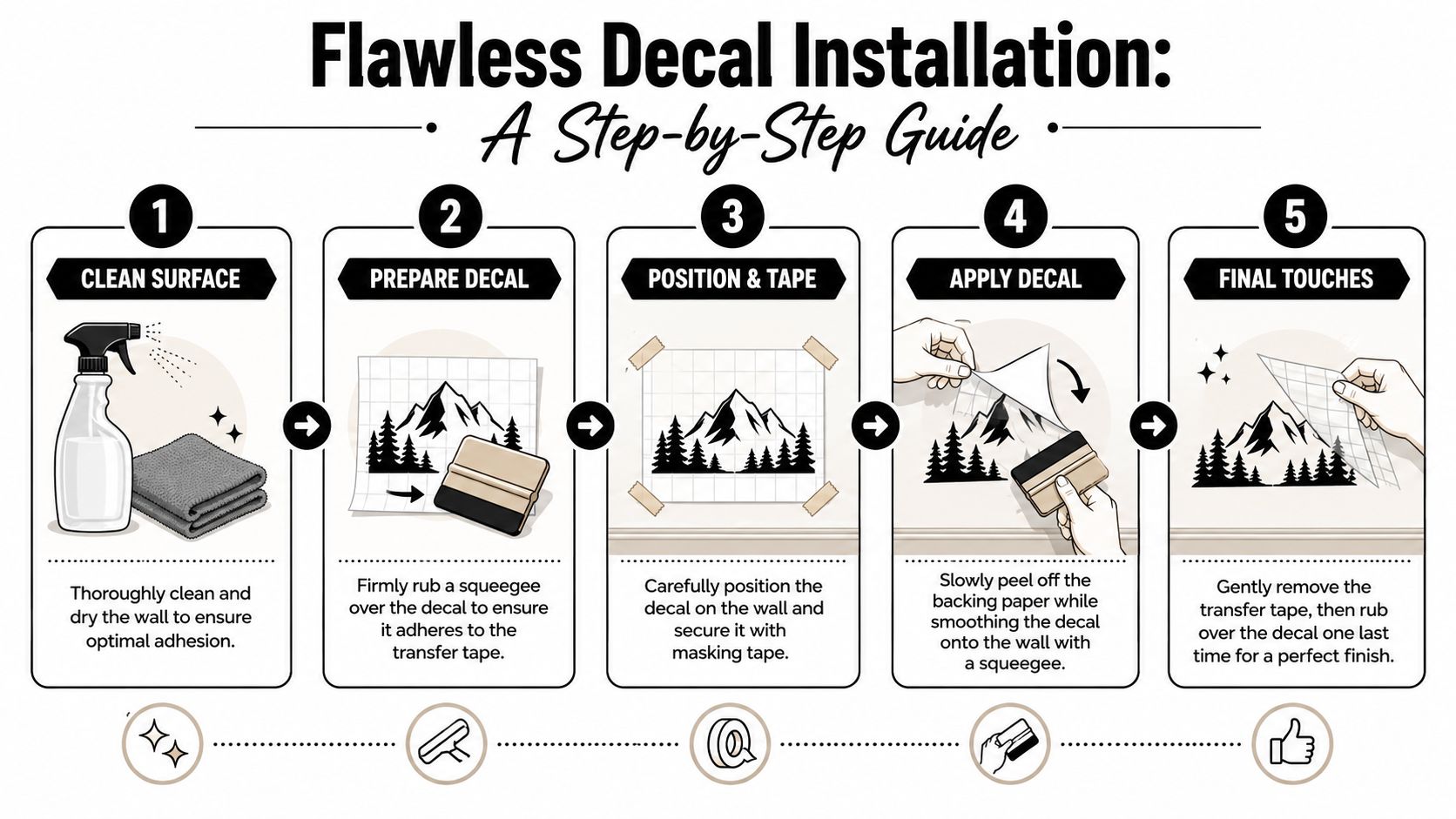
Prep the wall before you touch the decal
A clean wall beats a fancy tool kit. Dust, residue, and moisture are the enemy. Wipe the surface gently, let it dry fully, and don't apply over a wall that still feels chalky, damp, or freshly washed.
Fresh paint deserves special patience. Even if the wall feels dry to the hand, that doesn't always mean it's ready for adhesive. Paint needs time to cure, and rushing this step is one of the easiest ways to create a bad bond or removal headaches later.
Use the hinge method
The hinge method keeps large or detailed decals under control. It's simple and it saves a lot of frustration.
- Position the decal on the wall with the backing paper still on.
- Tape it in place across the top or down the center with painter's tape.
- Check alignment from several angles before committing.
- Peel back one section of the backing paper and cut it away if needed.
- Squeegee the decal down gradually instead of pressing everything at once.
- Remove the transfer tape slowly at a sharp angle.
That slow removal is important. If a letter starts lifting with the transfer tape, stop, press it back down, and give it another pass with the squeegee.
Here's a visual walkthrough if you like seeing the motion before trying it yourself:
What works on textured walls and what usually doesn't
Light texture can be manageable. The key is pressure and realistic expectations. Thick, simple letters usually do better than fine script with hairline details.
Heavy texture is where people get disappointed. The decal may stick in some spots and bridge over the low areas in others. That creates small air gaps, and those gaps become lifting edges.
If your wall texture is more than mild orange peel, keep these points in mind:
- Choose thicker lettering: It gives the adhesive more contact area.
- Avoid delicate flourishes: Fine tails and thin loops lift first.
- Warm the decal slightly during removal, not installation: Gentle warmth can help later when peeling, but overheating during install can make handling harder.
- Test a corner if possible: Especially on unusual finishes or older paint.
Textured walls don't always reject decals. They just punish overly delicate designs.
Long-term care and safe removal
Once the decal is up, leave it alone for a bit. Don't scrub it, pick at corners, or test whether it's “really stuck.” For regular care, a light dusting is usually enough.
When it's time to remove it, go slowly. Lift a corner, peel back at a low angle, and don't yank outward from the wall. If the room is cool or the vinyl feels stiff, a little gentle warmth can make removal calmer and cleaner.
The best removals come from decals applied to well-cured paint on compatible walls. That's why the wall-type decision at the buying stage matters so much. Removal success starts long before the first peel.
Your Questions Answered About Wall Decals
Are wall decals the same as stickers
Not really. People use the words interchangeably, but in practice a proper wall decal is usually made from cut vinyl and applied with transfer tape. A cheap sticker feels more like a label. On the wall, that difference shows up in the finish, the edge quality, and the way it removes.
Can I reuse a personalized name decal
Usually no. Most name decals are designed for one clean installation. Once you remove them, the adhesive and alignment are rarely good enough for a second full application. If reusability is your top priority, ask specifically about fabric-based removable products, but even then, wall condition still matters.
How long should I wait after painting
Wait until the paint is fully cured, not just dry to the touch. Different paints behave differently, and low-VOC or specialty finishes can be especially worth waiting on. If you rush this, you can end up with weak adhesion now or paint trouble later.
What should I do if my wall is textured or low-VOC
Treat that as a product-matching question, not a guess. Ask what material the decal uses, whether the seller has experience with painted drywall, and whether your level of texture is light or heavy. On textured walls, simpler and thicker designs usually have the best chance of success.
Why choose a specialist maker instead of a random marketplace listing
Because materials, spacing, transfer tape, and cut quality all matter. A good shop uses professional-grade vinyl, sends lettering that's ready to align, and gives removal and surface guidance that reflects real-world walls, not just ideal ones.
If you want a custom decal from a family-run American shop that understands fit, finish, and everyday usability, Custom Sticker Shop is worth a look. They make premium vinyl decals with professional Oracal material, ship custom orders with value-focused pricing, and bring the kind of practical experience that helps you avoid the usual wall-decals headaches before they start.