
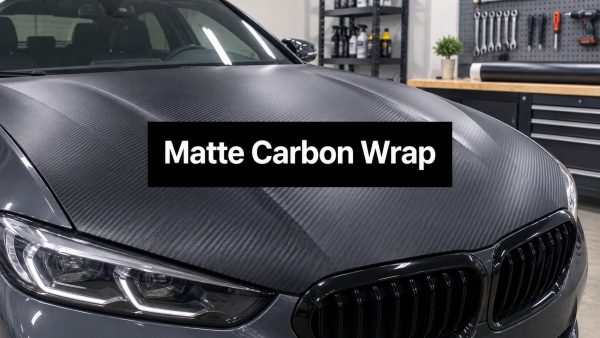
You're standing in the driveway, looking at a truck or coupe that still runs fine but feels plain, and the choice in front of you isn't simple. A fresh paint job sounds expensive, gloss wrap looks flashy, and matte carbon wrap has that moody, technical look that seems to fit almost anything. The tricky part is knowing whether you're buying a finish that'll age well, install cleanly, and still leave room for a few decals without turning the vehicle into visual noise.
Why Drivers Are Choosing Matte Carbon Wrap Right Now
A lot of people start with the same question. They want their vehicle to look sharper, but they don't want to commit to paint or choose a finish that screams for attention every time the sun hits it. That's where matte carbon wrap keeps showing up in real driveways, on work trucks, and in weekend builds, because it sits between flashy and practical.
The market backdrop helps explain why this isn't a fringe trend anymore. MarketsandMarkets estimated the broader carbon fiber wrap market at USD 1.62 billion in 2024 and projected it at USD 2.38 billion by 2029, a CAGR of 8.0% over 2024 to 2029, which means the category is expanding rather than fading away (MarketsandMarkets). That matters for buyers because matte is one of the finish segments inside that larger market, so the product aisle is being shaped by steady demand, not novelty.
Practical rule: if a finish category keeps growing, shops tend to stock better rolls, better tools, and better training around it.
There's also a behavior shift inside premium wrap demand. An Alibaba-cited installer-panel dataset reported mineral matte at 29% of premium wraps installed in Q1 2026, up from 12% in Q1 2024, and the same source noted a lower 3.2% rework rate for mineral matte versus 11.7% industry-wide for matte variants (Alibaba product insights). That doesn't mean every matte film is equal, but it does show buyers and installers are getting more comfortable with subdued finishes that still look premium.
For a first-time buyer, the key takeaway is simple. Matte carbon wrap is no longer just the “cool” choice, it's a sensible one if you want a finish that can carry a whole vehicle or act as a backdrop for smaller accents. If you're also thinking about adding a windshield banner or a theme decal, something like a Jeep graphic from this windshield banner option makes more sense on matte than on a busy, mirror-bright surface.
What Matte Carbon Wrap Actually Is
At its simplest, matte carbon wrap is a vinyl film made to look like carbon fiber, then finished with a low-sheen surface instead of a glossy one. It functions as high-end contact paper for vehicles, except it's built to bend, stretch, and settle over panels while giving you that woven race-inspired look. The word matte refers to the surface sheen, not a color underneath.
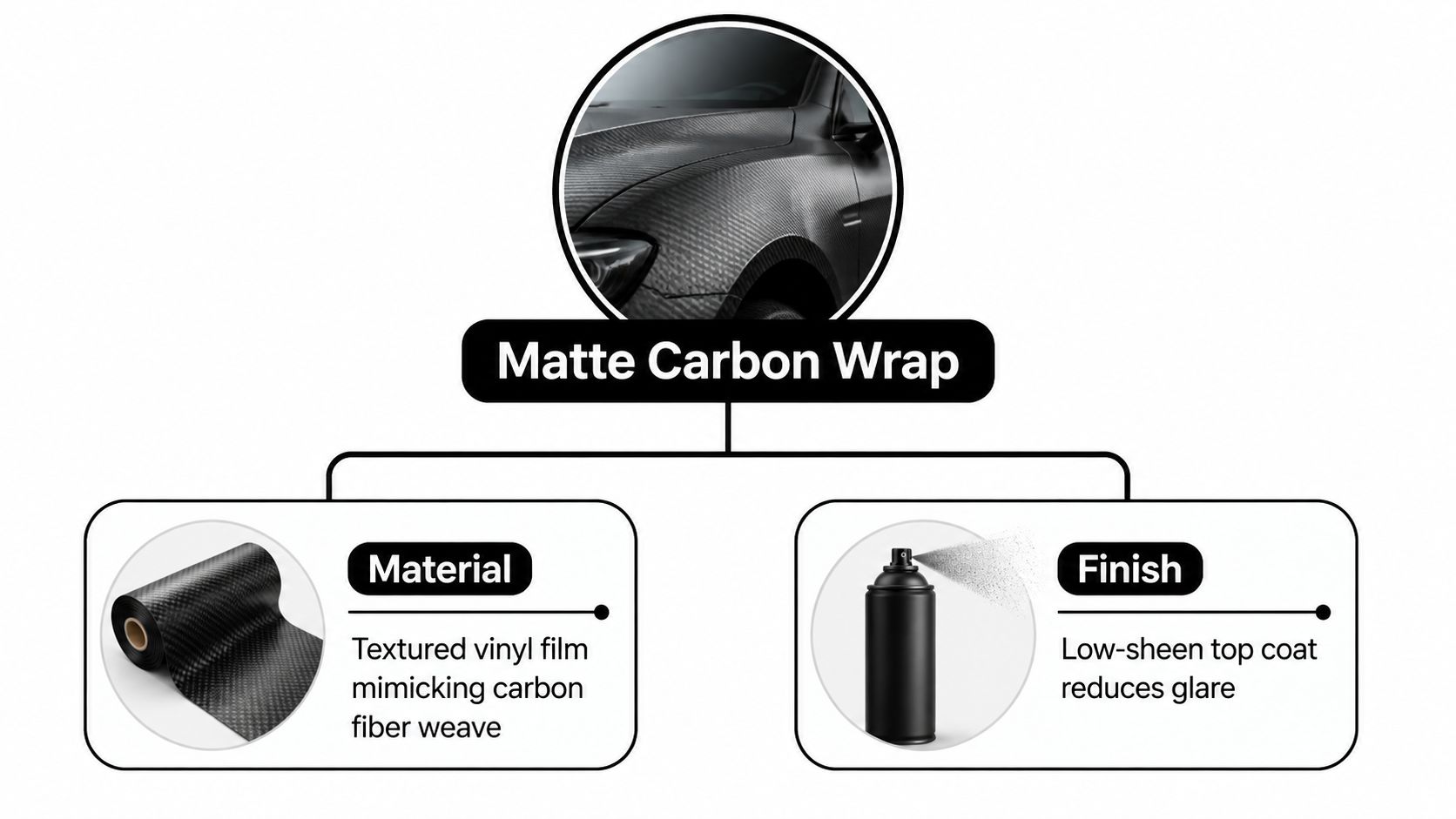
Most rolls are built in layers. You'll usually see a face film that carries the carbon look, an adhesive layer, and a release liner that protects the back before installation. Many products are also described as pressure-sensitive, repositionable acrylic films with air-release channels, which is installer language for “you can slide it around a little before it locks down, and trapped air has a path out” (Wrapford spec sheet).
That construction matters more than people expect. A textured carbon finish and a smooth carbon finish don't behave the same way on the vehicle, because texture changes how light scatters and how fingerprints show. The matte version softens reflections, so it reads more like a stealth performance part than a polished trim piece.
If you're comparing a wrap to paint protection or a coating, it helps to separate appearance from protection. A wrap changes the look, and it also gives the panel a sacrificial surface, but it isn't the same thing as a coating system. If you're trying to sort that out before buying anything, this paint-protection comparison resource is a useful sanity check because it keeps finish choices and protection choices in their own lanes.
One more thing beginners miss, the pattern is only half the purchase. The adhesive behavior, film pliability, and top-surface sheen determine whether the wrap looks clean on day one and still looks even after a few seasons. That's why spec sheets matter as much as photos.
Matte Carbon Wrap vs Gloss Carbon, Hydro-Dip, and Paint
Choose your finish by asking what you want from the vehicle, not which option sounds most impressive. A hood, roof, or accent panel does a different job than a full respray, and a first-time buyer usually feels that difference most once the project is already underway. Matte carbon wrap sits in the middle of the field, because it gives you a performance look, a reversible path, and a softer surface tone without locking you into paint.
Where each finish wins
Gloss carbon gives you a wet, high-reflection look. It catches sunlight fast, which is part of the appeal, but it also puts dust, fingerprints, and swirl marks on display. That makes it attractive for show vehicles and less forgiving for daily use.
Hydro-dip works better on smaller parts with tricky shapes. It can produce a sharp pattern on trim pieces and interior parts, yet it is harder to use as a large-panel solution. If the part gets damaged, refinishing is usually more involved because the component often has to come off first.
Paint is still the deepest customization route. It gives the most permanent result and the widest room for bodywork and color matching, but it is also the hardest to undo. For a first-timer, that permanence can be exciting on paper and intimidating in the garage.
Matte carbon wrap sits between those choices. It is reversible, usually easier to commit to than a full repaint, and better at hiding light dust than gloss carbon. The trade-off is simple, though. Once the matte surface gets marked or altered, you usually see that change instead of polishing it away the way you might with gloss paint.
| Finish | Typical Cost | Reversible | Best For |
|---|---|---|---|
| Matte Carbon Wrap | Mid-range | Yes | Daily drivers, trucks, and stealth builds |
| Gloss Carbon | Mid-range to higher | Yes | Showy accents and bright reflections |
| Hydro-Dip | Varies by part | Sometimes | Small parts with detailed patterns |
| Paint | Highest | No, not easily | Permanent, full-custom builds |
If you want the easiest visual reset later, wrap is the safer bet. If you want permanence, paint still wins.
That table only gives the headline. The decision comes down to how you plan to use the vehicle day to day. Pick matte carbon wrap if you want a subdued performance look, expect your taste to change later, or plan to use decals without overwhelming the finish. Pick gloss carbon if you want strong reflections and do not mind extra visual upkeep. Pick hydro-dip for smaller pieces with unusual geometry. Pick paint if you are committed for the long haul and willing to pay for that permanence.
One beginner mistake is treating every finish like it exists on the same playing field. It does not. Wrap gives you a controlled visual layer, which is why it pairs well with accent graphics, logos, and small vinyl pieces from Custom Sticker Shop when you want the vehicle to look customized without burying the carbon texture. Paint can do that too, but it usually asks for a bigger commitment and a bigger budget, while hydro-dip is better thought of as a parts-finish solution rather than a full-body style system.
The simplest way to judge the right choice is to picture how you want the car to read from ten feet away and up close. Matte carbon keeps the look restrained, gloss carbon pushes brightness, hydro-dip pushes pattern, and paint gives the most total freedom. If you are building something that needs to stay sharp but not loud, matte carbon wrap usually makes the cleanest compromise.
How to Judge Quality Before You Buy
A glossy product photo can hide weak points that only show up when the film hits a hood, a fender, or a sharp body line. The spec sheet is where you separate a clean-looking roll from one that will behave during install. It tells you whether the wrap is likely to lay flat, keep its shape, and stay visually even after heat and trimming.
Read the construction, not just the finish name
Start with the film build. A matte carbon wrap that sits in the 3.7 to 4.1 mil range for the film body, plus about 1.6 mil of adhesive, gives you a useful picture of how the material may handle on larger panels. Some matte carbon products are also listed at roughly 0.13 to 0.20 mm total thickness in published specs, which helps explain why one roll may feel more forgiving than another during install. Teckwrap spec data
That thickness matters because vinyl behaves a little like fabric under tension. A heavier-feeling film can be easier to control on broad surfaces, but it usually asks for more care around corners, deep recesses, and trimmed edges where the material has to settle without fighting back.
Shrinkage is the next clue to read. Product data that places acceptable shrinkage at less than 4% gives buyers a practical benchmark, since lower shrinkage points to less pullback at the edges after stretching and heat-setting. If two rolls both claim a premium look, this is one of the first details that can explain why one seems more stable than the other after installation.
Compare the adhesive behavior before you compare the color
A matte carbon film is easier to place when the adhesive gives you some repositioning time. One published sheet for a matte carbon wrap reports a release force of 0.12 N/25 mm, initial tack of 1360 g/25 mm, peel strength of 7.05 N/25 mm, and holding power of 72.09 hours under controlled conditions (Wrapford spec sheet). That kind of information does not turn a buyer into an installer, but it does show whether the film is built to be adjusted first and locked down later.
A simple comparison helps here. If you are choosing between a roll with published repositionable adhesive data like the Wrapford sheet above and another matte carbon product whose spec sheet focuses more on thickness and shrinkage, the first gives you more insight into how the film may feel during placement. The second tells you more about how the finished panel may behave after it is stretched and trimmed. Good buyers look at both sides of the story.
Read the warranty like a shop owner would
Warranty language sounds boring until something lifts at an edge. Product sheets commonly put outdoor durability in the 2 to 5 years range, depending on maintenance and exposure, but that promise only helps if you know what the warranty covers. Some warranties exclude installation damage, lifting caused by poor prep, or changes caused by the wrong cleaners, so the fine print matters as much as the headline.
A practical way to judge any exterior film is to pair the spec sheet with care guidance from Nanak Car Wash detailing advice. That gives you a better sense of how cleaning habits affect the finish long before a warranty claim would ever enter the picture. If a seller cannot explain thickness, shrinkage, adhesive style, and durability in plain language, keep looking.
Buyer filter: if the seller won't tell you thickness, shrinkage, adhesive style, and outdoor durability in plain language, keep shopping.
One beginner mistake is buying the prettiest swatch and treating every matte carbon roll as if it will install the same way. It won't. A strong spec sheet helps you judge whether the film is built for broad panels, tight edges, and normal maintenance, while a weak one leaves you guessing until the car is already in the bay.
Installation Overview and Troubleshooting Tips
A matte carbon wrap job can look calm and finished, or it can broadcast every rushed decision under shop lights. The difference usually comes down to prep, patience, and how well the installer handles the film once it starts to stretch. A first-time DIYer can manage smaller pieces, but bigger panels leave less room for guesswork.
The basic workflow
Start with a thorough wash and decontamination, because any dirt left behind turns into a bump under the film. Measure the panel, cut with a little overlap, and set the piece in place before the adhesive grabs. Warm the film lightly instead of forcing it, then use a squeegee from the center outward so air has a path to escape.
After that, the finishing steps matter just as much. Edges and recesses need post-heating so the vinyl stays where it was placed, and trimming should happen last after the film has had time to settle. Matte carbon is different from a decorative sticker because the surface has to read evenly across changing reflections, not just stick to the panel.
Common mistakes and how they show up
Here's a quick reference you can use while working:
| Mistake | Symptom | Fix |
|---|---|---|
| Over-stretching the film | The pattern looks distorted, and the edge may try to pull back later | Ease up on tension, relax the panel, and stop forcing the wrap around the curve |
| Skipping post-heat | Corners lift, especially on mirror caps, hood corners, and deep body lines | Reheat the stretched areas and make sure the film is locked down |
| Working in a cold garage | The film feels stiff, the adhesive behaves unevenly, and repositioning gets messy | Warm the space or the panel before you continue |
| Re-laying the same section too many times | Bubbles, silvering, or a hazy spot starts showing up | Leave the adhesive alone once it starts to settle, and reset the piece if needed |
| Trimming too tight | Corners want to lift soon after install | Leave a safer margin, then check the edge after post-heating |
A few fixes help once trouble appears. If a bubble is trapped, move it toward a nearby edge before the film fully seats. If a corner wants to lift, check the prep work, confirm that the area was post-heated, and look at whether the trim line was cut too close. If the panel looks cloudy from repeated repositioning, stop chasing the same spot and reset the section instead of working it over for another hour.
You do not win with matte wrap by pulling harder. You get better results by moving slower and leaving the adhesive alone once it starts to settle.
For a first attempt, interior trim pieces, mirror caps, and simple flat panels are fair game. A full hood, roof, or complex truck bedside is where many DIY projects turn into all-weekend frustrations. If you want a smaller starting point, a product page like this Ford F-150 windshield banner option is a better test of your patience than jumping straight to a full wrap.
Pairing Matte Carbon Wrap With Vinyl Decals and Graphics
A matte carbon finish is one of the best backdrops for accent graphics because it doesn't fight for attention. The low sheen lets a decal stand out cleanly, especially if the graphic has a gloss finish or a strong silhouette. On a glossy vehicle, the decal and the paint can compete with each other. On matte carbon, the decal usually gets the stage it needs.

Placement that complements, not overwhelms
The safest rule is to treat the wrap as the main surface and the decal as punctuation. Small graphics work well over the carbon texture when they're meant to be noticed up close, while larger badges often look cleaner on flatter, more solid panel areas. Contrast matters more than size alone, because a bold design in the wrong place can make the vehicle look busy instead of finished.
That's why theme-specific graphics often work best in moderation. Military tributes, JDM-style marks, and hunting or fishing graphics can all fit matte carbon if you keep the placement disciplined. A single badge on a hood corner, a windshield banner, or a bedside accent can be enough to give the build a point of view without covering the finish you paid for.
Why the decals install cleanly
Most pre-spaced decals use transfer tape and a dry-apply method, which helps them sit neatly on wrap surfaces when the panel is clean and fully cured. That's important because you don't want moisture trapped under the decal or aggressive rubbing that could disturb the matte finish. Light pressure and a clean squeegee pass usually do the job.
If you're comparing themes, a truck build with a matte carbon hood and a muddy tire tread accent can be a strong combination because it reads as intentional, not crowded. A good example is the truck muddy tire tread bedside graphic set, which makes sense when you want one obvious graphic instead of a whole collage.
A clean real-world layout is easy to picture. Matte carbon hood, one badge-style decal in the corner, and maybe a windshield banner if the rest of the vehicle stays quiet. That combination works because the wrap carries the character, and the graphic just finishes the sentence.
Maintenance, Longevity, and When to Reconsider
Matte carbon wrap stays sharp only if you treat the surface like a finish, not like bare paint. The maintenance rules are simple, but skipping any one of them can change how the surface reflects light. Once a matte finish turns shiny in a spot, that change is usually there for good.
What to do, and why it matters
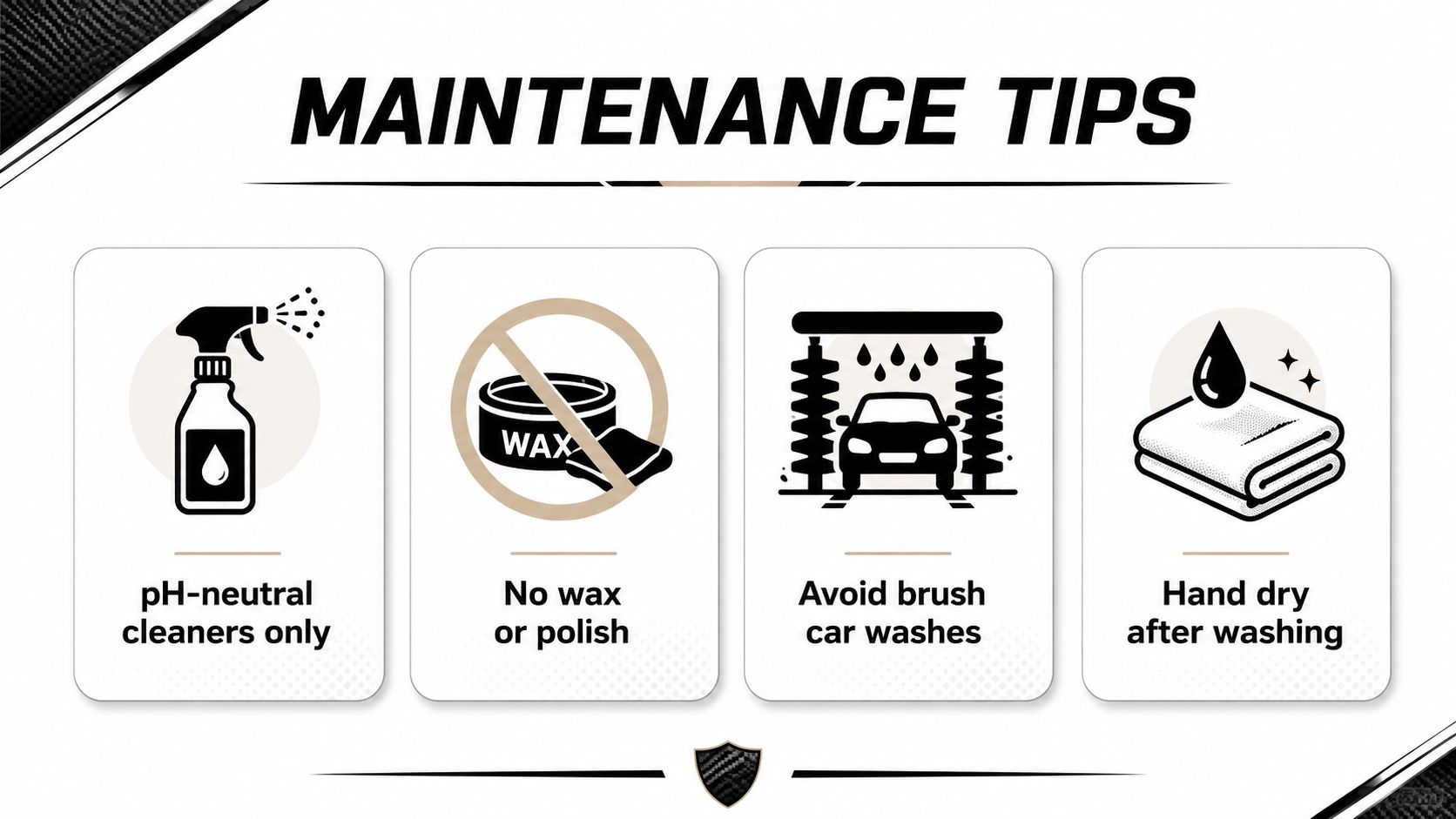
Use pH-neutral cleaners only, because harsh chemistry can be rough on the surface over time. Skip wax and polish completely, since gloss enhancers can permanently change the texture and leave shiny spots. Avoid brush car washes, because brushes can catch edges you don't even notice until they've started lifting.
Hand drying is worth the extra few minutes. It reduces water spotting, keeps streaks from drying into the finish, and gives you a chance to inspect high-stress areas like door handles, mirror caps, and the hood's leading edge. Those are the spots that usually tell you first whether the wrap is still healthy.
When the wrap is getting tired
Neutral product guidance suggests matte finishes are more vulnerable to visible shine changes, and maintenance advice consistently recommends gentle cleaning rather than aggressive correction (Wraps Motorsports guidance). If you start seeing yellowing at the edges, surface shine spots, or adhesive bleed, the film is telling you it's nearing the end of its useful life. At that point, trying to “save” it with stronger cleaners usually makes the problem worse.
Climate and storage matter too. A garage-kept vehicle in mild conditions will generally be easier to keep looking even than one that sits in hot sun all day, especially on horizontal panels. That's why the same wrap can age gracefully on one truck and get tired fast on another.
A solid routine fits on a fridge note:
- Wash gently: use pH-neutral products and soft towels.
- Never wax the matte surface: gloss spots are hard to undo.
- Skip brush washes: edge lift is easier to create than to repair.
- Inspect often: check corners, seams, and high-wear areas every few months.
If the film is losing its even look across multiple panels, re-wrapping beats chasing spot fixes. A tired install can make the whole vehicle look neglected, while a fresh replacement resets the finish before damage spreads.
If you're ready to turn a plain truck or car into something cleaner and more personal, browse Custom Sticker Shop for vehicle graphics that fit matte carbon wrap without overwhelming it. Their decals are a smart way to add a badge, banner, or theme accent after you've chosen the right wrap, especially if you want the finish to stay the star of the build.