
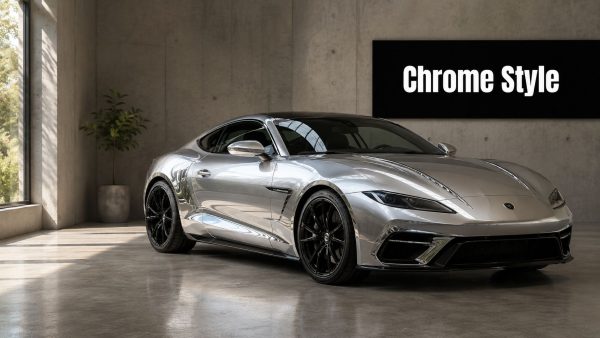
You're standing in the driveway with a clean car, one finger scrolling through chrome decals, and the question is simple, does this look sharp on my vehicle or is it going to look cheap by next month? That's the right question to ask before buying chrome stickers for cars, because the finish can either add a clean highlight or turn into a reflective mess that fights the shape of the bodywork.
Chrome styling still has real pull in automotive customization. The broader market for automotive chromium finishing was valued at USD 4.23 billion in 2025 and is projected to reach USD 5.28 billion by 2030, while decorative chrome held 67.13% of market share in 2024 and is forecast to grow at 4.95% CAGR through 2030, which tells you chrome is still a major visual language in vehicle design, not a passing gimmick. At the aftermarket level, chrome accessories and chrome-delete vinyl both keep showing sustained demand, with one market study estimating the chrome accessories market at USD 3.968 billion in 2024 and another projecting chrome-delete vinyl growth to USD 0.67 billion by 2034 from USD 0.4 billion in 2025 (automotive chromium finishing market, automotive chrome accessories market).
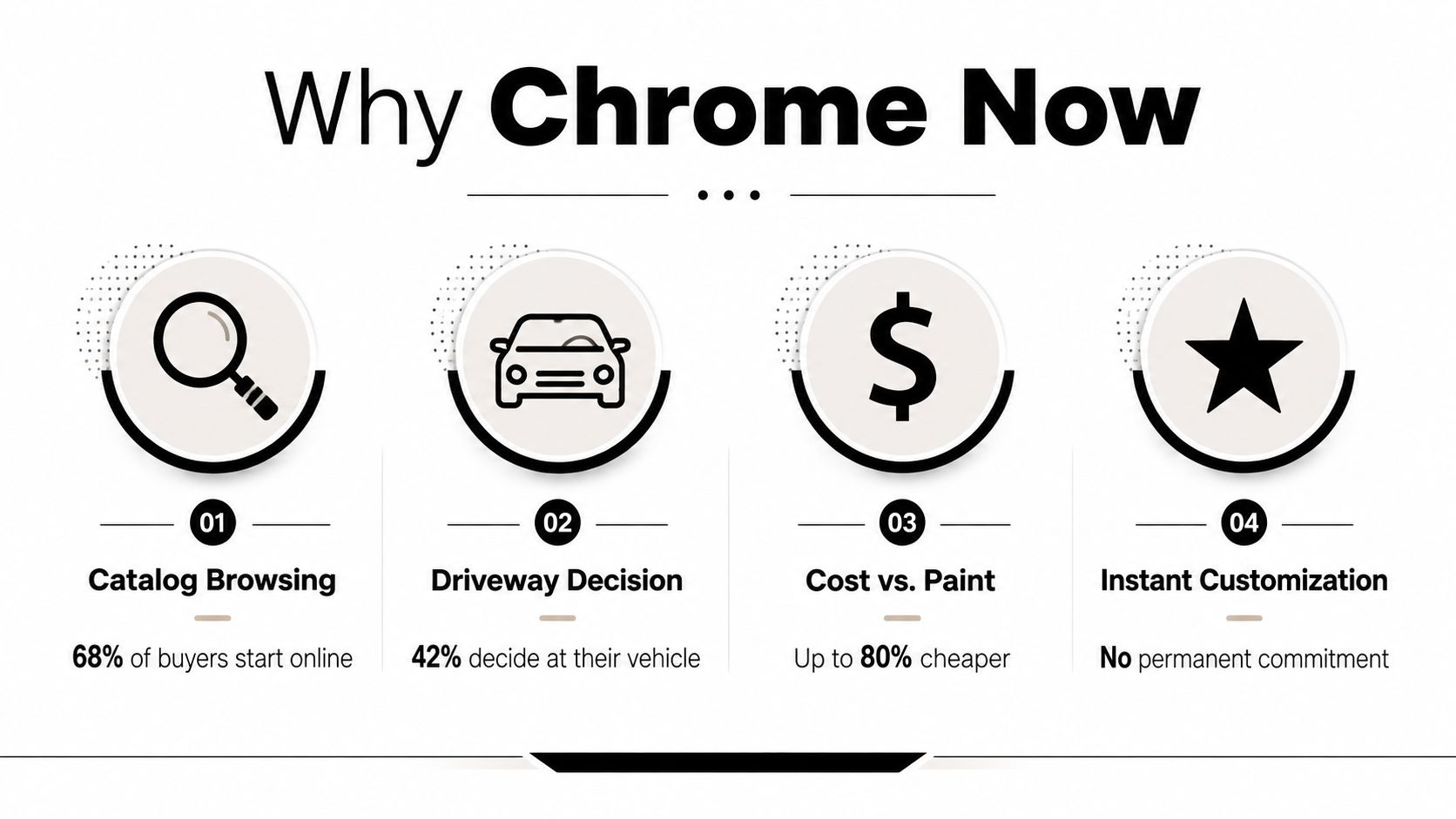
Why Drivers Are Choosing Chrome Stickers Right Now
A lot of buyers don't start with a grand plan. They're parked outside the house or sitting in the dealership lot, noticing that their truck, Jeep, or sedan needs something that breaks up all that blank paint. Chrome stickers solve that problem fast, because they add contrast, shine, and a custom look without the commitment of a full wrap or the expense of plating.
That's why the product appeals to so many different owners. Daily drivers want a little visual lift, Jeep owners want something that stands out against black trim and trail gear, military families want a tribute piece that looks deliberate, and show-truck builders want reflective accents that catch the light. Chrome works when the goal is to make a vehicle look more finished, not more complicated.
Practical rule: if the vehicle already has strong body lines, chrome should emphasize those lines, not fight them.
The market data supports that chrome still belongs in mainstream styling. Premium exterior aesthetics and OEM requirements around chromium-related finishes keep chrome tied to current automotive design rather than a fringe aftermarket cue (market report). That matters because buyers usually want something that feels current, even when they're choosing a custom decal.
Chrome stickers also make sense for people who want a reversible change. You can test a look on a rear window, tailgate, or fuel door before committing to a larger set. If you like it, you can expand the design later. If you don't, you can remove it and move on.
What Exactly Are Chrome Stickers for Cars
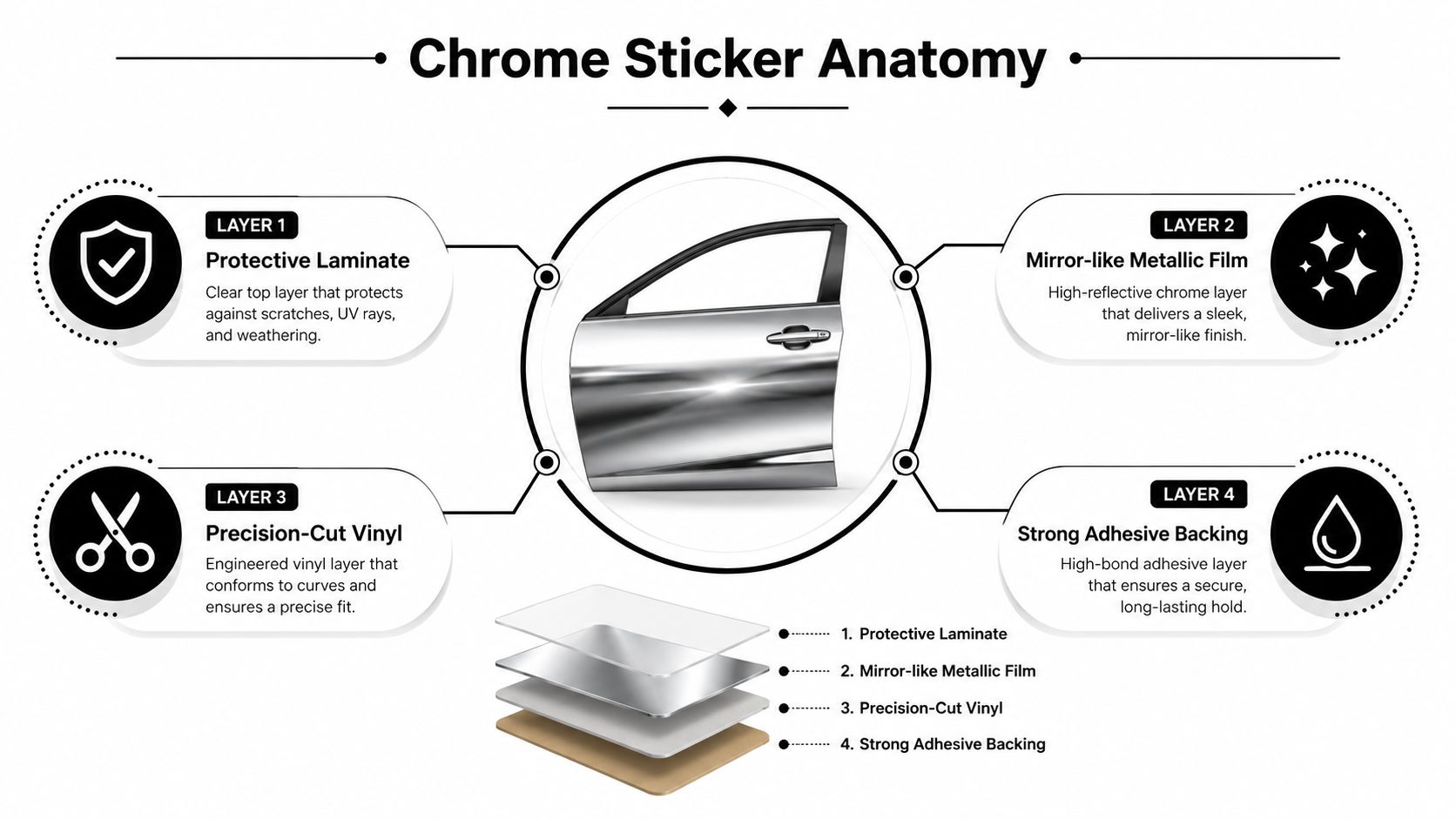
A real chrome sticker isn't just a silver-colored sticker. It's a vinyl decal finished with a mirror-like metallic surface, built to reflect light in a way that plain gloss or metallic gray can't copy. That reflective face is what gives chrome its sharp, dimensional look on paint, glass, and trim.
How the construction works
Premium chrome films are layered products. Avery Dennison's Conform Chrome Series, for example, uses a 142 micron chrome facefilm with a 30 micron acrylic adhesive layer, and it's built for vehicle graphics rather than paper-label use (Avery Dennison data sheet). That layered construction is why chrome can look smooth and polished, but also why it reacts badly when over-stretched or rushed onto a curved panel.
Chrome also isn't the same as brushed metal, satin chrome, holographic vinyl, or standard gloss vinyl. Brushed metal has directional texture. Satin chrome softens the reflection. Holographic film throws color shifts and rainbow effects. Gloss vinyl reflects, but it doesn't deliver the same metallic depth. If the goal is a true mirror-style accent, the chrome finish is the one that reads as chrome at a glance.
The adhesive layer and liner matter just as much as the finish. A good chrome sticker needs enough tack to stay put on a vehicle surface, but it also needs to be workable during placement. That balance is what separates a clean install from a piece that grabs too fast and traps air.
When shoppers compare products, the easiest test is simple. If the listing doesn't clearly describe the material stack, the adhesive, and the intended surface, it's probably a generic chrome-look product rather than a serious automotive decal.
Materials and Durability You Can Actually Trust
Chrome is less forgiving than ordinary vinyl, so material quality matters more than it does on a simple matte text decal. A thicker chrome facefilm can look more premium and hold its shape better, but it also demands better handling because it doesn't stretch and recover the way softer films do. That's why a chrome decal that looks great on a flat door panel can become a headache on a tight curve if the installer tries to force it.
Avery Dennison's Conform Chrome Series gives a useful benchmark. It reports 0.15 mm max dimensional stability, 90 gloss units at 20°, initial adhesion of 350 N/m, ultimate adhesion of 440 N/m on stainless steel, a service range of -40°C to 80°C, and a minimum application temperature of +10°C (Avery Dennison data sheet). In shop terms, that means the film is made to bond hard and last, but you still need disciplined panel prep and light hand pressure.
Material specs at a glance
| Spec | Typical Range | Why It Matters |
|---|---|---|
| Chrome facefilm thickness | Around 142 micron in premium chrome graphics | Thicker films hold their appearance better but need careful application |
| Adhesive type | Acrylic or solvent acrylic | Strong, long-term bonding on vehicle surfaces |
| Dimensional stability | Tight tolerance, such as 0.15 mm max | Better stability means less distortion on panels |
| Service temperature | Wide temperature range, such as -40°C to 80°C | Helps the decal handle heat and cold swings |
| Application temperature | Often above +10°C | Cold installs make chrome harder to seat cleanly |
| Gloss level | High reflective finish, such as 90 gloss units | Higher gloss gives a stronger mirror effect |
Durability also depends on where the sticker lives. RI-Mark's chrome accent wrap uses a 2.8 mil cast vinyl construction and is rated for 2 years outdoor life in vertical exposure in a temperate climate, but the maker warns that less-than-vertical exposure, hot climates, or proximity to heat sources such as engines will reduce durability (RI-Mark product sheet). That warning is the whole game. A chrome decal on a rear quarter panel has a much easier life than one on a hood, wheel face, or engine-adjacent area.
Chrome doesn't fail just because it's chrome. It fails when the panel gets too hot, too curved, or too aggressively washed.
If you want a decal that survives real use, choose cast vinyl, confirm the outdoor rating, and respect the surface it's going on. Chrome can last, but it needs the right job.
Popular Chrome Sticker Themes and Where They Fit Best
Chrome decals work best when the theme matches the vehicle's personality. A clean emblem on a Jeep says something different from a chrome family name decal on a rear window, and both can look right if they're placed with intent. The trick is to let the vehicle do most of the talking and use chrome as the accent.
Military-themed chrome insignia fit well on trucks, SUVs, and family vehicles tied to service. They usually look strongest on rear glass, tailgates, or a smooth interior dash plaque, where the reflective finish adds honor without crowding the body lines. For a veteran-owned truck, a chrome tribute on the rear window often lands better than a large side-panel graphic.
Jeep owners tend to use chrome more sparingly. A grille badge, trail emblem, or hood accent can add just enough shine against black trim and factory plastics. On off-road builds, less is usually more, because chrome reads as a highlight, not the main event.
Matching theme to vehicle
- Military tributes: Best on rear glass, tailgate, or interior plaque, where the message stays visible but restrained.
- Jeep and off-road graphics: Best on grille details, hood accents, or door-corner emblems for a balanced look.
- JDM and tuner styling: Best on quarter windows, rear glass, or trunk badges, especially when the rest of the build stays clean.
- Custom names and family decals: Best on side windows, rear glass, or fuel doors, where the text stays readable and personal.
You'll see lots of options in one place on the custom car decal design page, and that's useful because chrome is one of those finishes where the category matters as much as the artwork. A chrome wordmark on a sedan can look premium. The same treatment on a heavily textured bumper can look like an afterthought.
For shop owners and fleet builders, placement matters even more. A rear-window chrome logo reads clearly at distance. A small chrome emblem on a curved mirror housing may look great in photos but can be hard to apply cleanly and harder to keep clean over time.
The general rule is simple. Put chrome where the panel is smooth, the shape is readable, and the reflection helps the design instead of obscuring it.
How to Install Chrome Stickers Like a Pro
Chrome install work starts before the backing paper comes off. Wash the area, dry it completely, and remove wax, road film, and polishing residue. If the panel has stubborn buildup, a clay bar can help, and an alcohol wipe right before application gives the adhesive a clean shot at bonding.
Temperature matters too. Chrome stickers behave better on a surface that's not scorching hot or cold-soaked. RI-Mark's guidance for chrome accent wrap, plus Avery Dennison's minimum application temperature of +10°C, both point in the same direction, keep the install controlled and don't rush it in bad weather (RI-Mark product sheet, Avery Dennison data sheet).
Clean placement beats fast placement
Use tape to mark position before the decal touches the car. On larger chrome graphics, that small step saves time because the reflective surface makes errors obvious. A center hinge, light squeegee pressure, and patient edge work are the difference between a crisp decal and one with trapped air.
The neutral installation notes from Folia Tec reinforce that method matters. They tell users to confirm surface fit, mark position with tape, and moisten the vehicle surface with a detergent-water mix before applying the sticker (Folia Tec installation guide). That's the kind of practical detail most storefront listings skip, and it's exactly where buyers get into trouble.
When you're choosing between a single-piece chrome decal and a pre-spaced kit, the decision usually comes down to complexity. A single piece works well for a badge or short wordmark. A pre-spaced transfer-taped kit is easier for longer text, windshields, or anything that needs alignment across several elements.
If you want a reference point for layout and fit on a body panel, a fender-style graphic like the Mustang hash decal layout shows how small, repeated shapes can stay clean when the spacing is deliberate.
Shop-floor rule: chrome should be pressed, not scrubbed, and edges should be sealed before the adhesive starts fighting back.
A polished install isn't about speed. It's about leaving the film enough room to sit flat, bond cleanly, and keep its mirror look.
Safe Removal and Long-Term Care
Every chrome decal eventually reaches the point where it needs to come off or get swapped. The cleanest method is heat-and-peel, because gentle warmth softens the adhesive and lets the film release without tearing into tiny bits. A heat gun on low, or even patient warmth from a dryer, is usually enough for a manageable piece, and a plastic squeegee helps lift edges without gouging paint.
For stubborn sections, fishing line can help cut through the adhesive under the film. Work slowly, keep the line moving, and don't yank at the decal just because one corner lets go. Once the film is off, use an adhesive cleaner that's safe for paint, then finish with a mild wash so the panel doesn't keep attracting dust.
Care matters just as much as removal. RI-Mark's chrome accent wrap guidance makes the key point plain, vertical exposure is the safest orientation, while heat and aggressive exposure shorten life (RI-Mark product sheet). If the decal is on a hood, near an engine, or on another hot surface, it's going to age faster than one on a door or rear quarter.
A chrome sticker also likes a calmer wash routine. Hand washing is the safest path, and pressure washers can lift edges if the stream is too close or aimed straight at a corner. Wax around the decal, not over it, so you don't load the chrome surface with residue it wasn't meant to hold.
When edges begin to lift in the later years, don't ignore them. Trim, heat, and reseal the edge before dirt gets under the film and makes the problem bigger. That one small repair can add real life to a decal that still looks sharp.
Smart Buying Decisions for Chrome Car Stickers
Price is the first filter, but it shouldn't be the only one. Entry-level chrome decals can start around $7.99 through Custom Sticker Shop's published pricing, while more complex custom work costs more because the material, cutting time, and alignment work all increase (Custom Sticker Shop). If a listing is cheap but vague about the film, the adhesive, or the intended surface, that's usually a warning sign.
Look for named materials, clear application guidance, and an outdoor life rating. If a seller can't tell you whether the chrome is cast or calendered, whether it's transfer-taped, or how it handles heat, you're buying blind. That's how people end up with stickers that look fine in the product photo and fail on a real vehicle panel.
Shipping and service matter too. A shop that offers fast fulfillment, clear support, and straightforward ordering is usually easier to work with when you're buying multiple decals or matching a build theme. For buyers who want a custom layout, the custom design page is the kind of starting point that makes sense because it keeps the request tied to the actual vehicle, not just a random catalog image.
If you're comparing options, one more resource worth bookmarking is SwiftJet's hazy chrome fix techniques, especially if you're deciding whether a dull finish can be restored or if the decal needs to be replaced instead. That distinction saves money and keeps you from chasing problems with the wrong product.
The best purchase is the one that tells you exactly what you're getting. Clear specs, honest durability language, and responsive support beat flashy promises every time.
Your Next Move with Chrome Stickers for Cars
Chrome still works when it's chosen with restraint. Pick a true chrome vinyl, place it where the panel can support the reflection, and buy from a shop that gives you real material details instead of vague shine language. Start with one decal, live with it through a few washes and a stretch of weather, then decide whether to build out the rest of the look.
That's the practical path to a finish that feels personal instead of trendy. Chrome can look modern, durable, and sharp in 2026 when the film, the surface, and the install all line up.
Custom Sticker Shop makes custom vinyl decals and automotive graphics for cars, trucks, and Jeeps, which makes it a practical place to source chrome-style personalization when you want a shape, theme, or layout matched to your vehicle. If you're ready to test a chrome accent on your own car, visit Custom Sticker Shop and choose a decal that fits the panel, the finish, and the way you drive.