

Most advice about reusable vinyl decals starts with the wrong promise. It treats “reusable” like a universal property, as if one decal can jump from wall to glass to vehicle paint and keep working the same way. In real installation work, that's not how it behaves, especially once you add heat, rain, road film, and repeated handling.
A decal that peels cleanly from a storefront window can still fail fast on a hood, door skin, or windshield edge. The difference isn't marketing, it's surface energy, adhesive design, and contamination, and those three things decide whether a decal comes off for the third time or gives up after the first wet week. If you're shopping for vehicle graphics, the question isn't whether a product is reusable, it's where it can be reused without turning into a frustrating partial-bond mess.
The market helps explain why the category keeps growing. The global vinyl graphics market reached $9.1 billion in 2022, North America held 38% of that market, and Asia Pacific is growing fastest at a 6.3% CAGR from 2023 to 2030 according to the cited dataset (vinyl graphics industry statistics). That same source says 42% of commercial sign companies name vinyl graphics as their primary product, and advertising accounts for 28% of commercial vinyl graphics use. So this isn't a niche craft topic, it's a serious graphics category with real commercial pressure behind it.
The Truth About Reusable Vinyl Decals
“Reusable” sounds simple until you put the decal on a real surface. In practice, it describes a range of adhesive behaviors, not a guarantee that the same graphic will behave well everywhere, every time. A removable wall graphic can be a perfect fit for a smooth interior wall or glass panel, while the same concept can become unreliable on an exterior vehicle panel that sees dirt, thermal cycling, and moisture.
Reusable does not mean universal
The most common mistake is assuming the adhesive can be peeled, parked somewhere, and then pressed onto any new target. Most guidance that uses the word reusable is talking about smooth, non-porous, indoor surfaces, not car paint under sun and road grime. That distinction matters because a vehicle is a much harsher environment than a wall, and even a carefully made low-tack film has limits.
Practical rule: if the surface gets washed, heated, scuffed, or exposed to rain, treat “reusable” as a short-term convenience, not a long-term promise.
That's why the question behind reusable vinyl decals should be more specific. Ask whether the decal is reusable on glass, on painted walls, or on vehicles, because those are different jobs. The answer changes with the substrate, and it changes again with weather exposure and how often the graphic is removed.
A basic check helps separate hype from reality. Custom decal buyers who want vehicle graphics can start with a product page such as car decals for custom sticker projects and compare the stated use case against the actual surface they plan to cover. If the page talks about vehicles, windows, or paint-safe use, that's a better fit than a generic wall-only description.
Why vehicle use is the hard test
Automotive surfaces punish weak adhesives. Heat softens some films, cold stiffens them, and dirt sitting at the edges makes a clean reapplication harder every time. That's why a decal that feels fine on day one can start lifting at the corners after a week outdoors.
Vehicle owners often want the same convenience they get from wall decals, but that expectation usually conflicts with the demands of the road. The reusable label can still be useful, it just needs a narrow, honest definition. On cars and trucks, repositionable is usually safer language than fully reusable anywhere.
How Reusable Vinyl Decals Are Engineered
Reusable performance starts with the adhesive, not the print. A true reusable vinyl often uses an ultra-removable acrylic system with only 5 ± 2 oz/in adhesion, plus a 90# layflat release liner that helps protect the adhesive and lets the film go back onto the liner for storage (technical datasheet). That low tack is the whole point. The decal has to release without tearing, stretching, or leaving a heavy grab behind.
What the numbers mean
A low adhesion rating like 5 ± 2 oz/in is not a quality problem by itself. It means the adhesive was built for repositionability, not permanent bonding. The same datasheet also pairs that construction with 4, 6, or 8 mil film options, a 40°F (4.4°C) minimum application temperature, and 1 year outdoor durability, which shows the trade-off clearly. Reusability usually comes from giving up long-term weather resistance.
That trade-off shows up in other film specs too. A 6.0 mil polymeric vinyl with removable acrylic adhesive reports tensile strength above 3300 psi, elongation above 100%, and very low dimensional change, with peel strength on stainless steel staying in the low range after both 15 minutes and 24 hours (General Formulations GF-223). In plain terms, the film can stretch and conform without fighting the installer, but it still does not cling hard enough to behave like permanent wrap film.
The balance installers look for
The best reusable films do two things at once. They conform enough to lay flat, and they release enough to be repositioned before the adhesive picks up dirt or dust. That balance matters more than the wording on the front of the package.
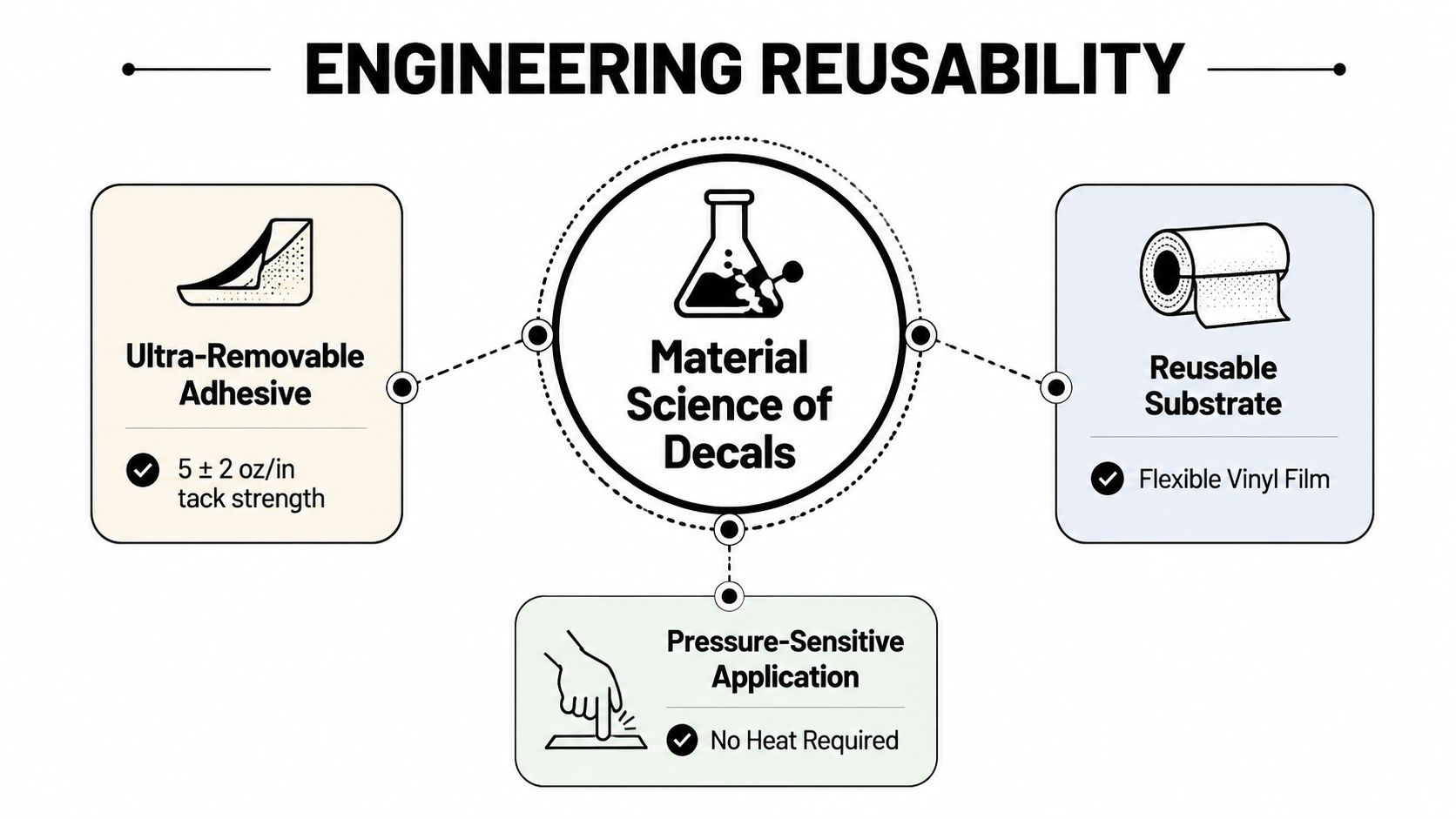
If you read datasheets regularly, look for the whole picture, not just the word removable. Film thickness, minimum application temperature, and outdoor life tell you more than a glossy product name ever will. For installers, those details separate a decal that can move from one clean panel to another from one that turns into waste after the first peel.
If the seller will not show adhesive strength, substrate notes, or outdoor durability, the word reusable is mostly branding.
Reusable Vinyl vs Permanent Vinyl
The choice is between movement and staying power. Permanent vinyl usually wins on long-term hold, while reusable vinyl gives you more room to reposition and remove it cleanly. On vehicles, that trade-off is sharper than it looks on a sample sheet. Heat, rain, road film, and frequent washing punish low-tack adhesive much faster than the same material on an indoor wall.
Side by side
| Attribute | Reusable Vinyl | Permanent Vinyl |
|---|---|---|
| Adhesive strength | Low tack, made for repositioning | Stronger bond, made to stay put |
| Outdoor durability | Shorter service life, especially on exposed vehicle surfaces | Designed for longer outdoor exposure and better retention |
| Surface fit | Best on smooth, clean, non-porous surfaces | Better on long-term branded surfaces like paint, metal, and glass |
| Removal | Easier, usually cleaner if kept uncontaminated | More effort, but more dependable retention |
| Cost over time | Can work well for temporary graphics, but repeated replacement adds up | Often better value when the same decal must survive weather |
Permanent vinyl gets the nod for outdoor vehicle branding because it holds up better under abuse and spreads cost across a longer useful life. Reusable vinyl still makes sense for short campaigns, rentals, and surfaces that get updated often. The problem is that marketing language often treats “reusable” as if it means the same thing everywhere, and that is where vehicle work separates from indoor use. A low-tack decal that can be lifted from a clean glass panel may still fail early on a truck door once heat cycles, dirt, and moisture get involved.
For a truck door, hood graphic, or any exterior placement that has to survive weather, permanent or semi-permanent vinyl is usually the safer buy. Reusable material can save time on short-term jobs, but it is not the right answer just because it peels up easily. A better match is a product used in a real vehicle-style application, such as vinyl windshield banner decal stickers, because that kind of use case forces you to think about curves, glass, and visibility at the same time.
The installer's job is to match the adhesive to the abuse level, not to the wish list. Indoor wall graphics and temporary event decals give reusable vinyl a fair shot. Exterior vehicle graphics usually demand more hold than the word reusable suggests.
Applying and Reapplying Reusable Decals
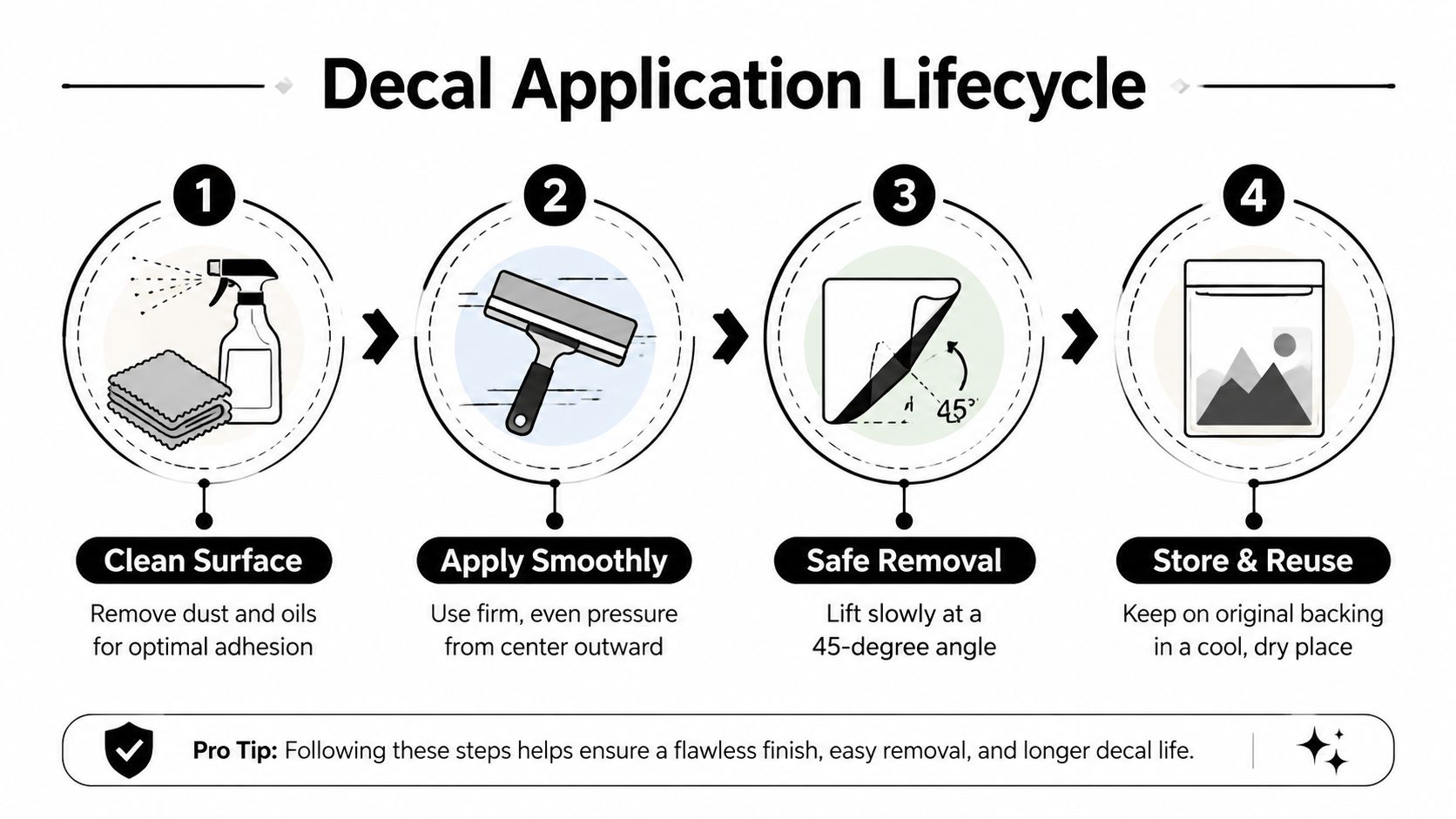
Reusable vinyl only works when the surface is ready for it. Clean, dry, and smooth wins every time. Low-tack films are easier to reposition than permanent vinyl, but they still fail fast when dust, oil, road film, or texture get in the way.
The application sequence that actually holds up
Start with isopropyl alcohol on a lint-free cloth, then let the surface dry completely. If the substrate is below the manufacturer's minimum application temperature, wait. Low-tack adhesives do not behave well when they are cold.
A smooth install matters more than heavy pressure. Use firm, even strokes from the center out, and do not trap dust under the edges. For a vehicle-style layout, a product such as windshield banner decal stickers is a better reference than a wall graphic because it forces you to think about curves, glass, and visibility at the same time.
- Clean the substrate. Remove oils, road film, and loose dust before you try to place anything.
- Align the decal gently. Low-tack film gives you a little room to adjust, so use it.
- Press from the center out. That reduces trapped air and keeps the edges from curling.
- Lift slowly if you need a reset. Fast yanks stretch the film and contaminate the adhesive.
Field note: the cleaner the backing stays, the more times a decal usually survives reapplication. Once the adhesive picks up lint, it stops behaving like reusable material and starts acting like a compromised sticker.
Outdoor vehicle work is harder than indoor wall work. Heat, moisture, and dirt shorten the useful life of low-tack adhesives quickly, especially on doors, hoods, and other exterior panels that see constant abuse.
Storage matters as much as installation
After removal, press the decal back onto its original liner if the manufacturer allows it, or store it flat in a clean sleeve. Do not ball it up in a glovebox, and do not stick it to dirty paper. The more debris the adhesive collects, the faster the repositioning window closes.
The same logic applies to reapplication. If the decal has sat in a hot vehicle, picked up dust, or touched a textured surface, expect weaker behavior the next time. Reusable does not mean endless, it means the adhesive can survive a limited number of clean cycles.
Where Reusable Decals Work Best
A renter with a blank wall and a seasonal display problem is the ideal customer for reusable vinyl. So is a small shop that changes window promotions often, or an event team that wants temporary glass signage without permanent residue. In those settings, the decal gets a fair shot because the surface is smooth, the environment is controlled, and the graphic doesn't spend its life fighting weather.
Real use cases that make sense
On interior walls, reusable graphics can refresh a room without paint or wallpaper. On storefront glass, they can support rotating messages, holiday sales, or short-run promos. On smooth panels at events, they can do the job for a weekend and then come off without a fight.
The market gap appears when buyers ask the harder question, whether reusable vinyl decals work on vehicles. Much of the available guidance limits reuse to walls, glass, storefronts, or static-cling-style products, not exterior car paint or body panels. That's why a Jeep owner trying to swap seasonal graphics often gets a disappointing answer, because the road is a harsher test than a living room wall.
What fails in automotive use
Heat bakes weak adhesives, rain gets into edges, and dirt contaminates the bond line. Once that happens, the decal may still stick in spots while lifting in others, which looks worse than not using it at all. For trucks, Jeeps, and daily drivers, a permanent or semi-permanent product usually fits the use case better than a low-tack wall-style graphic.
I'd separate use cases into two buckets. Indoor and glass-based reuse is where the category performs naturally, while exterior vehicle reuse is where buyers need to be careful and honest about expectations. That's not a sales pitch, it's just how the materials behave in the world.

If the job is an interior decor refresh, a glass promotion, or another smooth non-porous surface, reusable vinyl can be a clean solution. If the job is a fender, hood, or door panel that sees weather, treat it like an automotive project and choose accordingly.
Troubleshooting Common Reusable Decal Problems
Most failures show up at the edges first. That's where dust, lifting, and contamination expose a weak bond before the center of the graphic gives up. If a reusable decal starts acting tired, the problem is usually one of three things, dirty adhesive, poor substrate prep, or a decal that's already been reused past its comfortable limit.
What to do when the decal misbehaves
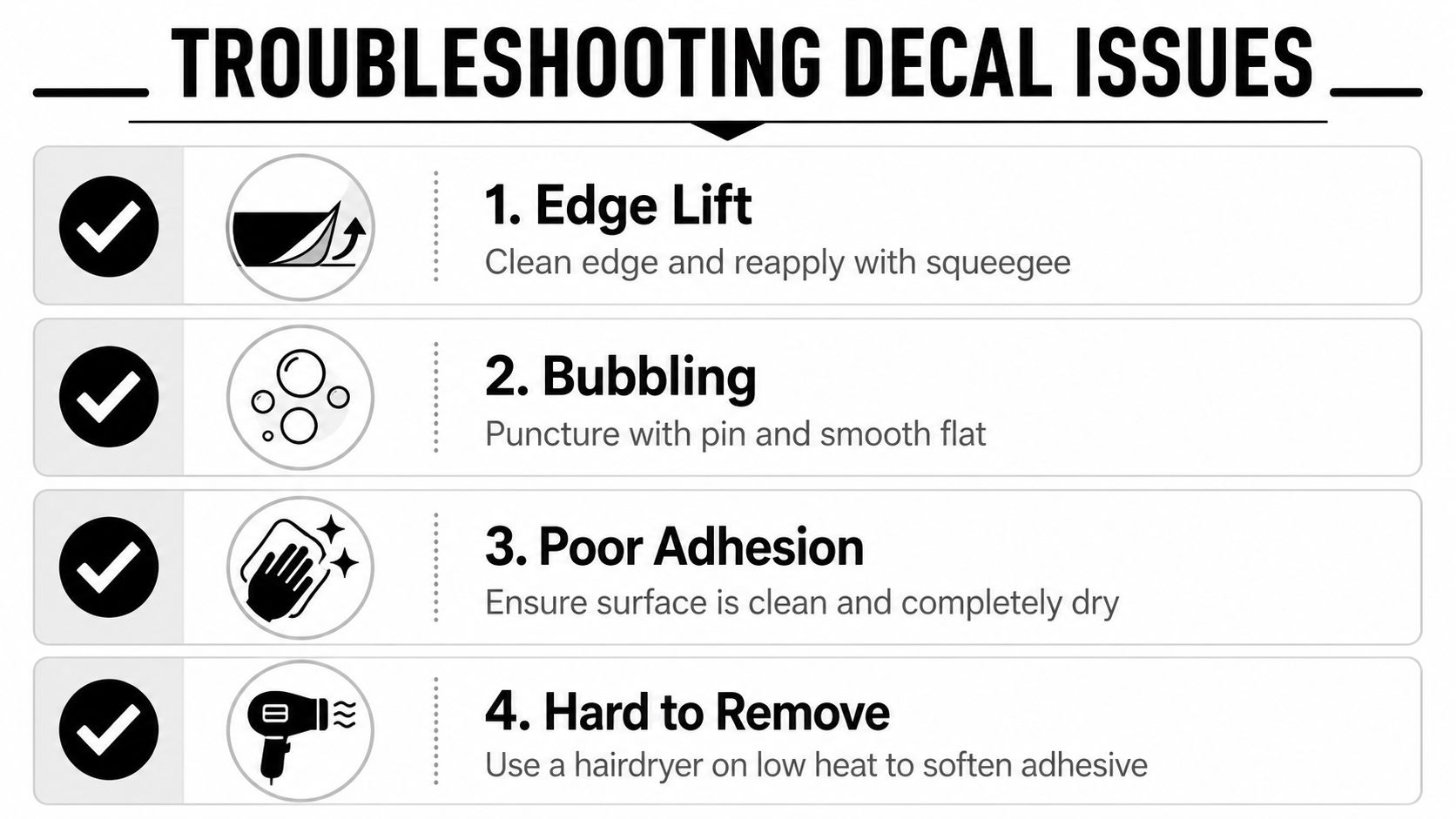
Edge lift usually means the edge picked up dust or the surface wasn't clean enough. Lift the area carefully, clean it, and press it back with a squeegee. If you catch it early, you can often save the decal.
Bubbling can happen when air gets trapped during installation. A small pinhole lets you release the air, then smooth the film flat. Don't overwork it, because repeated smoothing can fatigue a low-tack adhesive.
Poor adhesion usually traces back to moisture, oil, or a surface that wasn't fully dry. Reclean the substrate and let it dry before trying again. If the decal has been handled a lot, the adhesive may be too contaminated to perform.
For removal problems on glass, a useful practical reference is how to get stickers off glass, especially if you're dealing with residue or stubborn corners after a long install. That kind of cleanup discipline matters because bad removal habits often shorten the next reuse cycle.
When to stop trying to save it
StickerGenius says its reusable StickleMe product can be reused 100+ times if the adhesive stays clean (repositionable sticker signs). That's a product claim, not an independent durability standard, and it still depends on clean handling and favorable conditions. In practice, washing, temperature swings, rough handling, UV exposure, and repeated dust pickup all shorten the life of a reusable decal.
If the film won't lay flat after cleaning, or if the adhesive feels weak even on a clean, smooth panel, it's time to replace it. Repositionable doesn't mean immortal.
Choosing the Right Vinyl for Your Project
The right call comes from matching the adhesive to the job, not from chasing the word reusable. If the project is an interior wall, a glass panel, a temporary event sign, or another smooth surface that will be changed often, reusable vinyl makes sense. If the project is an exterior vehicle graphic, long-term branding, or anything that has to survive weather, permanent vinyl is usually the safer path.
Use the surface as the first filter
Ask where the graphic will live. Smooth, clean, non-porous surfaces are the natural home for reusable products, while rougher or outdoor environments push you toward more durable films. Then ask how often the graphic will be moved, because frequent repositioning always adds wear.
For a practical example of a product that sits in the custom-decal space, see round tan vinyl patio cover, which shows how shoppers often evaluate finish, fit, and application context before they commit. The same logic applies to decals, where material choice should follow use case instead of trend language.
Questions worth asking the supplier
- What adhesive system is used? Ask whether it's low tack, removable, or permanent.
- What surface is it meant for? Wall, glass, painted metal, or vehicle use all point to different films.
- What are the durability limits? Outdoor life tells you more than sales copy.
- Can it be reapplied to the liner? That's a strong sign the product was built for repositioning.
If you're shopping for a custom decal for a vehicle or tumbler, a product like Yeti tumbler cup custom name decal stickers can help you compare small-format adhesive behavior before moving up to larger graphics. It's a good reminder that a decal's real value is in how it behaves on the surface you own, not the surface the ad photo chose.
The safest buying habit is simple. Read the datasheet, match the adhesive to the surface, and ignore any claim that sounds universal. That's how you avoid buying a wall decal and expecting it to act like a vehicle wrap.
If you're ready to order decals that fit the way you use them, visit Custom Sticker Shop and compare custom vinyl options with the surface, lifespan, and application method in mind. The shop offers made-to-order decals for vehicles, windows, and related graphics, so you can choose a product that matches the job instead of gambling on a vague reuse claim.