
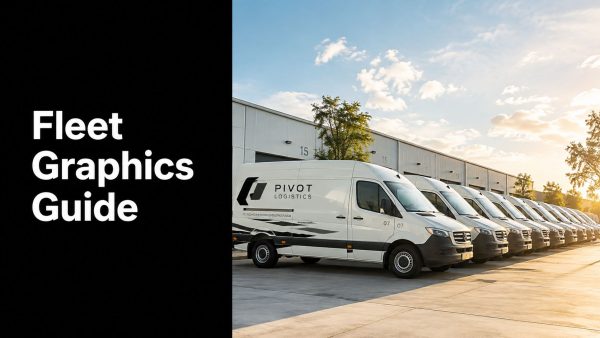
A wrapped vehicle can cost as little as $0.15 per 1,000 impressions according to 3M, while online ads can run up to $21 per 1,000 impressions. That gap changes the conversation fast, because fleet vehicle graphics aren't just decoration, they're a media channel attached to assets you already own and drive every day.
The right way to evaluate them is the same way you'd judge any marketing investment, by reach, recall, durability, and fit with your routes. A good wrap program turns vehicles into repeatable local exposure, but only if the film, design, and installation match the job.
What Fleet Vehicle Graphics Actually Are
Fleet vehicle graphics are engineered marketing systems wrapped around real vehicles, not stickers slapped on a panel and forgotten. They combine vehicle geometry, film chemistry, adhesive behavior, and brand strategy so a company's message can survive motion, weather, washing, and daily use. That's why the question isn't “Do we want graphics?”, it's “What job do we need this vehicle to do?”
The right graphic depends on the problem
A full wrap makes sense when a vehicle spends time parked in public view or moving through dense routes where broad, bold branding can do heavy lifting. Partial wraps fit fleets that need strong visibility without covering every surface. Lettering and decals work well when the goal is identification, contact details, or compliance copy rather than a full visual statement.
Other applications solve narrower problems. Perforated window film preserves outward branding while keeping visibility from the cabin, which matters on vans and some service vehicles. Magnetic graphics help temporary, rotating, or shared vehicles that can't stay branded permanently.
Practical rule: choose the graphics format from the use case first, then build the artwork around the vehicle.
Why panel selection matters more than coverage
A truck body isn't one uninterrupted billboard. Doors, handles, trim, hinges, sensors, windows, and body lines all interrupt adhesion and readability, so the usable canvas is smaller than the vehicle's outer shape. That's why fleet planning starts with panel selection and legibility zones, not with a pretty mockup of the whole vehicle.
The most effective programs think in terms of outcomes. A contractor's van may need clean identification and a phone number. A delivery truck may need big brand marks that people notice at intersections. A sales car may need a lighter treatment that still looks polished in a parking lot. A vehicle graphic is effective when it supports the business problem, whether that problem is awareness, route recognition, compliance, or lead generation.
Types of Fleet Vehicle Graphics and Materials
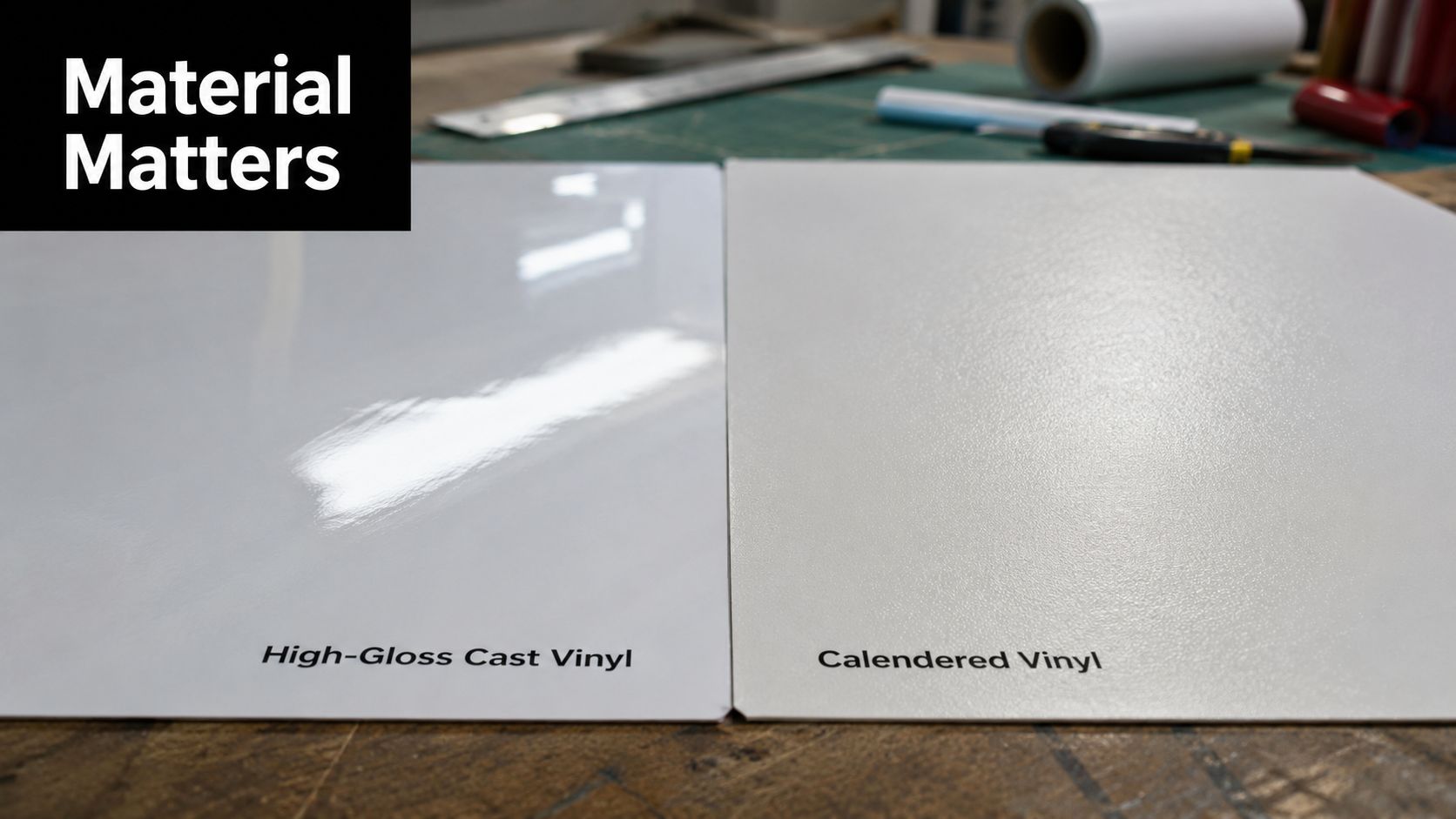
The biggest material mistake fleet buyers make is assuming every vinyl behaves the same way. It doesn't. A fleet built around flat trailer sides, curved van panels, and corrugated truck boxes needs different film properties, or the graphics will fight the vehicle instead of fitting it.
Cast vinyl versus calendered vinyl
Cast vinyl is the better fit when the graphic has to conform to compound curves, stretch around recesses, or hold up to repeated washing and road exposure. Calendered vinyl is usually the more budget-conscious option for flatter surfaces and shorter planned service life. In simple terms, cast film is built for tougher shapes, while calendered film is built for easier jobs.
That difference matters because many fleet vehicles aren't flat at all. Vans have curved sides and body transitions. Box trucks often have large flat faces but still include rails, rivets, and edges that complicate installation. Trailers may look simple until a design crosses corrugation lines or panel seams.
Finishes, film behavior, and real operating choices
Finish affects more than appearance. Gloss can pop visually in sunlight, while matte and satin reduce glare and create a subtler look. Metallic and textured finishes can signal premium branding, but they're usually decisions about style first, utility second.
layout.](https://customstickershop.us/wp-content/uploads/2026/08/fleet-vehicle-graphics-vinyl-comparison.jpg)
Air-release films help installers push out bubbles and reduce rework. Repositionable adhesives matter on large projects because alignment rarely happens perfectly on the first pass. Removable films make sense for leased vehicles or fleets that rotate branding often.
The key technical choice is fit. 3M's fleet-graphics guide says to build a formal film specification with a sales representative and graphics partner rather than assuming one vinyl works for every vehicle, and it points to films such as IJ380 for high conformability and lifting resistance, and 180C/IJ180C for air release, repositionability, slideability, and removability (3M fleet graphics guide). That approach is what separates a neat-looking installation from a wrap that survives real work.
The Business Case and ROI of Fleet Graphics
Fleet graphics make sense when you stop treating them like décor and start treating them like media. 3M reports that fleet graphics can cost as little as $0.15 per 1,000 impressions, while online ads can cost up to $21 per 1,000 impressions (3M fleet graphics power page). That spread is why business owners keep coming back to vehicle branding when they want long-term visibility without ongoing media rotation.
What the impression numbers mean in plain terms
3M also cites research showing 30,000 to 70,000 daily vehicular impressions in dense driving markets, which is why a single wrapped vehicle can accumulate a very large number of views over a year in active routes (3M fleet graphics power page). Independent industry summaries echo the idea that one wrapped vehicle can generate roughly 16 million annual visual impressions, and one cited figure puts mobile outdoor advertising recall at 97% (TKO Graphix fleet graphics statistics).
Those numbers don't mean every vehicle performs the same way. Route density, dwell time, and local traffic patterns still matter. But they do show why fleet graphics have become a standard mobile out-of-home channel, because the vehicle keeps working whether it's parked outside a job site or moving through neighborhood traffic.
Consumer perception is part of the return
The ROI isn't only in views. A 3M infographic cites research showing 98% of respondents said fleet graphics created a positive image for the company, 96% said they had more impact than billboards, 75% formed an impression about the company and its products, and 29% said that impression would influence a buying decision (TKO Graphix fleet graphics statistics). That's useful for owners because it connects branding to actual purchasing behavior, not just vanity metrics.
A fleet wrap is easiest to justify when you compare its lifespan to a recurring media buy. The vehicle keeps advertising after the install work is done.
A simple decision table
| Channel | Cost per 1,000 Impressions | Key Advantage |
|---|---|---|
| Fleet graphics | As little as $0.15 | Long-term exposure on an owned asset |
| Online ads | Up to $21 | Fast deployment and targeting |
The business case becomes strongest when you compare cost, reach, and durability together. That's the framework owners should use before they sign off on design work.
Design Best Practices for Fleet Vehicle Graphics
Good vehicle graphics are built for motion, not for a design award board. A van that's seen in traffic for three seconds needs a different layout than a truck parked in a loading zone for twenty minutes. The smartest design teams start with route data, because where a vehicle goes and how long it stays visible changes the entire communication strategy.
Design for the route, not the mockup
A highway route gives drivers almost no reading time, so the layout has to be branded, simple, and instant. A neighborhood service route gives passersby more dwell time, so a vehicle can carry more service-area language or a QR code. That's why the same business may need two different design approaches for two parts of its fleet.
The practical rule is straightforward. Keep copy short, use high contrast, and leave room for the viewer to understand the message at a glance. If the vehicle is moving most of the day, the logo and business name should do more work than long explanatory text.
Measure the usable space first
One of the most common mistakes is designing to the full body outline instead of the usable panel area. That creates problems around handles, hinges, trim, windows, sensors, and body lines. It can also make compliance text unreadable or force a logo into a broken panel that looks awkward from the street.
Fleet planning guidance recommends measuring the usable panel area, not the whole vehicle shell, and reserving a clear space for compliance items like DOT numbers where required (TKO Graphix fleet graphics checklist). That same guidance emphasizes minimum letter height, strong contrast, and placement near the cab doors so markings stay visible from a distance.
Design rule: if a reader can't understand the message while the vehicle is moving, the design is too busy.
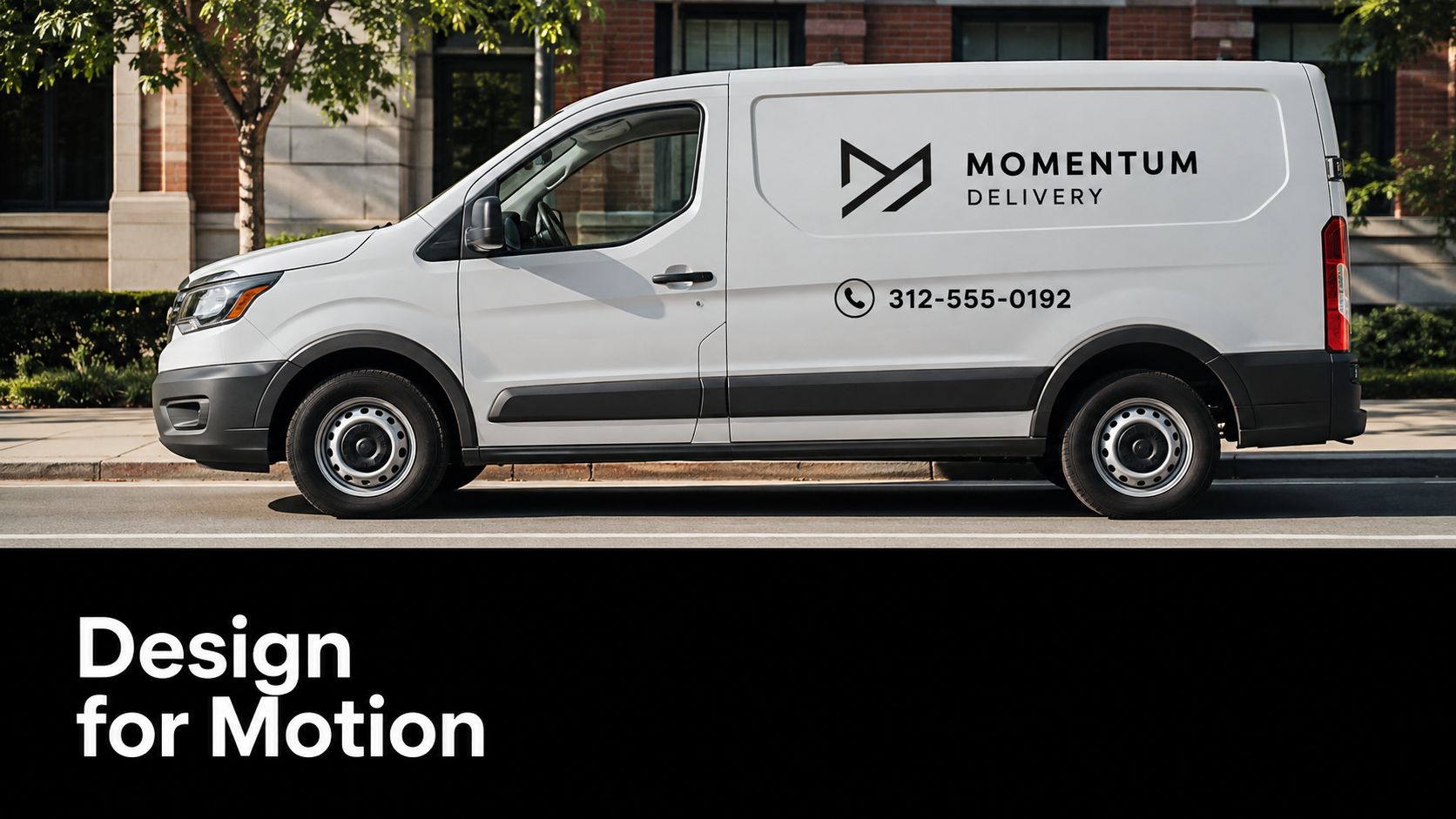
The best fleet layouts treat design as communication engineering. They use the vehicle's shape, route, and viewing distance to decide how much information belongs on each panel, then they let the artwork support that decision instead of fighting it.
Installation and Maintenance Considerations
A strong design can still fail if the installation is sloppy. Surface prep, temperature, and panel alignment all affect how the film bonds to the vehicle, and those details matter more than most owners expect. The install is where the investment either becomes durable marketing or turns into a repair problem.
Installation starts before the first sheet goes on
A proper install begins with cleaning and degreasing the vehicle so dust, oil, and residue don't interfere with adhesion. Installers also need the right temperature conditions, because extreme heat or cold can change how the film behaves on contact. On compound curves, careful stretching and edge work matter more than speed.
Air bubbles, trapped moisture, and misalignment usually come from rushed prep or poor handling. Transfer tape helps position multi-panel graphics accurately, especially when the design crosses several surfaces. Pre-spaced, pre-taped graphics can also reduce the chance of installation errors and make field work simpler for a team that's applying several vehicles in a row.
Maintenance is mostly about protecting the film
Routine washing should stay gentle. Harsh chemicals and aggressive pressure can shorten the life of the graphic or lift edges prematurely. Small scuffs can often be repaired if they're caught early, but tears, large lifts, or fading usually mean the panel needs replacement or the whole graphic needs refreshing.
The easiest way to manage maintenance is to build a quick inspection into regular vehicle checks. Look for edge lifting, discoloration, surface cracking, and damage around handles and corners. Those are the areas most likely to show wear first.
Before and after every install
- Surface condition: confirm the vehicle is clean, dry, and free of contaminants.
- Panel fit: check that the artwork matches the usable panel area, not the full body outline.
- Edge finish: inspect corners, seams, and recessed areas for proper adhesion.
- Field care: use the right wash method and repair small issues before they spread.
If a fleet runs in extreme weather, handling and storage matter too. Cold film can be less forgiving, and hot panels can make placement harder. A disciplined install process protects both appearance and lifespan, which is the whole point of paying for professional graphics in the first place.
Cost Factors and Budgeting for Fleet Graphics
Fleet graphics pricing is easiest to understand when you break it into drivers, not just a quote total. Vehicle size, surface complexity, material quality, install labor, and design time all shape the final number. That means two fleets with the same number of vehicles can still land at very different budgets.
What changes the price
Bigger vehicles use more film and take more labor. A flat trailer side is easier to cover than a van with curves and seams. A partial branding package costs less than a full wrap because it covers less surface area, but it may still deliver the impression value the business needs.
Material choice matters just as much as coverage. A higher-grade cast vinyl that lasts longer can cost more upfront, but it can lower replacement frequency and reduce downtime later. That's the total cost of ownership view, which is usually the right way to compare options.
Hidden costs can also show up in planning. Removal of old graphics, paint correction, proofing, compliance copy, and cleanup supplies all affect the budget. If a vehicle has existing decals or worn film, removal work can be a line item rather than a footnote.
Table for common application types
| Application Type | Cost Range per Vehicle | Typical Lifespan |
|---|---|---|
| Partial lettering on a pickup | Lower-budget range | Shorter than a full premium wrap |
| Full wrap on a cargo van | Mid- to higher-budget range | Longer when premium cast film is used |
| Mixed-fleet program | Varies by vehicle and coverage | Depends on material and upkeep |
A smart budget also looks at volume. Per-vehicle costs usually improve when a fleet order covers several units, because design setup and production work spread across more vehicles. That's why fleet buyers should ask for pricing by vehicle type, not just a single flat number.
How to Choose a Fleet Graphics Vendor
A fleet graphics vendor should understand vehicles, not just printing. The wrong partner can produce a visually strong mockup that installs poorly, misses compliance details, or falls apart too early. The right partner helps you choose materials, spec the job correctly, and keep the fleet consistent over time.
Questions worth asking before you sign
- Fleet experience: how many multi-vehicle programs they've handled.
- Material spec: what film they recommend for your vehicle mix and why.
- Installation quality: whether they use trained installers and documented prep steps.
- Production capacity: whether they can keep up with your rollout timeline.
- Service model: whether they can support future replacements or updates.
A useful vendor also shows you physical samples, not just screen renders. Digital proofs hide texture, adhesive feel, and finish differences that matter on the actual vehicle. If the vendor can't explain how the film handles curves, removability, or weather exposure, that's a warning sign.
Custom Sticker Shop is one option for buyers who want pre-spaced, transfer-taped vehicle decals and custom printed graphics that can be applied across multiple vehicles. Their production approach is built around quick installation, which is useful when a fleet team wants to standardize the look without adding unnecessary on-site complexity.
The best next step is to start with one pilot vehicle. That gives you a live test of material choice, readability, and installation quality before you commit to the whole fleet. It also gives your team a chance to compare the actual vehicle against the proof and catch issues early.

Frequently Asked Questions About Fleet Graphics
How long fleet graphics last depends on the film, install quality, route conditions, and care. In the verified data, 3M's fleet guide identifies IJ380 with a listed 5-year expected durability, and the publisher background notes Oracal vinyl rated for up to 7 years outdoors, so buyers should match the material to the intended service life rather than assuming every wrap performs the same way (3M fleet graphics guide).
Can graphics be removed without damaging paint? Usually yes, if the film was installed and removed correctly on a sound surface. Damage risk rises when low-quality materials are used or when removal is rushed.
What about mixed fleets with different vehicle types? That's normal. A van, pickup, and box truck should not be treated as identical canvases, because each body shape changes panel layout, compliance placement, and film choice.
How do graphics affect resale value? Cleanly removed graphics can help preserve a professional appearance, but the result depends on maintenance and paint condition. If a vehicle has been well cared for, the graphics often function more like a reversible brand layer than a permanent modification.
What if you need help on a damaged body panel before rebranding? For larger body repair work on specialty vehicles, a specialist such as the RV body restoration specialists at Class A RV Repairs can be a useful reference point when the vehicle needs repair before new graphics go on.
How often should graphics be refreshed? The right schedule depends on fading, route exposure, and whether your brand has changed. A worn wrap can make a fleet look older than it is, so inspection matters more than a fixed calendar.
Custom Sticker Shop makes vehicle decals and custom printed graphics that can help a business turn company vehicles into consistent brand assets. If you're comparing materials, install ease, and rollout options for a fleet program, visit Custom Sticker Shop to review what they offer and see whether it fits your vehicles and your budget.