
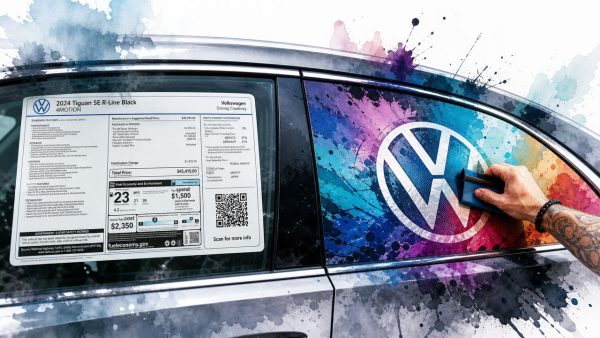
You're probably here for one of two reasons. You just looked at a Volkswagen's factory label and want to know what you're reading, or you want to put something cool on the glass of your own VW and don't want it to look cheap, peel early, or land in the wrong spot.
That split is where most confusion starts with VW window stickers. In real use, that phrase can mean the official factory information label on a new vehicle, or a vinyl decal you apply later for style, identity, or club culture. Those are completely different things, and treating them like they're the same is how buyers miss important vehicle details or owners order decals that don't fit the car or the job.
Volkswagen owners tend to care about both sides. We want the build details right, and we also want the car to feel like ours. A clean rear quarter decal on a Golf, a subtle hatch graphic on a GTI, or a period-correct look on a Bus can work beautifully. But only if you know which sticker you're dealing with first.
The Two Types of VW Window Stickers Explained
A lot of owners type “VW window stickers” into search and get a messy mix of dealer pages, VIN tools, and decal listings. That's not your fault. The term gets used for two separate products with two separate purposes.
The first is the factory Monroney label. On a new Volkswagen sold in the U.S., this is the official disclosure label that shows model information, pricing, fuel economy, and a QR code for EPA data, as described in this guide to reading a Volkswagen window sticker. It exists for compliance and comparison shopping, not for appearance.
The second is the aftermarket vinyl decal. That's the sticker most enthusiasts mean when they're talking about a rear glass logo, custom text on a hatch window, a club banner, or a heritage-style design on quarter glass.
How to tell which one you need
If your question sounds like any of these, you mean the official label:
- “What options came on this car?” You're trying to verify original equipment.
- “Why doesn't the sticker match the car?” You're checking for a spec or dealer-install discrepancy.
- “Can I get the window sticker from the VIN?” You need build validation.
If your question sounds more like these, you mean a vinyl decal:
- “What size looks right on my rear window?”
- “Will it survive sun and washing?”
- “Should I use removable or permanent vinyl?”
Practical rule: If the sticker helps you confirm what the vehicle is, it's paperwork. If it helps the vehicle express who you are, it's a decal.
That difference matters because the buying criteria are totally different. For the factory label, accuracy is everything. For a custom decal, material, placement, contrast, and clean installation matter more than anything else.
Why VW owners get tripped up
Volkswagens attract buyers, collectors, commuters, modders, and nostalgia-driven owners all at once. One person wants to confirm the exact trim and tire package on a used Tiguan. Another wants a low-key rear quarter decal for an Atlas. Another is chasing a retro look that nods to older Type 2 culture.
That's why the smartest approach is simple. First, identify whether you need vehicle information or visual personalization. Then make decisions from there. Once you do that, the rest gets much easier.
Decoding the Official VW Monroney Sticker
The official U.S. new-car window sticker isn't just dealer paperwork. It's the Monroney sticker, named for Senator Mike Monroney, tied to the federal law that required these disclosure labels. The requirement became effective on October 1, 1958, for the 1959 model year, and removing, altering, or obscuring the label before delivery became a federal offense with penalties of up to $1,000 and 1 year in prison per offense, according to this history of the Monroney sticker law.
That's why the label deserves more respect than most buyers give it. It isn't decorative. It's the official statement of what the vehicle is supposed to be when it reaches the customer.
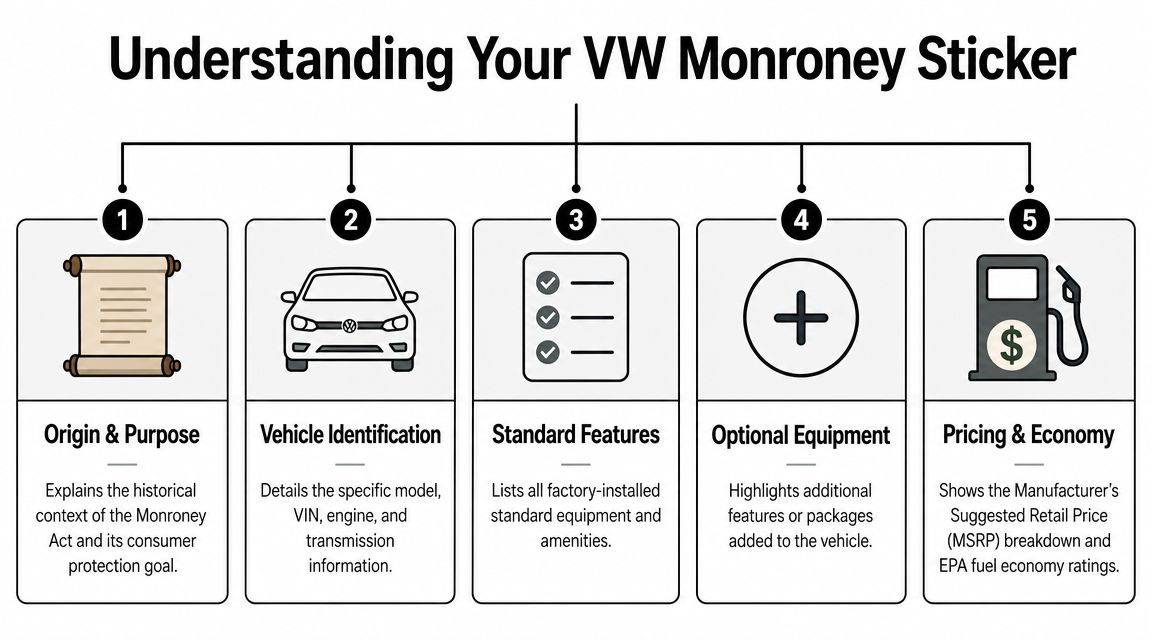
What to read first
When I look at a Volkswagen Monroney sticker, I don't start with the big price. I start with identity.
Check these items first:
Vehicle identification
Make sure the model, trim, VIN, engine, and transmission match the car in front of you.Standard equipment
This tells you what came with that trim from the factory, not what the salesperson assumes is included.Factory options
These line items matter because they separate one seemingly similar VW from another.
The parts that affect real buying decisions
The most useful thing about the U.S. window sticker format is that it's standardized. The label is typically affixed to a side window or windshield on new passenger cars and light-duty trucks before sale, and it includes items such as make, model, trim, engine, transmission, VIN, MSRP, destination charge, standard equipment, factory options with individual prices, fuel-economy ratings, and safety or environmental data, as summarized in the Monroney sticker overview.
Here's where buyers usually gain the most value:
| Section | What it tells you | Why it matters |
|---|---|---|
| Vehicle specs | Exact build identity | Confirms you're evaluating the right car |
| Standard equipment | Included features | Prevents confusion with higher trims |
| Optional equipment | Added packages and features | Shows what actually drives price differences |
| MSRP and destination | Price structure | Helps you compare cars fairly |
| Fuel economy and related data | Operating-cost context | Useful when two trims look similar on paper |
Read the option lines carefully. On Volkswagens, small equipment changes can completely change how the car feels to live with.
Where owners use it after the sale
The sticker doesn't stop mattering once the car leaves the lot. It becomes useful any time you need to verify original build content, compare a used vehicle against what it should have, or settle a question about whether something was factory-installed or added later.
That's especially important with VWs, where wheel packages, appearance bundles, drivetrain combinations, and interior details can change the car more than the badge on the hatch suggests.
Choosing the Right Custom Decal for Your VW
Factory labels are about facts. Vinyl decals are about judgment. Material choice, finish, and fit decide whether your Volkswagen looks thoughtfully personalized or like it picked up a gas-station sticker on the way home.
Generic product pages often skip the questions owners actually care about, including how decals hold up in sun, how they behave on curved glass, and when removable vinyl makes more sense than a more permanent option, as noted in this discussion of weather resistance and removability. Those are the questions that should drive your purchase.
What usually works best on Volkswagens
VW glass areas tend to reward restraint. A decal doesn't have to be huge to read well, especially on hatchbacks where the rear glass already dominates the back of the car.
I usually break decal choices into three buckets:
Die-cut text or logos
Best for club names, social handles, simple branding, and clean OEM-plus looks.Printed graphics
Better for multicolor art, illustrated designs, or more expressive themes.Small accent decals
Ideal for quarter windows, lower corners, or subtle nods to model culture.
For custom text, one option is a make-your-own custom sticker format that lets you tailor wording to the car instead of trying to force a premade phrase into the wrong shape or length.
Removable or permanent
This choice matters more than most buyers think.
Choose removable vinyl when:
- you like changing the look every so often
- you lease or rotate cars often
- you're testing placement before committing
Choose more permanent outdoor vinyl when:
- the design is part of the car's long-term look
- the VW sits outside regularly
- you don't want edges lifting after seasonal weather swings
Cheap vinyl usually fails at the edges first. That's where curved glass, heat, and bad prep expose every shortcut.
Design details that separate clean from cluttered
A few trade-offs make a huge difference:
Contrast against tint
White, silver, and light gray usually read better on darker rear glass. Black can disappear on factory tint.Lettering thickness
Thin scripts look elegant on screen and frustrating on a car. Slightly bolder lettering survives distance better.Shape versus glass curve
Straight, long decals can fight compound curves. Smaller or segmented designs sit better on many VW quarter windows.
The goal isn't to make the glass busy. It's to make the car look intentional.
Sizing and Placement Tips for Popular VW Models
Placement is where good decal ideas go right or wrong. A strong design can still look awkward if it's oversized, jammed into a corner, or fighting the shape of the glass. Volkswagens have distinct window layouts, so treating a Jetta, Golf, and Tiguan the same is a mistake.
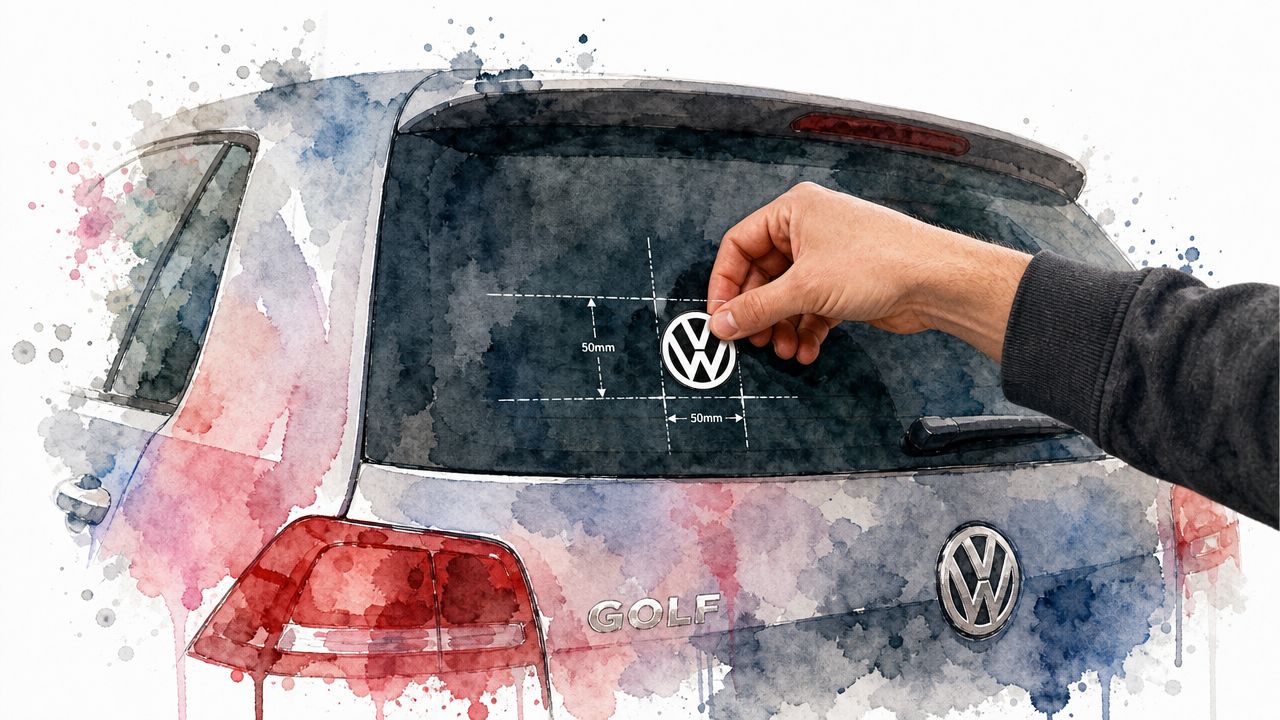
Hatchback, sedan, and SUV placement
Here's the basic fit logic I use:
| VW body style | Best glass area | What usually looks right |
|---|---|---|
| Golf, GTI, Golf R hatchback | Lower rear glass corner or small quarter area | Compact logos, short text, subtle club decals |
| Jetta sedan | Rear side glass or lower rear windshield edge | Narrow text, understated graphics |
| Tiguan or Atlas SUV | Rear quarter glass or upper rear window band | Slightly broader designs with clean spacing |
On a Golf, the rear hatch glass already has a lot going on visually. Wiper, defroster lines, and the hatch shape all compete for attention. A small decal low in one corner usually looks cleaner than a wide banner unless you're building a very specific show-car style.
On a Jetta, the side rear glass often gives you the neatest result. It frames a decal better than the main rear windshield, especially if you want the car to stay understated.
Matching decal shape to glass shape
If the window narrows toward one end, don't force a blocky decal into it. Tapered text, shorter phrases, or compact symbols sit more naturally. In such cases, a custom text window decal format makes more sense than trying to trim or squeeze a design that was never sized for your glass.
A good visual test is to step back and ask whether the decal follows the car's lines. If it feels like it was pasted onto the glass instead of designed with the glass, it's probably too large or in the wrong spot.
Safety and common-sense placement
Avoid putting decals where they interfere with your main sightlines. That includes the driver's forward view and any area you rely on heavily during lane changes, reversing, or parking.
If you have to look through the decal to drive comfortably, move it.
Rear glass is usually the safest place for style decals, but even there, moderation wins. Defroster lines, backup visibility, and rear camera habits all matter. Small and intentional beats big and obstructive almost every time.
Popular VW Window Sticker Design Ideas
Volkswagen sticker culture is broad because Volkswagen culture is broad. Air-cooled nostalgia, Euro minimalism, tuner humor, surf and camping references, family decals, heritage typography, and political or patriotic themes all show up on VWs. The trick is matching the design language to the car.
OEM-plus and Euro-clean
This is the safest lane if you want the car to stay mature. Think simple model references, monochrome logos, understated text, and designs that look like they could have come from a dealer accessory catalog even if they didn't.
This style works especially well on:
- GTI and Golf R hatch glass
- Arteon and Jetta rear side windows
- Tiguan quarter glass
The goal is subtle identity, not noise.
Vintage and Bus-inspired looks
Volkswagen's commercial-vehicle history gives sticker culture some real depth. The Type 2 Bay Window Bus arrived in late 1967, and Type 2 production in Brazil began on September 2, 1957 at VW do Brazil's São Bernardo do Campo plant, which helps explain why Bay Window references and collectible VW decals connect to a long, global model lineage, as outlined in this history of the VW Bay Window Type 2.
That history is why period-style lettering, travel references, campground motifs, and retro silhouettes still feel at home on a modern VW. They aren't random. They tie back to an established part of the brand's identity.
Personal, club, and statement decals
Window stickers are how owners make the car unmistakably theirs. Social handles, family names, local club references, military tributes, constitutional themes, motorsport nods, and hometown pride all fit here if the design is clean and the scale is right.
A good example of a more statement-driven style is a We the People window decal, which suits owners who want the glass to say something more direct than a logo alone.
The caution is simple. Don't stack too many messages on one window. One strong idea usually looks better than five smaller ones competing for space.
A Volkswagen with one well-placed decal looks curated. A Volkswagen with unrelated stickers scattered across every pane usually looks unfinished.
Quick Installation and Care for a Flawless Look
Bad installation ruins good vinyl. Most of the ugly results people blame on the decal come from dirty glass, rushed alignment, or peeling transfer tape too aggressively.
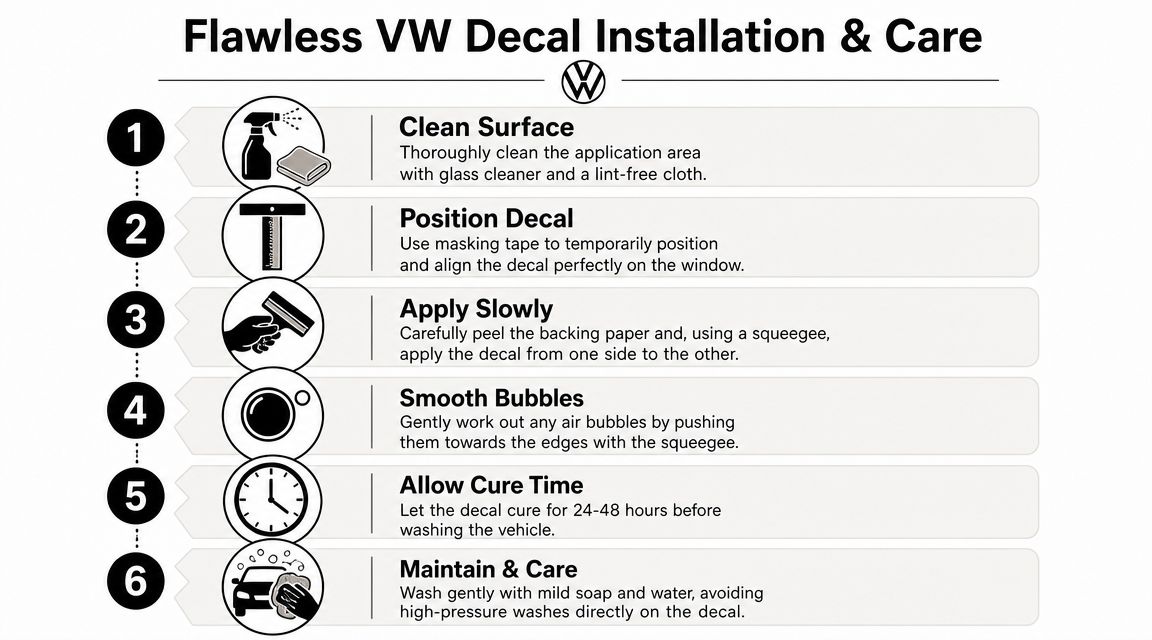
A clean install at home
Use a lint-free cloth, a proper glass cleaner, masking tape, and a squeegee or application card. Then work in this order:
Clean the glass thoroughly
Remove dust, oils, and residue. Old wax overspray around rear glass edges can cause lifting.Dry it completely
Moisture trapped under edges causes problems later, even if the decal looks fine at first.Test position with tape
Stand back. Check level against the body lines, not just the edge of the window.Apply with steady pressure
Start from one side and work across. Don't rush the center and assume the edges will sort themselves out.
A quick visual walkthrough can help if you haven't done one before:
What trips people up
The most common mistakes are predictable:
Applying to dirty glass
Even tiny contamination shows up as bubbles or weak spots.Ignoring temperature
Glass that's too hot or too cold makes vinyl harder to position and bond well.Pulling transfer tape too fast
That's how corners lift and fine lettering comes back up with the tape.
If your decal is pre-spaced and transfer-taped, installation is simpler because the layout is already set. That's especially helpful for text decals where uneven letter spacing instantly looks amateur.
Washing and removal
After application, let the decal settle before washing the car. Once it has bonded, wash gently and avoid aiming strong pressure directly at the decal edges.
For removal, warm the vinyl first, then peel slowly. Don't gouge at the glass with sharp tools. Any leftover adhesive should come off with the right cleaner and patience. Most damage happens when people try to rush a job that only needed another few minutes.
Frequently Asked Questions About VW Stickers
Can I get my original VW window sticker from the VIN
Often, yes. Window sticker data can be reconstructed from a VIN, and the label often reveals trim level, engine and transmission configuration, optional packages, and tire size, which makes it useful for validating original build content for resale or verification, according to this Volkswagen VIN and window sticker reference.
That's worth doing any time you're buying a used VW with unclear equipment, unusual wheel and tire combinations, or questionable trim claims.
Can I put a decal over rear defroster lines
You can, but you should be careful. Small, simple decals usually behave better than large designs with lots of thin cut sections. The risk isn't just adhesion. It's future removal. Defroster lines need a gentle hand, especially on older glass.
If you want the lowest-risk option, place the decal in a part of the rear window that avoids the most delicate-looking line intersections, or use quarter glass instead.
Are VW window decals legal everywhere
Window-decals laws vary by location, so common sense matters. Keep decorative decals away from the driver's primary view and avoid turning the glass into a visual barrier. If there's any doubt, stay small and keep the design on rear or rear-side glass.
For owners who treat their VW as part of their wider lifestyle and home aesthetic too, I've found that resources about blending coastal decor and VW can spark surprisingly good ideas for decal themes, color direction, and the kind of vintage details that translate well from memorabilia to glass graphics.
Will a decal hurt resale value
Usually, a well-installed removable decal won't matter much if you remove it cleanly before sale. What hurts resale is sun-baked adhesive, ghost outlines, or a design that suggests the car was neglected. Clean application and clean removal are what preserve flexibility.
If you're unsure, choose a smaller decal in an easy-to-remove location first. That gives you the look without turning the car into a commitment you may regret later.
If you want a custom vinyl option for your Volkswagen, Custom Sticker Shop offers automotive window decals, custom text designs, and pre-spaced graphics that fit the kind of clean rear-glass and quarter-window applications VW owners usually prefer.