
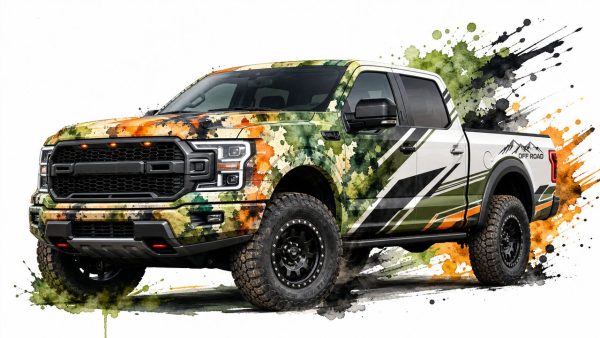
You walk out to your truck, look at all that factory paint, and know it doesn't say much about you yet. Maybe it's a work truck that needs to look sharper. Maybe it's your weekend rig and you want something tougher, cleaner, or more personal than stock. Maybe you love the idea of a full custom wrap, but the price and commitment give you pause.
That's where good truck wraps designs start. Not with flashy effects, but with a clear goal.
A lot of people use “wrap” to mean any kind of vehicle graphic, but in the shop world there's a real spectrum. One end is a full wrap that changes nearly everything you see. The other is a smart set of decals or side graphics that hit the right panels, respect the body lines, and deliver most of the visual punch without covering the whole truck. For a lot of owners, that second option is the sweet spot.
There's a reason interest keeps growing. The U.S. automotive wrap films market was valued at USD 1,496.2 million in 2024 and is projected to reach USD 4,110.0 million by 2030, which shows how vehicle customization has become a major industry. That growth reflects two things truck owners already know firsthand. People want vehicles that look like their own, and businesses want graphics that do real work.
Your Truck Is a Canvas Waiting for a Design
Most truck owners don't start by asking, “Should I buy vinyl?” They start by noticing what feels unfinished. The truck may run great and look clean, but it still looks like every other one in the lot. A design fixes that. It gives the vehicle an identity.
That identity can be loud or restrained. A contractor may want a clean side layout with a logo, service name, and strong contrast. An off-road owner may want hood graphics and body-side accents that make the truck look more planted and purposeful. A food truck owner may need graphics that support the whole visual experience, right down to how they outfit your mobile kitchen for service and presentation.
Design is more than full coverage
A lot of people assume truck wraps designs only mean full-body color changes or giant commercial graphics. In practice, the term covers a much wider range of solutions. Full wraps matter, but so do stripe kits, hood graphics, rear window lettering, bedside logos, tailgate accents, and partial side treatments.
That matters because the best design isn't always the one with the most vinyl.
A good truck graphic works with the truck's shape. It doesn't fight the wheel arches, door breaks, handles, or bed lines.
What owners usually want
In a family-run shop, you see the same pattern again and again. Customers want one or more of these outcomes:
- A custom look: They want the truck to stop looking factory-standard.
- A cleaner theme: They want all the visual pieces to feel intentional.
- Brand visibility: They need the truck to identify the business fast.
- Budget control: They want impact without paying for unnecessary coverage.
That last point gets ignored too often. Full wraps are impressive, but they aren't the only serious option. Smart decal placement can transform a truck in a way that feels custom, balanced, and affordable. If the design is strong, even a modest amount of coverage can look like a complete thought instead of an afterthought.
Choosing Your Coverage Full Wraps Partial Wraps and Decals
The first real decision isn't color. It's coverage. How much of the truck needs graphics to get the result you want?
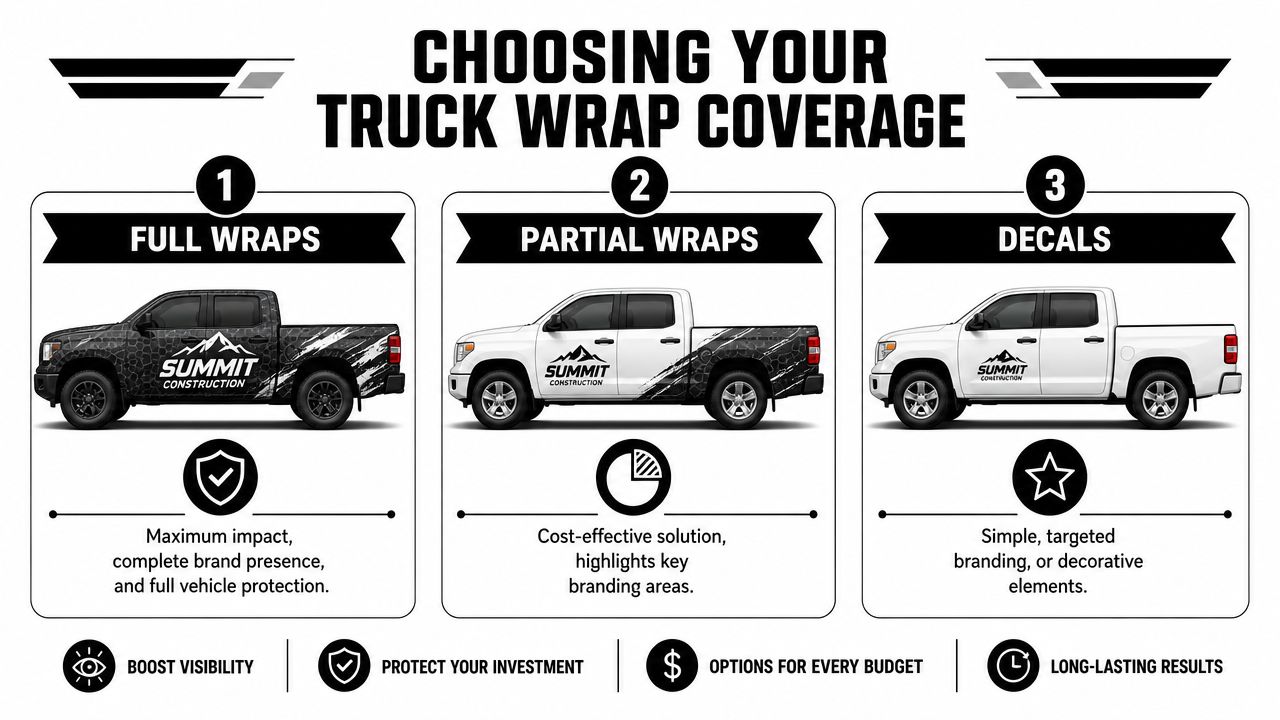
Full wraps
A full wrap covers most or nearly all painted surfaces. It is the option for complete transformation. If you want a color shift, a full camouflage treatment, a rolling brand system, or a highly immersive visual theme, a full wrap makes it happen.
The upside is obvious. You get maximum visual control. Every panel participates. You can tie the cab, bed, hood, and tailgate into one unified design.
The trade-off is commitment. Full wraps require more design labor, more material, more installation time, and more planning around seams, recesses, and panel transitions. They also make mistakes more expensive. If the layout is weak, the truck becomes a very large example of weak design.
Partial wraps
A partial wrap is the middle ground, and it's often the smartest choice. One guide notes that partial wraps typically cover about 25% to 75% of a vehicle, which makes them a practical option between a full wrap and targeted decals for a custom look, as described in these partial wrap coverage examples.
That range gives you a lot to work with. You can wrap the bedsides and tailgate, build out the lower doors, add a hood feature, or create a branded rear-quarter treatment without paying to cover every panel.
Practical rule: If one side view of the truck already tells the story, you probably don't need a full wrap.
Partial wraps work especially well when the truck already has a good base color. Black, white, gray, silver, and many darker OEM colors can carry a strong side package without needing total coverage.
Decals and graphics
Decals are the most targeted option. They can be decorative, informational, or both. Done well, they don't look “small.” They look precise.
A good decal package might include:
- Body-side graphics: Long horizontal elements that stretch and sharpen the truck visually.
- Hood accents: Great for off-road, military, or sport themes.
- Door logos: Best for business trucks that need clean identification.
- Tailgate or rear window details: Useful for finishing the look without cluttering the sides.
For many owners, this is the best value in truck wraps designs. You put the vinyl where the eye naturally goes and leave the rest alone. If you want a simple starting point, a universal stripe kit for truck sides is often enough to give a truck a stronger profile.
Side by side comparison
| Coverage type | Best for | Strength | Main trade-off |
|---|---|---|---|
| Full wrap | Complete transformation | Maximum visual impact | Highest cost and installation complexity |
| Partial wrap | Balanced custom look or branding | Strong presence with less material | Requires careful panel selection |
| Decals | Budget-friendly styling and targeted branding | Fast impact, easy upgrades | Less total coverage |
If you're torn between options, start with the question that matters most. Do you want to change the truck, or do you want to define it? Those are not always the same job.
Popular Truck Design Themes and Inspiration
Pull into a gas station with a plain white truck and it disappears. Pull in with the right graphic treatment and people read the truck before they ever read the logo. That reaction usually comes from a clear theme, not from piling on effects.
A good theme gives the design a job. It tells the eye what matters first, whether that is a business name, an outdoor lifestyle, a tribute, or a clean custom look. Full wraps can carry that idea across every panel, but a lot of trucks get a stronger result from a few well-placed graphics that match the body lines and leave some paint showing.
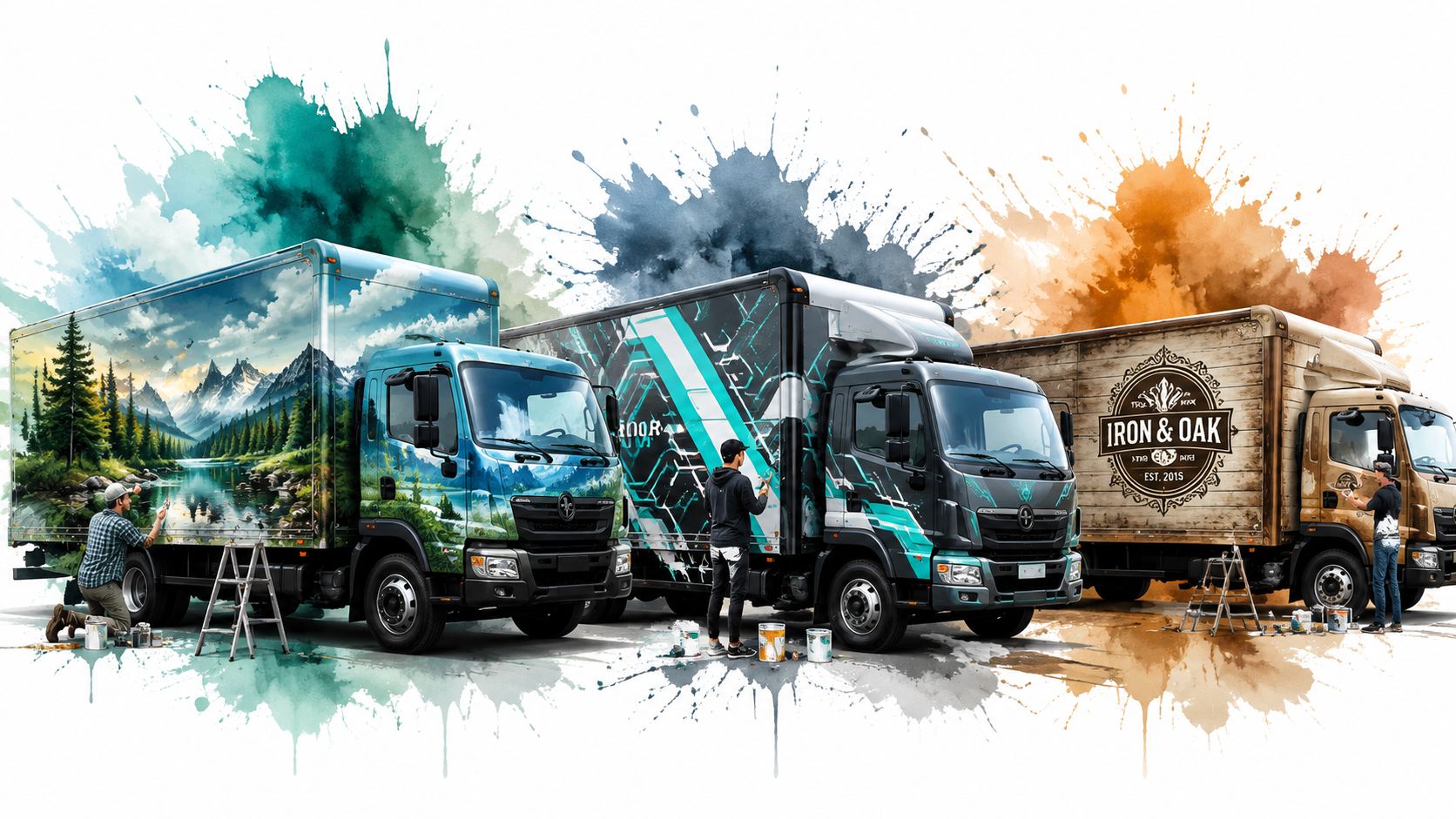
Commercial and fleet looks
Business trucks need to identify fast. On the road, nobody studies a complicated layout for ten seconds. They catch a color block, a company name, maybe one service line, and that is it.
The best commercial designs usually stay disciplined. A door logo, a service name on the bed or box, and contact details placed where they can be read beat a flashy wrap with too much copy. We see this all the time in our shop. Owners come in asking for a full wrap because they want impact, then realize a partial layout or decal package gives them better readability for less money.
Good commercial themes usually include:
- High contrast between text and paint
- One main color family with one accent at most
- Large placement on flat, easy-to-read panels
- Short wording that can be read in motion
Weak commercial themes usually have the same problems:
- Small text low on the truck
- Busy textures behind phone numbers or web addresses
- Long service lists that turn the side of the truck into a flyer
Rugged and off-road themes
This category works best when the graphics feel built into the truck instead of pasted onto it. Mountains, topo patterns, distressed bars, tree lines, claw marks, and terrain shapes all fit because they support the truck's character without fighting its shape.
A full scenic wrap can look great on the right build, especially if the truck already has wheels, suspension, and lighting to match. For a lot of owners, though, the smarter move is a single side treatment that runs with the body. A set of mountain and tree body-side graphics gives that outdoor identity without paying to cover every inch.
Placement matters more than theme alone. Long, low graphics usually make a truck look planted and lengthened. Tall graphics stacked in the middle of the door often feel cramped, especially once mirrors, handles, and badging cut through them.
Military and patriotic themes
Military and patriotic graphics carry weight, so the design has to be handled with some restraint. A truck built as a tribute should look deliberate. A truck built around a tactical theme should still read clean from twenty feet away.
That is why smaller elements often work better here than full coverage. Subdued flags, unit-inspired markings, stars, hood graphics, and bed-side insignias can say a lot without turning the truck into a collage. Camouflage wraps have their place, but they ask more from the install, cost more, and can overpower the rest of the build if the wheels, paint, and trim do not support the look.
The strongest tribute graphics feel intentional. They don't need to shout from every surface.
Later in the process, it helps to look at real installs and motion footage, because some graphics that seem dramatic on-screen read much more subtly once they're on a truck.
Modern and minimalist themes
Minimalist truck graphics are harder to do well than they look. Every line has to earn its place. Every gap has to feel intentional.
This style usually relies on sharp striping, satin or matte accents, geometric cuts, blackout details, and one controlled accent color. The trade-off is simple. There is nowhere to hide bad spacing or awkward placement. If a stripe breaks badly at a door seam or dies into a wheel opening, the whole design feels off.
That is one reason decals often outperform wraps in this category. A single hood accent, lower-door stripe, or bedside shape can give the truck a custom identity while keeping the factory paint as part of the design. Done right, that approach looks more confident than full coverage, and it usually costs a lot less.
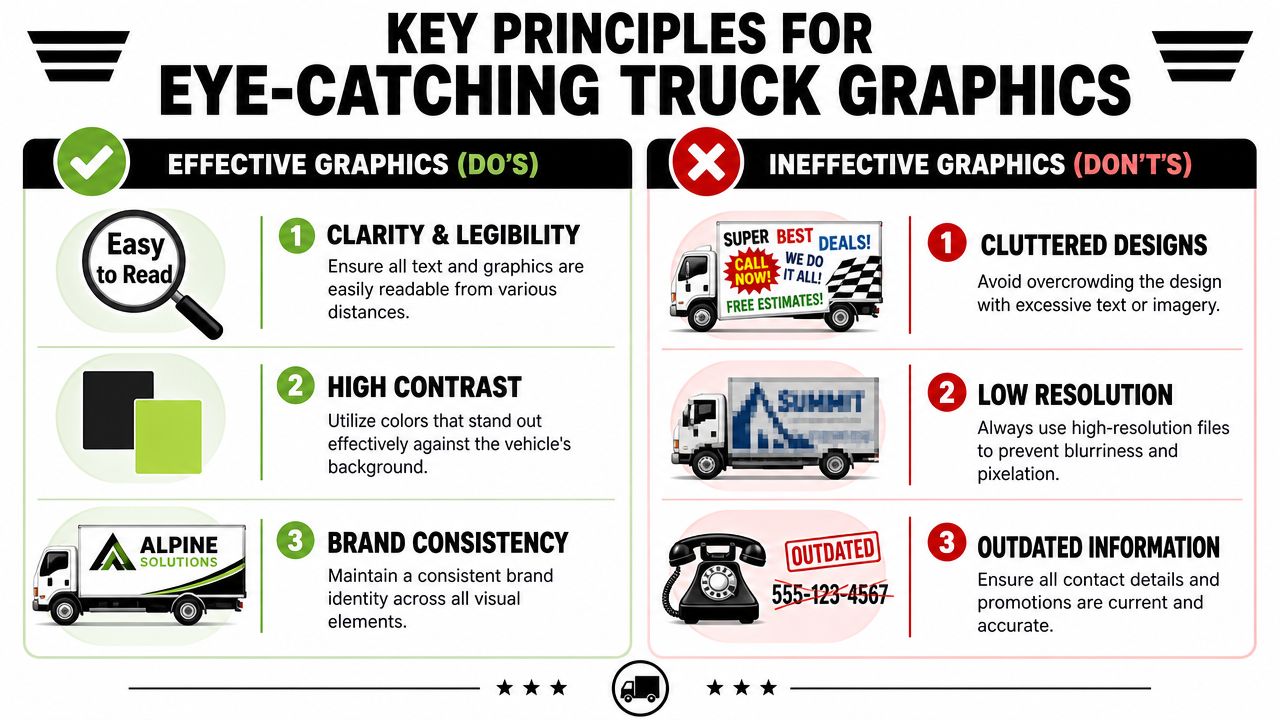
Key Principles for Eye-Catching Truck Graphics
A truck graphic can have great artwork and still fail on the vehicle. That usually happens when the design was made like a poster instead of a three-dimensional object. Trucks have doors, handles, fuel doors, wheel openings, body creases, and panel gaps. Good design accounts for all of it before anything gets printed.
Fit the truck before you judge the art
Professional wrap layouts are often built at reduced size to keep files manageable. One established workflow uses 1/20th scale before sizing up for production, which helps maintain accuracy without creating giant working files, as outlined in this guide to vehicle wrap design scaling.
That technical detail matters because scaling isn't just about file convenience. It forces the designer to think in proportions. A stripe that looks balanced on a flat mockup may dive into a door handle, get split by a body seam, or disappear around a wheel arch if nobody mapped the truck properly.
When reviewing any design, check these points first:
- Door breaks: Does the graphic survive when the doors are open or shut?
- Wheel wells: Do curves stop naturally, or do they look chopped?
- Handles and badges: Are key design elements colliding with hardware?
- Bed and cab relationship: Do both sections feel connected?
Make it readable in motion
Truck graphics are rarely viewed straight on and up close. Viewers catch them at an angle, in traffic, or while walking by. That changes everything.
Dense detail gets lost. Fancy typefaces become a blur. Thin outlines vanish against reflective paint. Big simple shapes win because the eye can process them quickly.
A strong layout usually has a clear hierarchy:
- The main name or theme
- The supporting graphic
- Secondary details, if needed
If someone has only a passing glance, they should still understand the truck.
For personal trucks, that might mean the side graphic should establish the style before any small supporting decal does. For business trucks, the name has to read before the viewer notices any decorative background.
Keep your design language consistent
One of the most common mistakes is mixing too many visual styles. Matte-inspired stripes with chrome-effect lettering, distressed military symbols, and cartoon flames on the same truck almost never land well together.
Choose one design language and stick with it:
- Modern: clean lines, controlled spacing, minimal texture
- Rugged: distressed edges, earthy silhouettes, terrain cues
- Performance: angular striping, speed lines, tighter contrast
- Tribute-focused: strong symbols, respectful spacing, restrained color use
That consistency is what makes a truck look designed instead of decorated.
From Screen to Steel Materials and Application
A graphic that looks good on a monitor still has to survive weather, washing, sunlight, and real-world handling. Material choice matters. So does the installation method.
Custom Sticker Shop uses professional-grade Oracal vinyl rated for up to 7 years outdoors, and that kind of durability is one reason well-made decals remain such a practical alternative to full wraps. You're not buying a temporary novelty piece. You're buying something built for exterior use on a real vehicle.
Why bold art prints better on trucks
Large vehicle graphics don't need the same file density as close-view print pieces. One wrap design checklist notes that 100–150 DPI is often adequate for wrap graphics viewed from distance, which is why big shapes and clean typography usually outperform intricate artwork in this format, as explained in this article on vehicle wrap image resolution.
That's not a license to use poor artwork. It means you should design for the medium. Fine textures, tiny shadows, and hairline details often don't improve the truck. They just create visual noise once installed across curves and seams.
Full-wrap installation versus decal installation
The gap between wraps and decals becomes very real.
A full wrap installation takes planning, alignment, trimming, heat management, surface prep, and experience around recesses and panel transitions. The installer has to manage large printed sections without stretching critical areas out of shape. On a truck, that's serious labor.
Decals are much simpler. Pre-spaced, transfer-taped graphics can be aligned panel by panel without handling giant printed sheets. For many owners, that means driveway installation is realistic if they work slowly, clean the surface well, and measure before committing.
A practical approach looks like this:
- Clean thoroughly: Remove wax, dust, and road film from the application area.
- Test placement first: Tape the decal in position and step back.
- Work from a reference line: Use body lines or measured tape marks.
- Press with control: Smooth from center outward to avoid trapped air.
- Leave the edges alone at first: Let the adhesive settle before aggressive washing.
The easier a graphic is to install accurately, the more likely it is to look professional when it's finished.
That's one reason decals stay so popular. They give truck owners a way to get crisp, intentional graphics without taking on the full complexity of wrap installation.
What to Expect for Cost Durability and Maintenance
A truck owner comes in wanting the full-wrap look, then sees the quote and pauses. That happens all the time. Full wraps can be worth the money, but they are rarely the only way to make a truck look finished, custom, and memorable.
The cost difference is simple. A full wrap prices in complete coverage, more printed material, more installation labor, and more future replacement cost if one area gets damaged. Decals and partial graphics let you spend money where the eye goes first, on the hood, bedsides, doors, rear glass, or tailgate. For a lot of trucks, that is the better buy.
That staged approach also gives owners more control. Start with a side graphic package. Add lettering later. If the truck still needs something, finish it with a tailgate element or a set of custom stripes built through a custom text decal builder for truck graphics. You do not have to commit to re-skinning the whole vehicle on day one.
Where value shows up over time
The upfront invoice is only part of the decision.
A full wrap gives you one big visual reset, but it also gives you one big surface to maintain. If a branch scrapes a bedside or fuel spills stain a printed section near the filler, repairs are more involved. Matching an older printed wrap can be tricky too, especially after sun fade.
Decals are easier to live with. If one piece gets torn, you usually replace that piece. If your business phone number changes, you replace the lettering, not the truck's entire skin. That matters for working trucks, hunting trucks, off-road builds, and any owner who uses the vehicle hard instead of parking it under perfect conditions.
What affects durability most
Material matters, but daily use matters just as much. A well-made graphic on a garage-kept truck will usually outlast the same graphic on a truck that sits outside year-round, runs job sites, and gets pressure-washed every weekend.
Three things have the biggest effect on service life:
- Film quality: Better vinyl and laminate hold color, adhesion, and edge stability longer.
- Surface condition before install: Wax, oxidation, and contamination shorten the life of any graphic.
- How the truck is treated afterward: Sun, chemicals, brush washes, and pressure aimed at edges all wear graphics down faster.
Full wraps usually ask for more attention because they cover more vulnerable area. Decals reduce exposure by covering less of the truck.
Maintenance that actually helps
Owners sometimes overcomplicate this part. The basics do most of the work.
- Hand wash when possible: It is gentler on edges, corners, and laminated prints.
- Keep high-pressure spray away from edges: Water forced into a seam can start lift.
- Clean off salt, mud, and bug residue early: Contaminants left to bake on are harder on both wraps and decals.
- Use mild soap: Harsh cleaners can dull print and weaken adhesive over time.
- Fix small lift early: A tiny edge problem is easier to correct before dirt gets under it.
My practical advice is consistent. Pay for a full wrap if you need full coverage for branding or a complete color change. Choose partial graphics or decals if you want strong style, easier upkeep, and better budget control. For many truck owners, that second path looks better on the road and feels better a year later.
Start Designing Your Truck's New Identity
The strongest truck wraps designs aren't always the biggest ones. They're the ones that know what job they're doing. Some trucks need full coverage. Many don't. A lot of the best-looking builds on the road get their personality from selective graphics placed in the right spots, at the right scale, with the right restraint.
That's the part worth remembering when you're choosing between a wrap, a partial layout, or a decal set. Coverage doesn't create quality. Design decisions do.
If your truck is meant to represent a business, keep it readable and disciplined. If it's a personal build, choose a theme that fits the truck's character instead of forcing a trend onto it. If budget matters, don't treat decals like a compromise. Treated correctly, they're often the sharper move.
When you're ready to act on the idea, start with the category that matches the identity you want. Military-themed owners can browse tribute graphics, off-road drivers can look at Jeep and outdoors-inspired styles, and anyone wanting something personal can create lettering with a custom text decal builder. That's usually the easiest way to move from vague inspiration to a truck that looks finished.
If you're ready to give your truck a sharper identity without overcomplicating the process, Custom Sticker Shop is a strong place to start. They're a family-run, veteran-friendly shop in Topeka, Kansas, making American-made vinyl decals since 2001. With more than 1,200 designs, including 295+ military tributes, 240+ Jeep graphics, and custom text options, they make it easy to build a look that fits your truck and your budget.