
You're probably looking at your Tacoma right now thinking the same thing most owners do at some point. The truck is right. The stance is right. The wheels, rack, tires, or bed setup might already be dialed in. But it still feels a little too anonymous.
That's where stickers toyota tacoma owners keep on their trucks make a difference. Not the bargain-bin stuff that looks tired after one hot season, and not random universal graphics that miss the body lines by half an inch. A good decal should look like it belongs on the truck, hold up to weather and washing, and fit your exact bed, panel, or glass without a fight.
A Tacoma is one of the few trucks where it makes sense to be selective and spend a little more on the graphic. CarEdge estimates the Tacoma will depreciate 22% after 5 years, with a projected 5-year resale value of $34,806 from an assumed new price of $44,395, and their table shows 78.40% retained value after 5 years (Tacoma depreciation data from CarEdge). That kind of long-term ownership changes the sticker conversation. You're not dressing up a temporary vehicle. You're building a truck you may keep for years.
Your Tacoma Is a Canvas Waiting for Personality
You finish a trail run, rinse the dust off the truck, and step back. The suspension, tires, rack, and bed setup all make sense. The Tacoma still looks like every other Tacoma in the parking lot.
That is usually the point where owners start looking at graphics, and it is also where bad choices show up fast. A decal on a truck that gets used has to do more than look good in a product photo. It has to match the body lines, fit the correct cab and bed configuration, and keep its edge after sun, washing, mud, and temperature swings.
A Tacoma earns personalization because it tends to stay in the driveway for a long time. Owners build these trucks around how they live. Work gear during the week. Camping setup on the weekend. Hunting rig, surf truck, overland build, daily commuter, or all of the above. The graphic should reflect that use instead of fighting it.
Why Tacoma owners get selective about decals
The best sticker is rarely the biggest one. It is the one that looks intentional six months later.
On Tacomas, that usually means graphics with a clean fit and a reason for being there. Bedside stripes that track the panel correctly. A topographic pattern scaled to the door or bed instead of stretched until it looks off. Rear window decals that stay readable without blocking too much visibility. Hood and windshield pieces sized for the exact generation, because a decal that fits a third gen poorly will look wrong on a fourth gen even before you start installing it.
Year-specific fitment matters more on these trucks than many buyers expect. Tacoma body lines change just enough between generations, cab styles, and bed lengths to make universal kits look cheap. I have seen good vinyl blamed for failures that were really fit problems. Corners sit under tension, edges land too close to seams, and the graphic starts lifting because it was never shaped for that panel in the first place.
What good personalization looks like on a working truck
Good Tacoma graphics usually share a few traits:
- They fit a specific panel cleanly: The decal follows the shape of the bed, door, hood, or glass without awkward gaps or forced stretching.
- They match how the truck is used: A daily-driven trail truck needs something that can handle repeated washing, sun exposure, and grime.
- They leave room for the truck to age well: Clean designs tend to hold up better than trend-heavy graphics you will want off next season.
- They can be removed without a body-shop surprise: Proper film and adhesive matter if you want a clean panel later.
That last part comes up in the shop all the time. A decal should add character, not create extra work when the owner wants a new look, sells the truck, or replaces a damaged panel. On a Tacoma, the right graphic feels like part of the build, not an afterthought.
Choosing the Right Vinyl for Your Tacoma Sticker
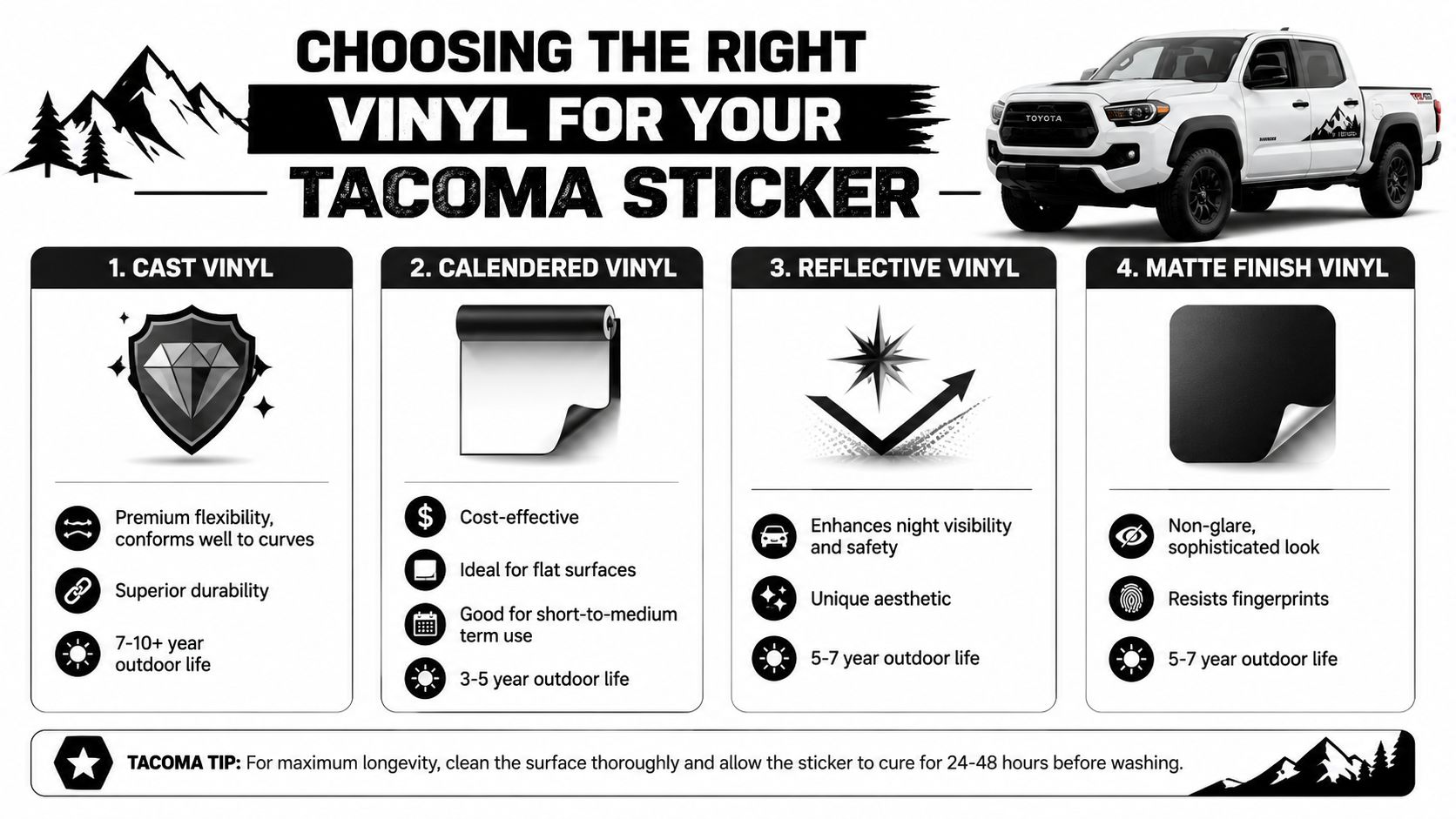
The material decides whether your decal looks sharp for years or starts curling at the first edge after a few months. Most disappointment with truck stickers doesn't come from the artwork. It comes from vinyl choice.
What separates premium vinyl from cheap vinyl
For a Tacoma, UV resistance is the first thing I care about. This truck spends time outside. It sees heat, cold, direct sun, and a lot of owners park it uncovered for long stretches.
Verified product data notes that premium vinyl such as Oracal can maintain color and integrity for up to 7 years because of UV stabilizers, while economy alternatives often fail within 3 to 6 months of sun exposure. For Tacoma use, that can create a 3 to 5x cost efficiency advantage over the vehicle's lifespan (outdoor durability details for Tacoma decals).
That gap is why experienced installers tend to prefer cast vinyl for anything important. Cast vinyl stays more stable, handles curves better, and doesn't fight the panel as hard once the truck heats up and cools down over and over. Economy calendared vinyl can work for temporary use or simple flat areas, but it's the wrong material for owners who expect trail use, pressure washing, and years of outdoor exposure.
Vinyl Sticker Material Comparison
| Feature | Professional Cast Vinyl (e.g., Oracal) | Economy Calendared Vinyl |
|---|---|---|
| Best use | Long-term Tacoma graphics, curves, bedside decals, banners | Short-term graphics, flatter areas |
| Sun exposure | Built for extended outdoor use | More likely to fade early |
| Fit on contours | Conforms better to body lines | Less forgiving on curves |
| Edge stability | Better resistance to lifting when installed well | More prone to shrinkage and lift |
| Long-term value | Higher upfront, lower replacement hassle | Lower upfront, more frequent replacement |
| Who it suits | Owners keeping the truck for years | Owners testing a look or using temporary graphics |
Finish matters too
Material is the foundation, but finish changes the final look.
- Gloss vinyl works well on trucks with factory paint that already has shine. It looks clean and familiar.
- Matte vinyl tones things down. It's a strong match for off-road builds, dark paint, and more subdued themes.
- Satin finishes often land in the sweet spot for bedside graphics because they don't glare as hard and still look finished.
If the decal sits over a body contour, laminate and finish can also affect how the edge behaves over time. On a Tacoma bedside with curves and tension points, that matters.
Buy for the truck's use first, the look second. If the truck sees sun, mud, and washes every month, the wrong vinyl will tell on itself fast.
What works and what doesn't
What works is straightforward. Premium cast vinyl, clean cut lines, good transfer tape, and realistic expectations about surface shape.
What doesn't work is buying based only on color, assuming all “outdoor vinyl” is equal, or sticking a thin cheap decal onto a panel that flexes and gets blasted with water. The Tacoma exposes weak material fast.
A Guide to Tacoma Sticker Sizing and Placement
The smartest Tacoma sticker isn't always the biggest one. Placement is what makes a decal look intentional instead of random.
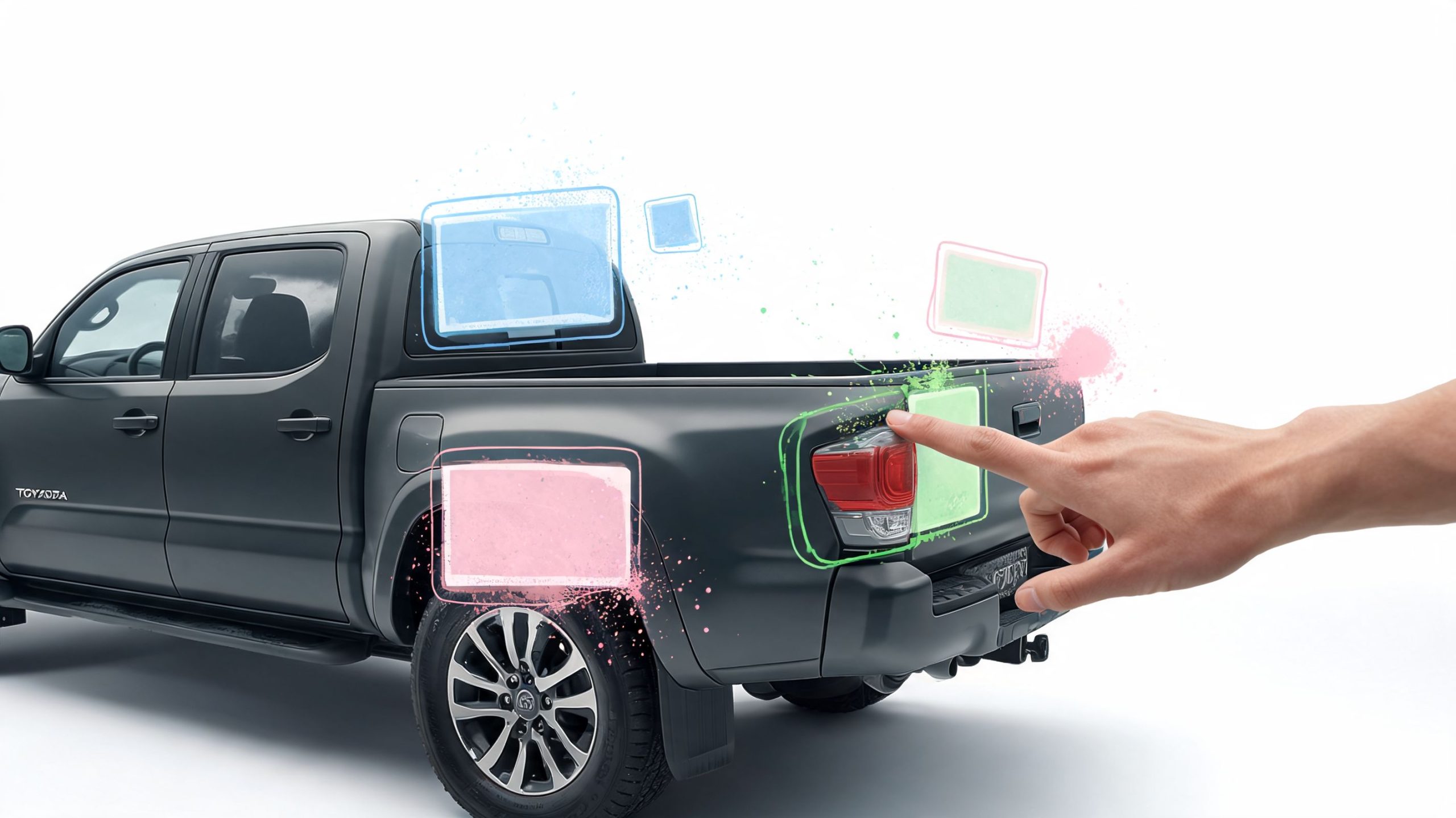
The spots that usually look best
Most Tacoma owners gravitate to a few proven locations.
- Bedside panels: Best for topographic graphics, mountain scenes, TRD-style side graphics, and longer horizontal layouts.
- Tailgate: Good for bold text, cut lettering, and simpler icons that need distance to read well.
- Rear window: Best for smaller statements, brand support decals, or a clean center or corner layout.
- Windshield top edge: Works for a banner if you size it carefully and stay aware of local visibility rules. A custom windshield side banner decal option can make sense when you want a more personalized look without committing to large body graphics.
- Quarter panels and small glass corners: Better for subtle designs, memorial decals, and hobby-related graphics.
Why fitment is where most buyers get burned
Topographic and terrain graphics are popular for a reason. They match the Tacoma's personality and look right on the truck when they're cut well. The problem is that buyers often assume “Tacoma fitment” means all Tacomas.
It doesn't.
Search analysis around Tacoma terrain bedside decals shows a common frustration. Generic decals often don't fit specific trims, bed sizes, or model years, and a decal pre-cut for a 3rd Gen Tacoma bedside won't align correctly on a 2nd Gen (Tacoma terrain bedside fitment notes). That's exactly the kind of mismatch that turns a clean design into a headache.
A simple placement checklist
Before you order, check these details:
- Model generation: First gen, second gen, third gen, and newer trucks all have different panel shapes.
- Bed length: Short bed and long bed layouts change graphic proportion.
- Trim details: Some trims add badges, flares, or panel details that affect the usable area.
- Accessories: Bed caps, liners, racks, and rails can interfere with placement.
- Texture: Smooth painted panels behave very differently from textured plastics.
A decal can be beautifully designed and still be wrong for your truck. Fitment is not a minor detail. It's the whole job.
Size should match distance
Large bedside graphics carry from across a parking lot. Smaller tailgate or rear glass decals reward close-up viewing. If you try to cram too much design into a small area, the truck looks busy. If you undersize a long panel, it looks lost.
The goal is balance. Let the body lines do some of the visual work for you.
Finding a Design That Tells Your Story
A Tacoma says a lot before you add anything to it. The sticker should add to that story, not confuse it.
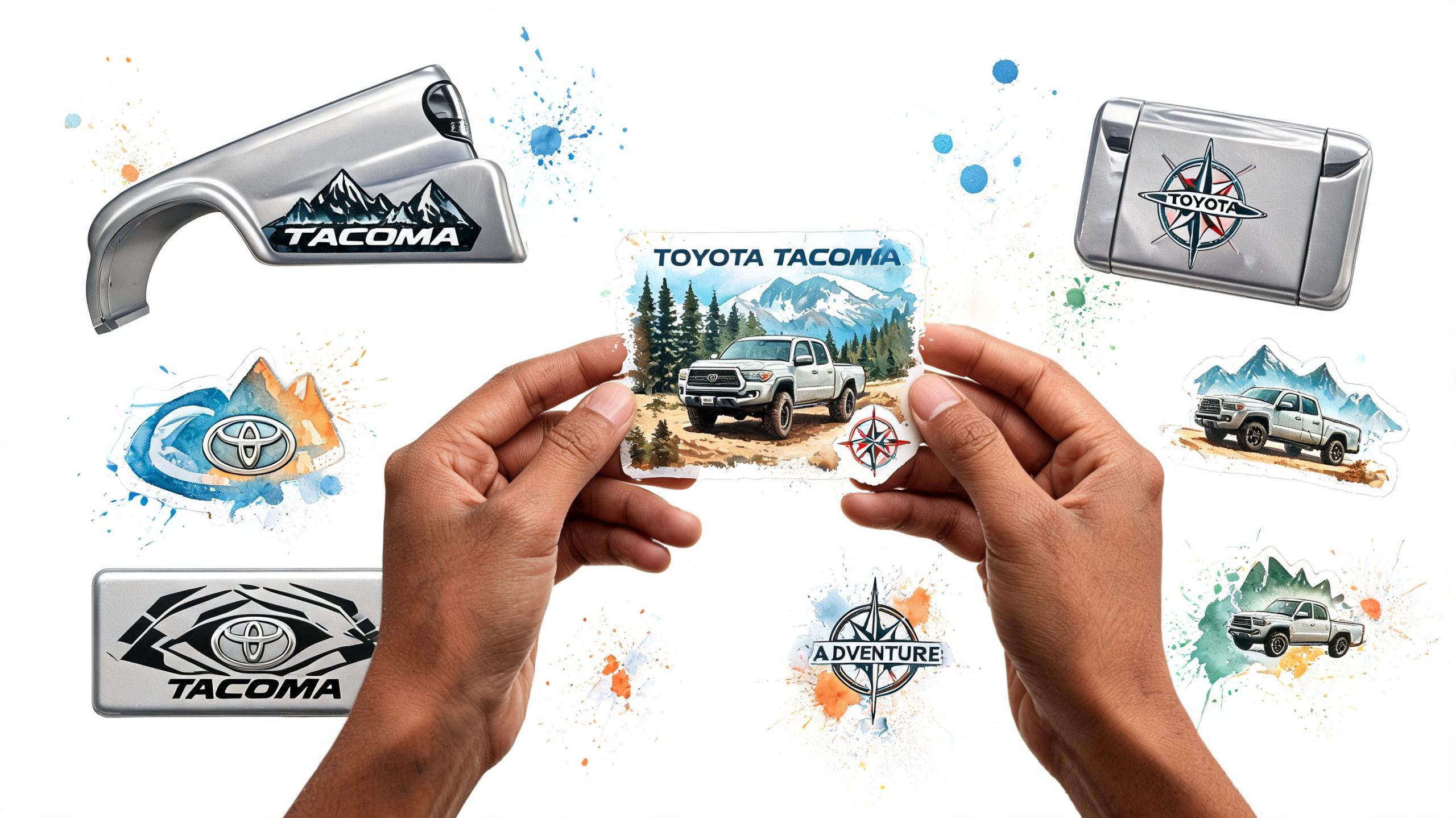
I've noticed Tacoma owners usually fall into a few design lanes. Not because they're copying each other, but because certain themes naturally fit how the truck gets used.
Designs that fit the Tacoma naturally
The first group goes rugged and outdoors-focused. Mountain silhouettes, tree lines, topo maps, antlers, fishing themes, and trail-inspired graphics all make sense on a truck that leaves pavement.
The second group keeps it cleaner. Cut text, low-profile windshield decals, monochrome side graphics, and subtle rear glass stickers give the truck identity without turning every panel into an ad.
Then there's the owner who wants the truck to represent service, family, or a specific part of life. Those are often the decals people keep the longest, because they mean more than a passing style trend.
A decal works best when it reflects the truck owner
One Tacoma might carry a small branch-of-service tribute in the rear window and nothing else. Another might wear a full bedside terrain graphic because the truck lives for camping trips and trail weekends. Another might get custom lettering that names a business, ranch, or family call sign.
That's why broad “best Tacoma decals” lists usually miss the mark. The right design depends on what you want the truck to say.
If you want a one-off look rather than a stock design, a make-your-own custom sticker option gives you more control over text, layout, and meaning than off-the-shelf graphics.
The best truck decal is the one that still feels like your truck after the novelty wears off.
Three design directions that age well
- Geographic and outdoor themes: These tend to hold up because they fit the Tacoma's character.
- Service and tribute graphics: They work when they're respectful, clean, and placed with restraint.
- Minimal custom text: Names, phrases, coordinates, or short identifiers often outlast trend-based art.
What usually ages poorly is overcrowding. Too many unrelated decals break up the truck's shape and make even quality vinyl look cheap.
How to Install Tacoma Decals for a Flawless Finish
A premium decal can still fail if the install is sloppy. On trucks that see dirt, pressure washing, and heat cycles, application technique matters just as much as the material.
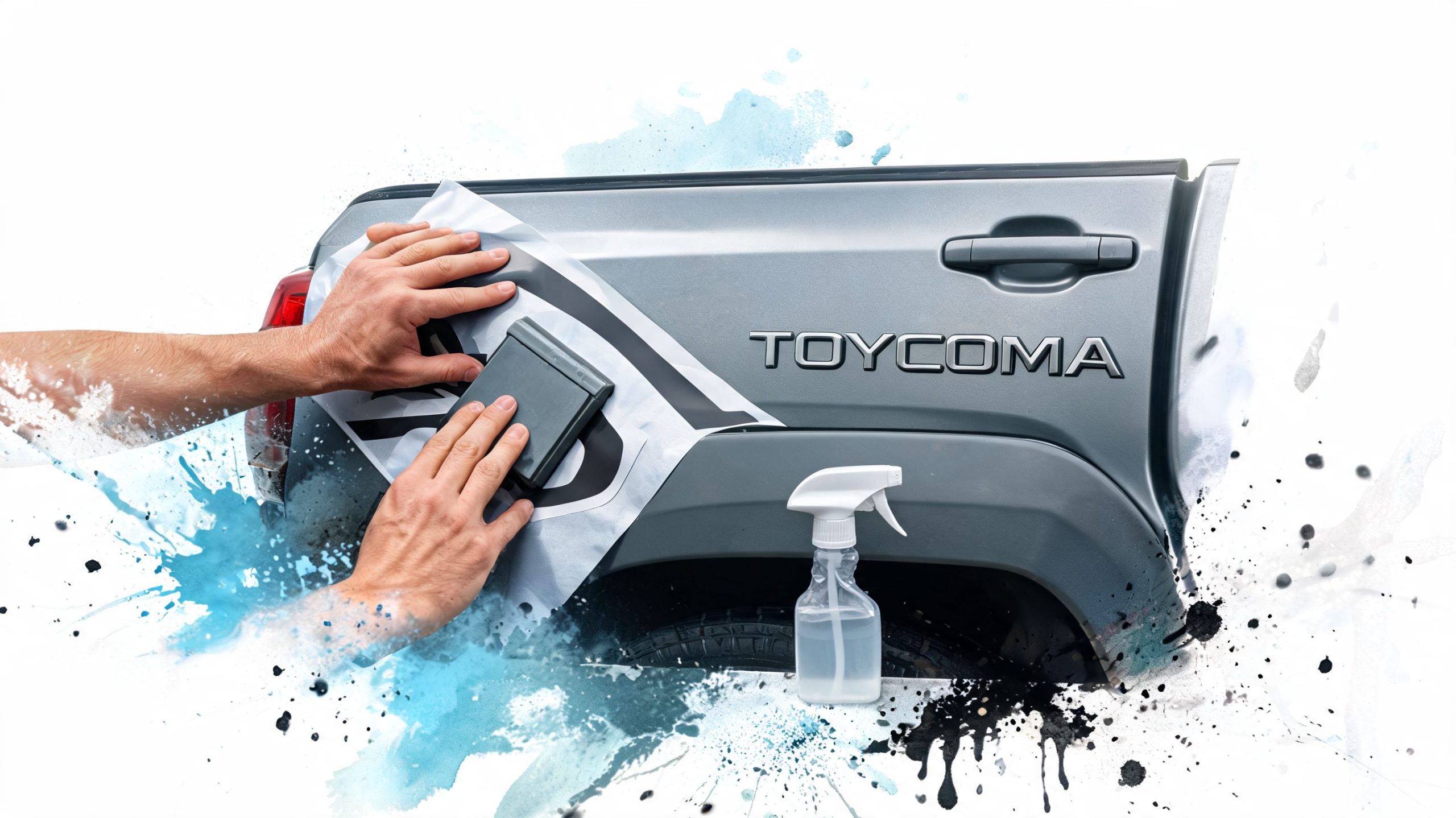
Industry analysis on truck sticker durability points to a simple reality. Real-world performance against mud, pressure washing, and abrasion depends heavily on how the decal is applied, and poor installation can trap air pockets and weak points that lead to edge lifting and early failure (decal durability and application guidance).
Prep the panel first
Don't start with the sticker. Start with the surface.
Wash the area well, then dry it completely. After that, remove any wax, residue, or road film. A panel can look clean and still have enough contamination to interfere with adhesion, especially on bedside sections behind the rear wheels.
If the truck has fresh mud splatter, dust in seams, or leftover dressing from a car wash, the vinyl edge will find it.
The wet method for larger graphics
For larger bedside decals or long side graphics, I prefer the wet method because it gives you working time.
- Test-fit first: Hold the graphic in place with masking tape and step back. Don't trust your eyes from two feet away.
- Mark position: Use tape guides so you can return to the same alignment.
- Mist the panel lightly: You want enough slip for positioning, not so much liquid that the decal floats forever.
- Lay the decal gradually: Start from one side and keep tension even.
- Squeegee from the center out: Push fluid and air out in overlapping passes.
- Let it set before peeling transfer tape: Rushing this step is where a lot of installs go wrong.
Pre-spaced and transfer-taped graphics make this much easier because the spacing is already locked in. A product like this mountains and trees body side graphic set is a good example of the kind of layout that benefits from careful alignment before final pressure.
Common installation mistakes
These are the mistakes I see most often:
- Applying in direct hot sun: The adhesive grabs too fast and the vinyl becomes harder to manage.
- Ignoring body contours: A graphic may need relief, patience, and even pressure to settle correctly over subtle shape changes.
- Under-squeegeeing the edges: The middle looks fine, then the perimeter starts lifting later.
- Peeling transfer tape too aggressively: That can pull fresh vinyl right back off the panel.
Here's a helpful visual walkthrough of the process in action:
What to do if you get bubbles
Small bubbles happen. Most aren't a disaster.
Leave tiny ones alone at first. Some settle as the adhesive cures. For a stubborn trapped spot, work it gently toward the edge if possible. The goal is correction without stretching the film.
Slow hands beat strong hands. Most ruined decals weren't hard to install. They were rushed.
Maintaining and Removing Your Vinyl Decals
Once a Tacoma decal is on correctly, maintenance is simple. The biggest mistake owners make is treating the edges like they're armor-plated.
How to wash without shortening decal life
Hand washing is safest, but machine washing isn't automatically a problem if the decal was installed well and has had time to set. The part that causes trouble is blasting high-pressure water directly into an edge or corner.
A few habits help a lot:
- Wash with normal automotive soap: Skip harsh cleaners unless you know they're safe for vinyl.
- Keep pressure washer spray off the edge line: Spray across the panel, not under the decal.
- Dry with a clean microfiber towel: Dirt trapped in a rough towel can scuff the film surface.
- Inspect corners after muddy trips: Trail grime tends to collect where edge problems start.
Safe removal years later
Good vinyl shouldn't punish you when it's time for a new look. Usually, removal is a heat-and-patience job. Warm the film, lift an edge carefully, and peel steadily instead of yanking.
If you want a solid walkthrough for film removal technique, Carmedics Autowerks' removal methods are worth reviewing because the same patient approach applies to many adhesive films on vehicle glass and painted surfaces. The principle is the same. Controlled heat, gradual lift, and cleanup after the film comes off.
If adhesive remains, remove it gently and avoid aggressive scraping that can mark the clear coat. Slow removal almost always beats force.
Legal Notes and Why to Trust Custom Sticker Shop
You finish a clean Tacoma decal install, step back, and everything looks right until the truck door opens and part of the factory payload label disappears under vinyl. That mistake causes real problems fast. A Tacoma that gets used for towing, camping, or hauling needs every factory label and visibility area left clear.
The simplest rule is still the one that saves the most trouble. Never cover factory safety labels. In 2024, Toyota recalled 33,848 vehicles across several model lines, including some 2024 Tacoma and 2024 Tacoma Hybrid units, because of incorrect weight-capacity stickers on the driver-side doorjamb. Toyota said the label-printing system miscalculated the weight of certain accessories, which could lead owners to overload the vehicle, and the remedy was corrected labels by mail or dealer replacement (Toyota recall details on incorrect weight-capacity stickers). This recall highlights why those labels matter and why aftermarket decals should never cover them.
A few habits keep a Tacoma both legal and practical:
- Leave doorjamb labels fully visible: Payload, tire, and loading information needs to stay readable.
- Use restraint with windshield decals: Local rules vary, but clear sightlines matter even more than the statute.
- Keep away from sensors, cameras, and lighting: Newer Tacoma trims pack more hardware into the body, and a decal placed for looks can create an annoying function problem.
Supplier knowledge shows up in the details. Tacoma owners need graphics cut cleanly, taped properly, and sized for the correct generation and panel shape. A design that fits a third-gen bed side will not always sit right on a fourth-gen truck, and cheap calendared film that looks fine online often shrinks early around recesses, edges, and stamped body lines once the truck sees sun, mud, and pressure washing.
Custom Sticker Shop is a family-run, veteran-friendly decal maker in Topeka, Kansas that has produced American-made vinyl graphics since 2001 using Oracal material rated for up to 7 years outdoors, with pre-spaced and transfer-taped orders, a large design library, and straightforward value details including free U.S. shipping on qualifying orders and a Buy 2 Get 1 Free offer, according to the company's published business information.
That matters for truck owners because the true test is not how a sticker looks on day one. It is whether it fits the panel you ordered it for, installs without a fight, and holds up on a Tacoma that truly gets used.