
You walk out to your Volkswagen, coffee in hand, and your eye goes straight to the same thing every time. The car looks good. It drives right. But it still feels a little too stock, a little too anonymous, like it hasn’t picked up your story yet.
That’s where decals make sense. Good stickers for Volkswagens don’t need to shout. A small quarter window graphic on a GTI, a tasteful windshield banner on a Beetle, a military tribute on a rear glass, or custom script on a Bus can change the whole personality of the vehicle without turning it into a rolling billboard.
The trick is getting the details right. Volkswagens have their own body lines, their own quirks, and in some cases their own heat and surface challenges. A decal that looks perfect on a flat pickup back window can look awkward on the curved glass of a New Beetle. A cheap vinyl that survives on a garage-kept commuter may fail fast near an older VW engine bay or on a daily-driven hatch that sees hard sun, winter salt, and frequent washing.
That’s the difference between buying a design and choosing the right decal. One is impulse. The other is fit, material, placement, and knowing what belongs on a VW.
Your Volkswagen Is a Canvas for Personal Style
You park next to a row of other VWs at a meet, and yours is the one that still looks factory. Clean, yes. Finished, not quite. That is usually the point where owners start looking at decals, not to cover the car up, but to give it some identity without fighting the design Volkswagen already got right.
That approach works especially well on VWs because these cars respond to restraint. A Golf has crisp shoulders and straight visual lines. A Beetle carries more curve, so the same sticker that looks tidy on a GTI can look crowded or off-balance on rounded glass and fenders. Older air-cooled models add another variable. Heat around the rear of the vehicle asks more from the material than many bargain decals can handle.
VW owners also come at styling from very different directions. Some want vintage script that fits a Bus or Type 3. Some want a sharp Euro look on a Jetta or Mk7 Golf. Some want club decals, military tributes, family graphics, or a small quarter-window mark that only another VW person will notice. If you spend time around the heritage side of the hobby, the stories and photos around VW Kombi lifestyle make that pretty clear.
What decals do well on a Volkswagen
The best setups usually respect the car first.
- Small side glass decals: Good for club names, initials, subtle logos, and heritage artwork.
- Windshield banners: Best when the height fits the glass properly and does not overpower the front end.
- Body-side accents: Strong on Golfs and Jettas when they track with a factory crease instead of cutting across the panel.
- Rear glass decals: A smart spot for family graphics, tribute pieces, and custom text that stays visible without dominating the vehicle.
A simple shop rule has saved plenty of customers from ordering the wrong graphic. If a decal only looks right once it gets oversized, it usually does not belong on that Volkswagen.
For owners with a specific idea, a make your own custom sticker option often fits better than forcing a generic layout onto a car with its own proportions. That matters even more on Volkswagens, where body lines, glass shape, and long-term durability all affect whether a decal looks like it belongs there.
Understanding Vinyl The Foundation of a Great VW Sticker
The biggest mistake buyers make is thinking all decals are basically the same. They aren’t. Design gets attention first, but material and construction decide whether the decal still looks good after weather, washing, heat, and time.
The first distinction to understand is die-cut vinyl versus full-color printed decals. If you think of a die-cut decal as a precision stencil and a printed decal as a photograph, you’re already most of the way there.
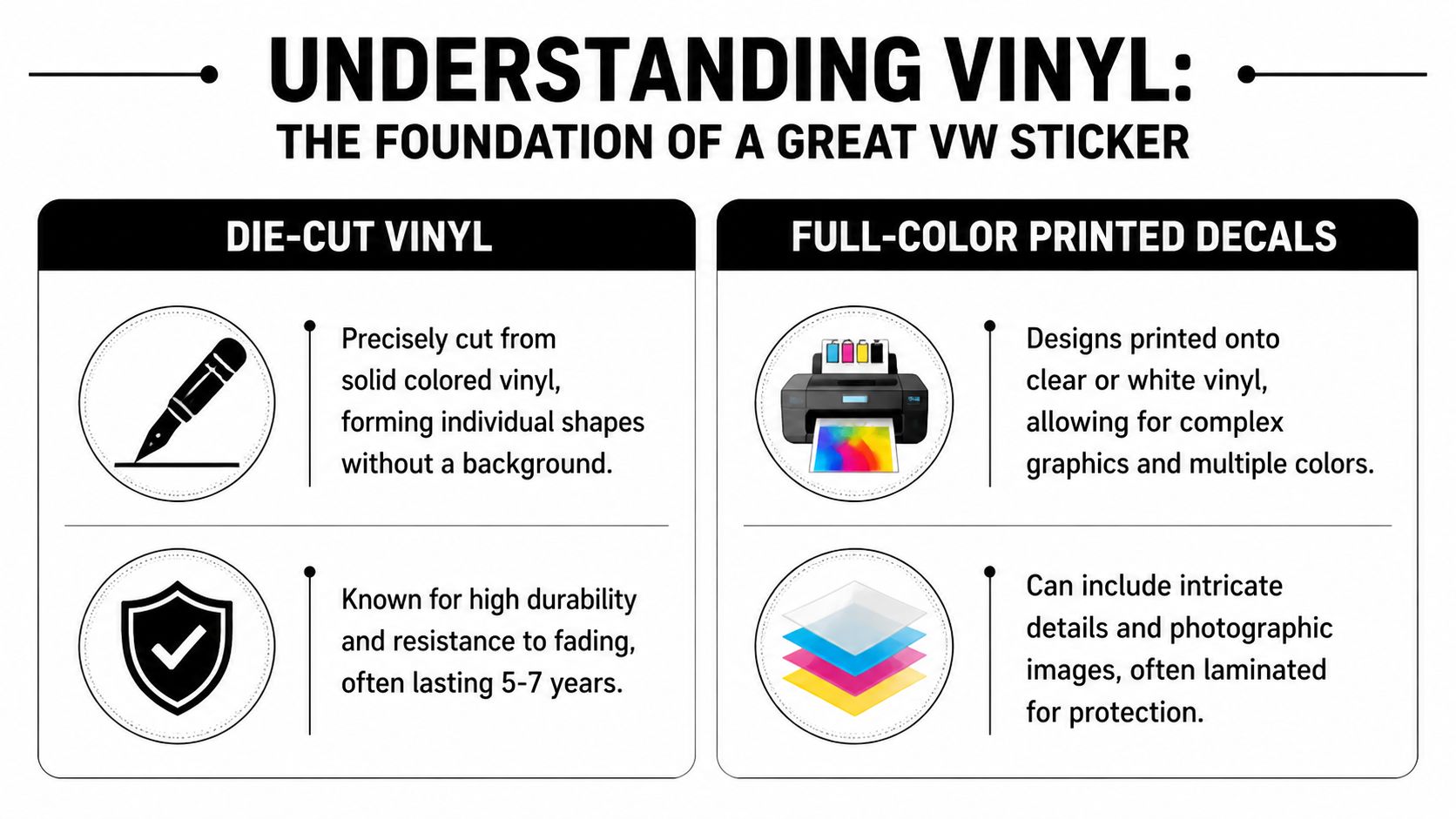
Die-cut decals
A die-cut decal is cut from a sheet of colored vinyl. The background gets removed, and only the letters, shapes, or artwork remain on the car. That’s why a clean die-cut sticker can look almost painted on when it’s installed well.
These are usually the right choice for:
- Lettering and names
- Simple logos
- Windshield banners
- Minimalist Euro-style graphics
- Tribute decals with strong shapes
Die-cut vinyl tends to suit Volkswagens especially well because VW styling often rewards restraint. A neat one-color design on quarter glass or rear glass usually looks more intentional than a busy print.
Printed decals
Printed decals work differently. The design gets printed onto vinyl, often on white or clear material, and may be laminated for added protection. This is the route for multicolor art, gradients, illustrated graphics, and more complex compositions.
Printed decals make sense when you want:
- Detailed artwork
- Multiple colors in one piece
- Illustrated or layered graphics
- A design that can’t be built cleanly from cut solid-color vinyl
Printed work can look excellent, but it’s less forgiving on a Volkswagen if the design is too busy for the panel. A Beetle can carry playful graphics. A Golf R usually looks better with stronger discipline.
Die-cut Vinyl vs. Printed Stickers at a Glance
| Feature | Die-Cut Vinyl Decals | Full-Color Printed Stickers |
|---|---|---|
| Appearance | No background. Only the cut design remains | Printed design on vinyl surface |
| Best for | Text, logos, simple shapes, banners | Complex artwork, multicolor graphics |
| Visual style on VWs | Clean, factory-like, understated | More expressive, more graphic-heavy |
| Edge look | Crisp cut outline | Printed edge around the design area |
| Surface impression | Often looks closest to painted lettering | More like an applied graphic panel |
Material grade matters more than most buyers realize
Type is only half the conversation. Grade matters too.
In plain terms, lower-grade vinyl is less cooperative on curves, recesses, and compound shapes. Better vinyl lays down cleaner, resists shrinkage better, and keeps its shape longer. That matters on Volkswagens because many of the best decal spots aren’t perfectly flat. Beetle glass curves. Golf hatch glass has contour. Even door sections that look simple can have subtle changes in plane that expose bad material fast.
Cheap vinyl usually fails at the edges first. That’s where you see lifting, dirt lines, and the “temporary sticker” look.
If you’ve ever seen a decal that looked good in the product photo but looked tired within a season on a car, material was probably the issue. Sometimes the design gets blamed when the actual problem was vinyl that didn’t have the stability for automotive use.
Matching the decal type to the job
The right choice comes down to what you want the decal to do.
- For a clean OEM-plus look, die-cut usually wins.
- For a character piece on a Bus or a fun family design, printed may make more sense.
- For windshield text, stick with cut vinyl.
- For small detailed art, printed can carry information a cut decal cannot.
Volkswagen owners usually do best when they edit hard. Pick one visual idea and let it breathe. A single well-placed decal on the right surface nearly always beats a collection of mismatched stickers scattered around the car.
Choosing Your Material for Maximum Durability
A Volkswagen decal earns its keep after the first hot summer, the first freezing wash, and the first year of parking outside. If it fades fast, shrinks at the edges, or turns brittle on the glass, the problem usually starts with material choice.
Volkswagens are hard on weak vinyl in model-specific ways. A Golf or GTI spends its life catching sun on broad hatch glass and flat roofline panels. A Beetle puts more stress on a decal because the surfaces curve sooner and more often. Older air-cooled cars add steady heat cycling around the rear of the vehicle, which can expose cheap film in a hurry.
That is why I pay attention to stated outdoor life and film quality, not just color and finish. A good shop should be able to tell you the brand, the grade, and the intended use without dancing around the question. In our trade, Oracal 7-year film is a common benchmark because it holds color, stays cleaner at the edges, and handles real automotive exposure better than bargain vinyl sold with vague "weather resistant" language.
What durability looks like on an actual VW
Durability is not one thing. On a Volkswagen, it usually comes down to four stress points.
- UV exposure: Dark colors and south-facing glass take a beating. Better vinyl keeps its color instead of washing out.
- Heat cycles: Rear-engine classics and black hatch glass both create repeated expansion and contraction. Poor film starts to pull back at corners and tips.
- Moisture and chemicals: Road salt, bug remover, wash soap, and hard water all test the face film and adhesive.
- Placement near problem areas: Fuel doors, lower rockers, and engine-adjacent panels see more grime, vapor, and temperature change than buyers expect.
A windshield banner is a good example. It looks simple, but it lives on glass that gets hot, cold, and constantly scrubbed. That is why cut lettering in quality film usually lasts better than cheap printed stock for that job. If you want a reference for the format, a VW-style windshield banner decal layout shows the kind of proportion and material use that tends to hold up well on automotive glass.
Where buyers get burned
The failure pattern is usually predictable.
Cheap vinyl often looks acceptable out of the envelope. Problems show up later. Edges collect dirt. Tight points lift first. Gloss turns dull. On a clean Volkswagen, especially one with straight body lines like a Mk7 Golf, those failures stand out fast.
Installation mistakes make it worse. Wax residue, tire shine overspray, cold panels, and textured trim can ruin even decent film. Good vinyl gives you a bigger margin for error, but it does not forgive bad prep forever.
A practical way to choose
Ask a few direct questions before you buy:
- What brand and grade of vinyl is it? "Permanent vinyl" is not a useful answer.
- Is it intended for exterior automotive paint or glass? Craft vinyl and car vinyl are not the same job.
- How long is it rated for outdoor use? A real answer should be specific, not vague.
- Is the design appropriate for the panel? Large graphics on a Beetle's curved surfaces need better film than a small die-cut on flat hatch glass.
- Will it arrive properly masked and ready to install? Pre-spaced decals usually go on cleaner and stay cleaner.
A good sticker should age like the car, not faster than it. Volkswagens have enough character on their own. The right material keeps the decal looking intentional instead of temporary.
Perfect Sizing and Placement for Popular VW Models
You park next to another Volkswagen at a show, and both cars are running nearly the same decal. One looks crisp and intentional. The other looks like it was slapped on after the fact. On VWs, that difference usually comes down to sizing and placement, not the artwork itself.
Volkswagen shapes are specific. A Mk7 Golf gives you clean horizontal references. A Beetle gives you curves and very little forgiveness for oversized graphics. Older air-cooled cars add another variable, too. Heat around the engine lid and rear apron can punish poor placement or cheap film faster than owners expect.
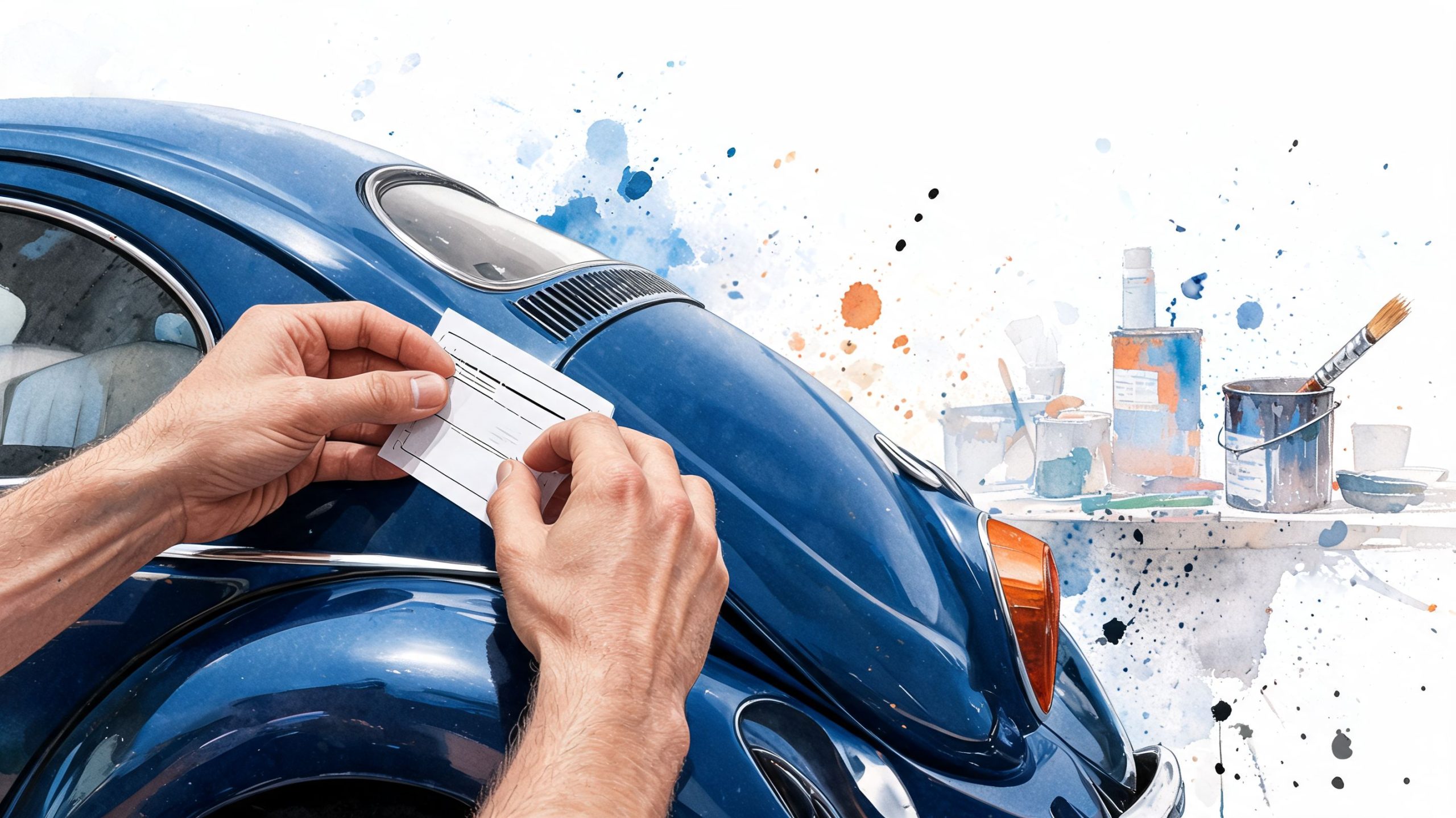
Golf and GTI
Golfs and GTIs are easy to decal well if you respect the factory lines. The rear quarter glass, lower hatch glass, and rocker area are usually the safest spots because the car already gives you strong geometry to follow.
Keep side graphics low and parallel to the body. If a decal climbs at its own angle, it fights the hatch shape and looks wrong fast. I usually steer owners toward longer, slimmer graphics instead of tall artwork, especially on newer Golfs where the sheet metal is already doing plenty of visual work.
Windshield banners need the same restraint. Narrow text almost always suits a Golf better than chunky lettering. The top edge of the glass tapers, so proportions matter more than people think. A windshield banner decal layout is a useful reference point for width and height before you cut one for a VW.
Beetle and New Beetle
The Beetle is where scaling mistakes show up immediately. Rounded panels can make a small decal look charming and period-correct. That same curvature can make a large flat graphic look awkward, especially on the hood or door.
Good placements usually include:
- Small hood decals with plenty of paint left around them
- Quarter glass graphics
- Rear window decals sized to the rounded opening
- Windshield banners with softer curves and extra margin at the corners
Classic Beetles reward subtle placement near the rear side windows and lower glass. New Beetles can handle more playful graphics, but they still look better with one clear idea instead of several unrelated stickers. On air-cooled cars, I also avoid placing decorative vinyl too close to high-heat areas around the engine lid unless the material is up to the job. Better film holds up longer there, and cheap film tends to shrink at the edges.
Jetta, Passat, and Arteon
Sedans tempt owners to go too big because the doors and quarter panels look wide open. The better move is usually the opposite.
A slim stripe, lower-door text, or one well-sized rear glass decal works with the car’s length. Large vertical graphics in the middle of the doors interrupt the clean surfaces and can make a good sedan look busy. The Arteon especially benefits from restraint because the roofline and side profile already carry a lot of style.
Leave room around the decal. On a sedan, negative space helps the graphic read cleanly.
Tiguan, Atlas, and other larger Volkswagens
SUVs can carry more visual weight, but they still need balance. A tiny sticker on an Atlas rear window often looks accidental. A properly scaled rear glass decal or a modest side graphic usually fits the vehicle better.
Panel size alone should not decide decal size. Window shape, beltline height, trim breaks, and how the doors open all matter. On Tiguan and Atlas models, I usually measure the visible glass area first, then scale the design so it fills the space without crowding the edges.
The factory stickers you should never cover
You should never cover factory data labels on a Volkswagen. The VAG options data sticker carries information that shops and owners use to identify equipment, engine details, and other build information. If that label is on the door jamb, in the spare tire well, or in another factory location, leave it visible. Ross-Tech forum guidance on VAG data stickers is a good reference if you want to confirm what you are looking at.
The same rule applies to original information labels and window documentation that came with the car. The original vehicle information is important for verification, resale, and restoration work. Decorative vinyl should frame those areas, not cover them.
A simple placement test before you install
Before you peel the backing, tape the decal in place and walk the car.
- Check it straight on.
- Check it from a front and rear angle.
- Make sure it follows the body lines.
- Open the doors, hatch, or hood if the decal sits near a seam.
- Confirm it clears any factory labels and trim edges.
That two-minute check saves a lot of rework. On a Volkswagen, a decal should look like it belongs on that exact model, not like it was sized for something else and made to fit.
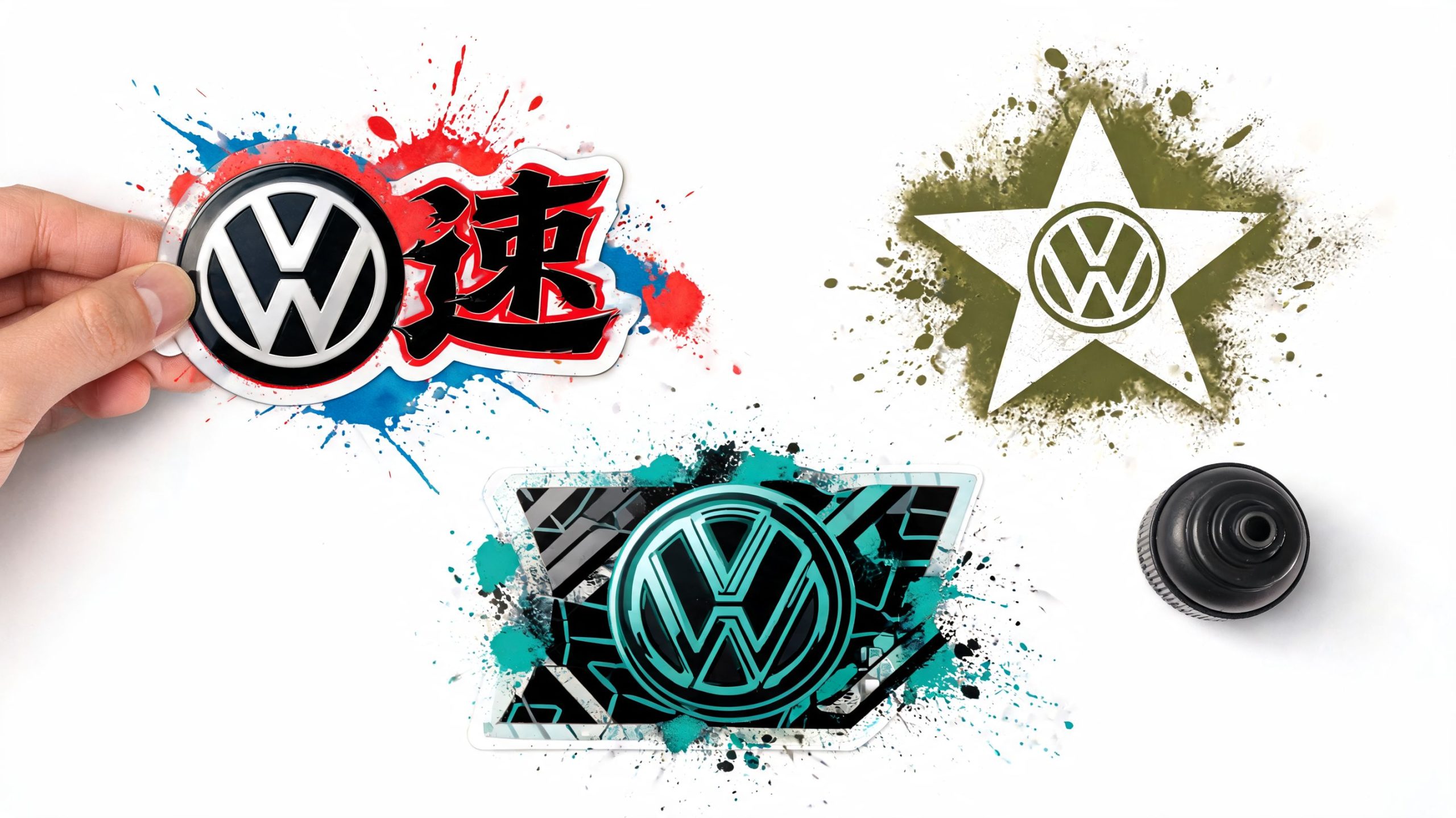
VW Sticker Design Ideas From JDM to Military Tributes
Volkswagen style isn’t limited to one lane. Some owners want that lean, tuned, import-inspired look. Others want something sentimental, patriotic, playful, or personal. The best sticker choices match the way the car is used and the personality of the owner.
Euro-clean and understated
This is the safest and often the sharpest direction for a Volkswagen. Think small windshield text, subtle monochrome logos, low-key side glass graphics, and simple typefaces.
A clean Mk6 or Mk7 Golf responds well to this because the car already has strong design. You’re adding punctuation, not rewriting the sentence.
JDM-inspired graphics on Volkswagens
Some VW owners like crossing scenes a bit and borrowing from the tuner world. That can work if you keep the scale under control and don’t stack too many visual cues at once.
A bold but compact circle-style tuner decal works well on side glass or the lower corner of a rear window. Something like a JDM circle decal style fits that lane better than a giant door graphic.
The key is making it feel curated, not random. A Jetta GLI or GTI can wear tuner-inspired stickers well if the rest of the car supports the look.
Military tributes and service-pride decals
These carry meaning beyond aesthetics, so they deserve thoughtful placement. Rear glass is usually the best home because the tribute stays visible without interrupting the flow of the body panels.
For military-themed decals, keep the lines clean and avoid crowding them with unrelated graphics. A tribute sticker gets lost when it’s jammed between novelty decals and oversized text.
A meaningful decal deserves its own space. Don’t make it compete with three other messages.
Family decals and custom text
Volkswagens often serve daily life as much as hobby life. Family name decals, kid-themed graphics, pet references, and custom phrases all have a place if they’re done neatly.
The trick is choosing placement that feels deliberate:
- Rear side glass for names or silhouettes
- Lower rear window corners for smaller family graphics
- Hatch glass center or upper corner for custom text with better visibility
On wagons and SUVs, these can look especially natural because the glass area gives you room without forcing the decal onto paint.
Vintage Bus and air-cooled personality
Air-cooled VWs can carry more charm, more humor, and more nostalgia than most modern cars. That doesn’t mean covering every panel. It means choosing graphics that fit the era or the spirit of the vehicle.
Older Buses can wear travel-style decals, club logos, retro script, or location-inspired graphics well. Beetles can carry heritage motifs, old-school typography, or simple icon graphics that feel right at home. The best designs look collected, not cluttered.
A good rule for any style is this: if every sticker tells a different story, the car starts reading like a scrapbook. Pick one theme and let the Volkswagen amplify it.
Installation and Removal Without Damaging Your VW
A quality decal can still look bad if the install is sloppy. Most problems come from rushing, working on a dirty panel, or trying to force vinyl onto a surface that wasn’t prepared correctly.
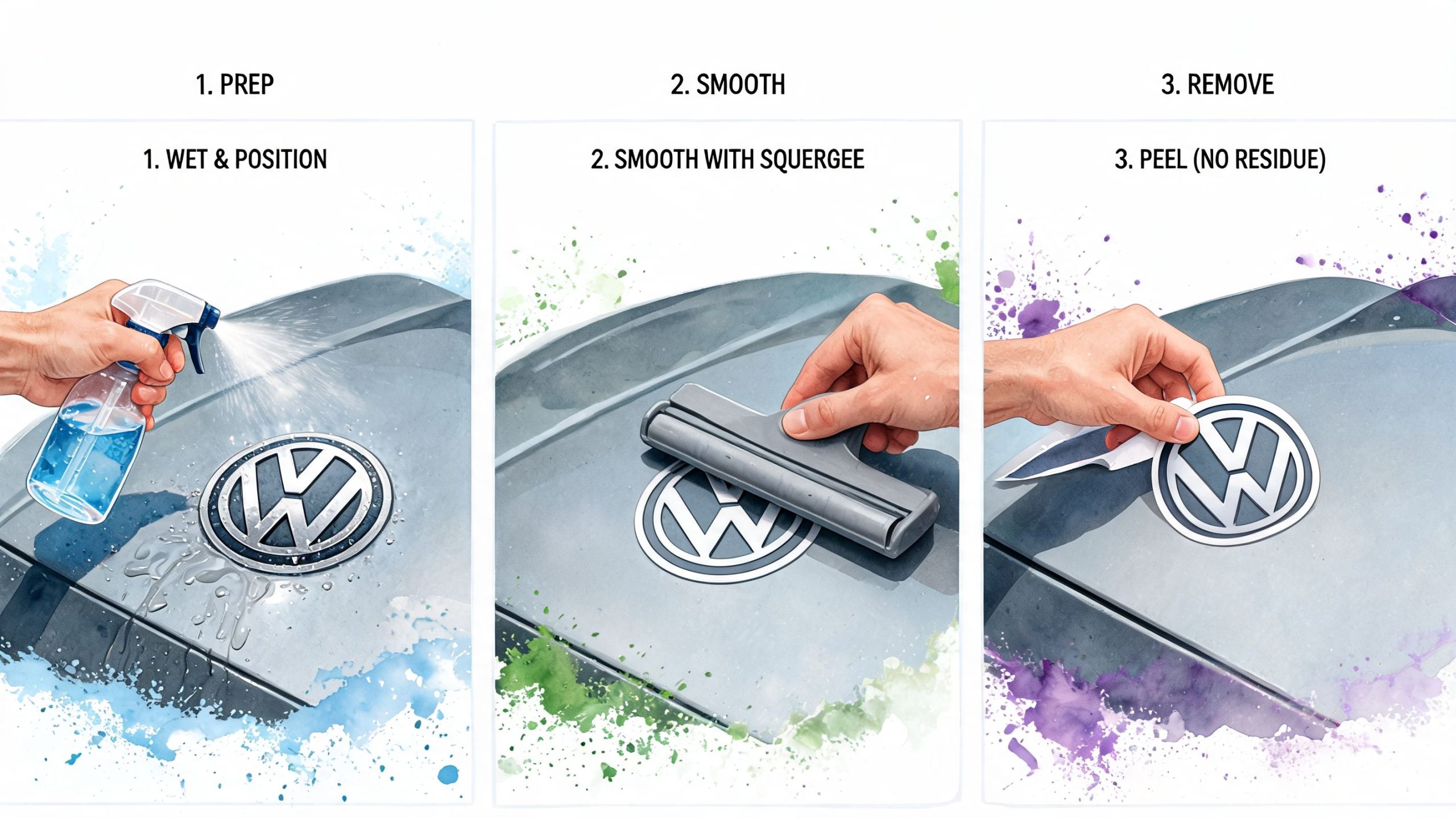
A clean install starts before the backing peels
Wash the area first. Then remove any leftover wax, quick detailer residue, or oily dressing from the exact spot where the decal is going. Paint and glass need to feel clean, dry, and squeak-free.
For many Volkswagen surfaces, especially glass and smooth paint, pre-spaced transfer-taped decals make installation much easier because the spacing is already set. You’re placing one assembled design instead of wrestling with separate letters or pieces.
The basic install process
Use a calm, methodical approach.
- Position the decal with masking tape. Step back and confirm level and spacing.
- Create a hinge. Tape one edge so the graphic stays aligned when you lift it.
- Peel the backing carefully. Make sure the vinyl stays attached to the transfer tape.
- Lay it down gradually. Use a squeegee or firm card wrapped in a soft cloth.
- Work from the center outward. Push out air as you go.
- Remove the transfer tape slowly. Pull it back at a sharp angle, not straight up.
If you prefer seeing the motion and hand pressure in real time, this install video helps:
Wet application or dry application
Small decals often go on dry just fine. Larger text or graphics on glass can benefit from a light wet method if the vinyl and application style allow for it. The point isn’t to soak the panel. It’s to give yourself a little slide and a little forgiveness before final squeegee pressure.
Use restraint. Too much fluid can slow bonding and create its own headaches.
Apply decals in moderate conditions. Very cold panels, hot direct sun, or a windy driveway all make good work harder.
Aftercare on a Volkswagen
Leave the decal alone for a bit after installation. Don’t scrub it right away, and don’t hit fresh edges with aggressive pressure washing.
A few maintenance habits help:
- Hand wash thoughtfully: Avoid digging a wash mitt into decal edges.
- Be careful with brushes: Automatic washes can be rough on older or poorly installed graphics.
- Skip harsh scraping: Frost removal on glass decals should be gentle.
- Watch trim dressings: Sling and oily residue can contaminate edges over time.
Safe removal when it’s time for a change
Removal doesn’t need to damage paint if you do it patiently. Warm the decal with a hairdryer until the adhesive softens, then lift a corner with your fingernail or a plastic edge and peel slowly.
If adhesive remains, use a paint-safe adhesive remover sparingly and wipe clean. Don’t attack the panel with metal tools, razor blades on paint, or brute force. Most removal damage comes from impatience, not from the decal itself.
Volkswagens tend to keep a crisp look when the graphics are either fresh and well installed or removed cleanly. Half-failed decals are what hurt the finish visually. If the sticker’s life is over, take it off before it starts dragging the whole car down.
Your Volkswagen Sticker Questions Answered
Can I apply decals to textured plastic trim
Usually, smooth paint and smooth glass are the safest surfaces. Textured trim can be hit or miss because the adhesive only contacts the high points of the texture. Small simple decals may hold better than detailed lettering, but if you want a lasting result, smooth surfaces are the better choice.
Are windshield stickers legal
That depends on local rules and how much of the driver’s view the decal blocks. Keep banners and corner decals positioned high and sized sensibly. If there’s any doubt, check your local regulations before installing.
Will a sticker damage factory paint
A quality decal applied to sound paint and removed carefully usually won’t damage the finish. Trouble starts when paint is already failing, has been poorly repainted, or the decal is yanked off cold and fast.
What about leased Volkswagens
Leased vehicles can still wear decals if you stick to removable placements and avoid anything that could leave a bad impression at turn-in. Glass is often a safer choice than large paint graphics. Remove the decal carefully before inspection.
Can I install decals over paint protection film
Maybe, but test your approach carefully. The issue isn’t only whether the decal will stick. It’s whether removal later could affect the film. If the car has PPF, check with the film installer or manufacturer before applying anything over it.
Should I put a decorative sticker near factory labels
No. Keep clear of technical and official labels, especially the VAG data sticker areas covered earlier. Those labels serve a purpose, and covering them creates unnecessary problems later.
If you want stickers for Volkswagens that suit the car, start with fit, material, and placement, not just artwork. Custom Sticker Shop is a solid place to browse American-made vinyl decals with a wide range of styles, from clean text and tuner-inspired graphics to family and military tribute options.