
Your truck sits outside through rain, road spray, freezing mornings, and the occasional rushed car wash. The decal on the back glass has to live through all of it. That is why the key question is not whether vinyl sounds durable on a product page. It is whether the full sticker build was made to keep water from becoming the reason it fails.
Quality vinyl stickers handle normal outdoor wet conditions well, and a properly made decal can last for years on a vehicle. The catch is that water usually does not destroy the face film first. It gets in at the weak point. That might be ink that was not protected, adhesive that loses grip at the edge, or a laminate that was skipped on a print that needed it.
That distinction matters on a vehicle.
A truck window decal, Jeep banner, or rear glass sticker deals with more than rain. It sees wash cycles, road salt, grime, heat, cold, and repeated expansion and contraction across the panel. A listing that says "waterproof vinyl" only tells part of the story. The material can be vinyl and still fail early if the print system, adhesive, and finishing were not chosen for outdoor use.
In our shop, that is the part we watch closely. Vinyl is the base. Ink durability affects whether the graphic fades, blurs, or starts looking worn after repeated exposure. Adhesive quality decides whether the edges stay down once moisture and dirt start working at them. Laminate adds another layer of protection, but only when it matches the job. For some decals, it is a smart upgrade. For others, the wrong laminate can add cost without solving the underlying problem.
A waterproof sticker is a system, not a single material. That is the difference between a decal that still looks clean after seasons on the road and one that starts peeling after a few wet weekends.
Are Vinyl Stickers Waterproof and What That Really Means
Most vehicle owners don't buy a decal because they want something “technically vinyl.” They buy it because they want it to stay put and keep looking good on a real vehicle that lives outside, gets washed, and sees changing weather.
The honest answer is yes, vinyl stickers are waterproof for normal wet-use conditions when they're made with the right materials. But that answer only helps if you know what “normal wet-use conditions” includes, and where the weak points are.
What a car owner should assume
For a quality vehicle sticker, you should expect it to handle:
- Rain and road spray: Regular exposure from driving and parking outside.
- Splashes and condensation: The kind of moisture that builds up in daily use.
- Routine washing: Especially gentle hand washing and ordinary exterior cleaning.
You should not assume every vinyl sticker is built for:
- Long soaking
- Constant edge saturation
- Aggressive wash methods
- Harsh chemical exposure
That gap is where a lot of disappointment starts. A buyer sees “vinyl” and hears “indestructible.” A maker sees vinyl and knows the material is only one piece of the puzzle.
The three parts that decide durability
A waterproof result comes from three working parts:
| Part | What it does | How it fails |
|---|---|---|
| Vinyl film | Repels water and forms the body of the sticker | Can still lift if edges are stressed or the surface prep was poor |
| Ink layer | Holds color and detail | Can smear, fade, or bleed if the print system isn't suitable |
| Adhesive | Keeps the decal bonded to the panel or glass | Can let water creep in from edges and corners |
Practical rule: Don't judge a vehicle decal by the word “vinyl” alone. Judge it by the full construction.
That's why two stickers can look almost identical on day one and perform very differently a few months later. One was built like an outdoor graphic. The other was built like a craft sticker with better marketing.
Understanding Waterproof vs Water-Resistant Stickers
A lot of confusion comes from these two terms getting used as if they mean the same thing. They don't.
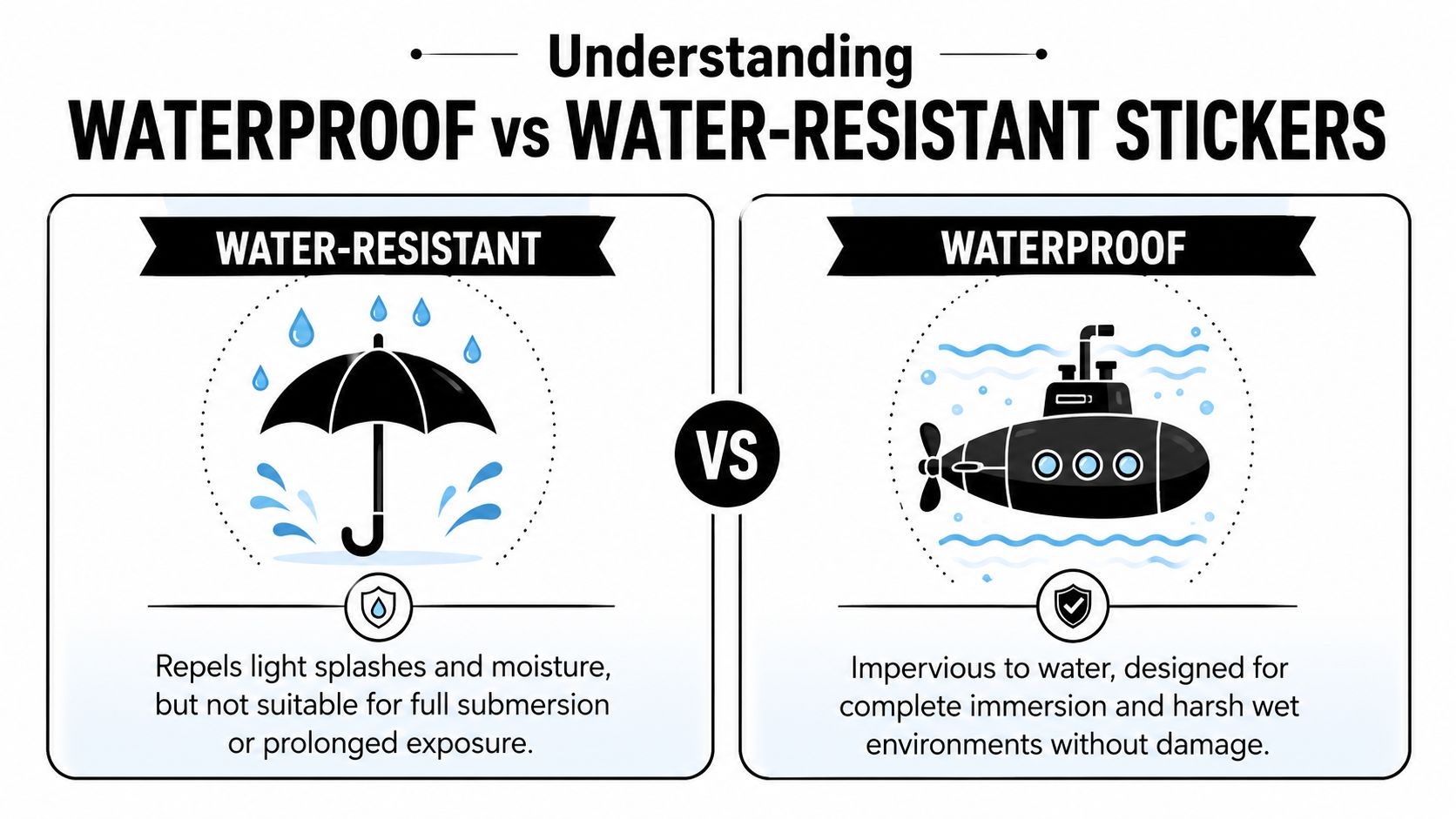
A water-resistant sticker is like a rain jacket. It handles ordinary moisture, light splashes, and short exposure. A waterproof sticker is closer to a drysuit. It's built so water can't easily penetrate the full system.
Why the distinction matters on a vehicle
That difference sounds academic until you put the sticker on a car. Vehicles create repeated stress at the edges. Water sits in trim lines. Dust and soap get pushed against corners. The sun heats the panel, then the temperature drops overnight. If the sticker only resists brief moisture, it may look fine at first and still fail early in use.
One industry guide says waterproof materials can block water for about 5–10 years, while water-resistant materials are suited to light exposure such as rain and may last less than 3 years. The same guide also warns that vinyl itself is only water-resistant and shouldn't be expected to survive prolonged submersion for several hours (HTVRONT guidance on waterproof vs water-resistant stickers).
A better way to read product claims
When a seller says “waterproof,” ask what they mean in practice:
- Normal outdoor exposure: Rain, splashing, moisture, and occasional washing
- Extended wet stress: Repeated soaking, standing water at edges, or prolonged submersion
- Print protection: Whether the ink is shielded from bleeding or abrasion
- Adhesive reliability: Whether the bond is built for outdoor surfaces
A sticker can survive rain and still not be the kind of waterproof most buyers imagine.
That's why cheap listings often disappoint. They use the strongest possible word for the broadest possible audience. A vehicle owner needs a narrower answer. You're not decorating a notebook. You're putting a graphic onto paint, glass, or plastic that has to deal with weather, movement, cleaning, and time.
The Anatomy of a Truly Waterproof Sticker
A vehicle sticker survives water as a built product, not because one layer happens to be vinyl. The film, the print, the laminate, and the adhesive all have to hold up together. If one part is weak, water usually finds that weak point first.
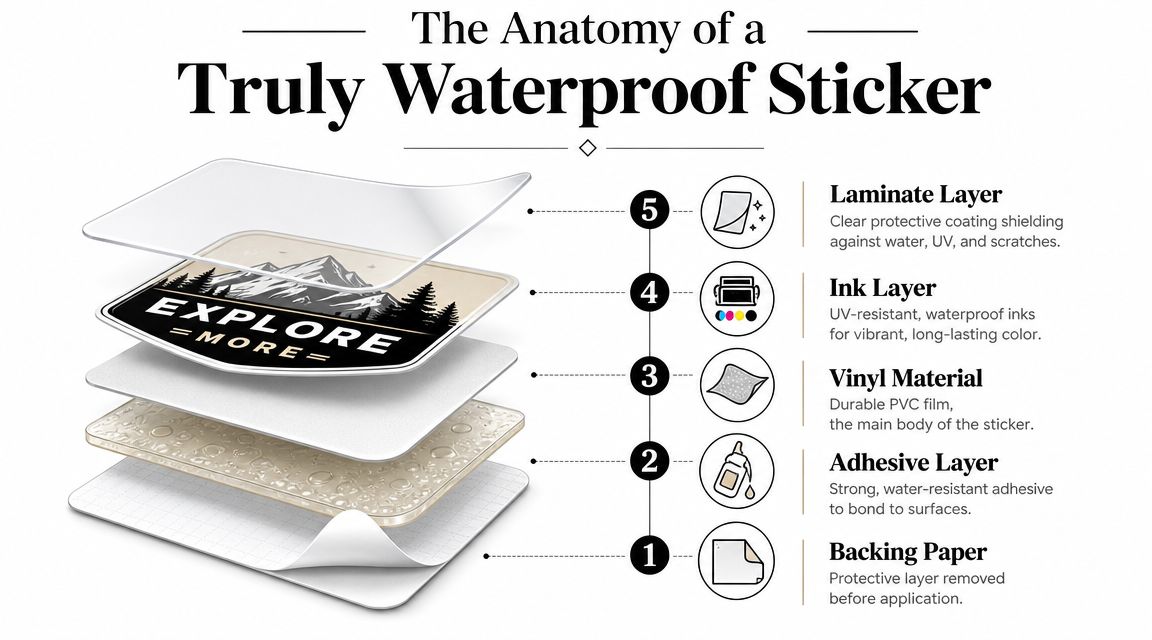
In the shop, this is the difference between a decal that still looks sharp after seasons outside and one that starts whitening at the edge, losing ink, or lifting at a corner after a few washes. Buyers often hear “waterproof” as if it describes a single material. It does not. It describes the whole construction.
The face film
The face film is the visible body of the decal. For vehicles, vinyl is the standard because it handles outdoor moisture far better than paper stock and conforms better to glass, painted panels, and many plastics.
Material grade matters here. Cast and calendared films do different jobs, and bargain vinyl often shows its weaknesses during application or after weather exposure. Premium sign vinyl cuts cleaner, lays flatter, and stays more predictable over time. That matters on anything from small door decals to a vinyl windshield banner decal for a Jeep Wrangler, where edge stability and clean adhesion affect both appearance and lifespan.
The print layer
A sticker can have good vinyl and still fail as a waterproof product if the printed image is exposed or poorly produced.
This is one of the biggest gaps between cheap online decals and professionally made outdoor graphics. The film may repel water, but the print can still scuff, blur, or fade unevenly if the ink system is not suited for exterior use. On a vehicle, that shows up fast on high-contact areas and on surfaces that get washed often.
Common print failures include:
- surface ink wearing away during cleaning
- moisture reaching unprotected print at cut edges
- patchy fading that leaves the decal attached but visibly tired
The laminate
Laminate is the layer many sellers skip when they want to hit a lower price point. For vehicle decals, that shortcut usually costs the customer more later.
A proper overlaminate helps shield the print from abrasion, chemicals, road grime, and repeated washing. It also reduces the chance that water works directly against the printed surface over time. Laminate does not fix bad vinyl or bad ink, but it gives a well-made sticker a much better chance on a daily driver.
The adhesive and the edge
Water problems usually start at the edge, not the center. The middle of a decal can look fine while a corner has already begun to fail.
That failure pattern is familiar to anyone who has removed old graphics from cars, trucks, or siding. Once an edge lifts, water, dirt, soap, and pressure get underneath and keep widening the problem. The same general principle shows up in exterior cleaning work, including what South Mountain Window Cleaning on vinyl siding explains about pressure, surface condition, and water intrusion.
Adhesive choice matters just as much as film choice. A permanent outdoor adhesive has to stay bonded through heat, cold, moisture, and cleaning. If it cannot, the sticker does not fail all at once. It starts with one edge, one corner, or one small tunnel where water gets under the film.
That is how a waterproof sticker should be judged. As a system built to stay sealed, stay readable, and stay bonded on the vehicle.
How Vinyl Stickers Perform in Real-World Conditions
Vehicle owners don't test decals in a lab. They test them in rain, in parking lots, at car washes, in winter slush, and during long sunny weeks when the vehicle sits outside.
Technical guidance from sticker manufacturers says vinyl stickers are generally considered waterproof in normal wet-use conditions because the PVC film repels water and can withstand rain, splashing, condensation, and hand washing. That same guidance also notes that prolonged immersion, repeated freeze-thaw cycling, and harsher exposure such as dishwasher cycles or saltwater can reduce lifespan or cause failure at the edges, while lamination mainly improves UV and abrasion resistance rather than creating water resistance from scratch (Stickers.com guidance on waterproof sticker performance).
What that means on cars, trucks, and Jeeps
On a daily driver, a quality vinyl decal usually does well with the kind of water exposure most owners deal with. A windshield banner sees rain at speed. A rear window decal gets morning condensation. A bedside graphic gets hit with spray from wet roads.
That's all normal use.
Where problems start is at the extremes:
- Repeated pressure at the edges: High-force washing can catch corners or seams.
- Winter cycling: Moisture, freezing, and thawing put stress on adhesive lines.
- Salt-heavy environments: Saltwater and road salt are rougher than plain rainwater.
- Neglected surfaces: Wax residue, grime, or oxidized paint can weaken the initial bond.
If you want a useful outside reference on how vinyl surfaces themselves react to pressure washing, South Mountain Window Cleaning on vinyl siding gives a practical look at why high pressure and bad angles can do more harm than people expect. The surface isn't your decal, but the lesson carries over well. Force aimed at an edge is where trouble starts.
A realistic expectation for washing
Hand washing is the safest baseline. Automatic washing may be fine for many decals, but the risk depends on brush contact, chemical strength, and whether the sticker already has a vulnerable edge.
A vehicle decal isn't fragile. It also isn't armor plating.
For example, a long horizontal banner across the windshield sees different stress than a smaller quarter-window decal. If you're looking at a style like a Jeep Wrangler vinyl windshield banner decal, the long exposed edge length makes clean application and careful washing even more important.
A quick visual helps if you want to see outdoor decal use in context.
How to Maximize Your Sticker's Lifespan
A good decal starts with good manufacturing, but the owner still plays a role. Most premature failures come from one of three things: poor installation, rough cleaning, or choosing the wrong construction for the job.
A printing industry source notes that in practical production terms, “waterproof vinyl stickers” are generally understood to mean vinyl plus a protective top layer. The same source says standard white vinyl is generally considered waterproof, and that true waterproof printable vinyl keeps printed color from bleeding even when sprayed or saturated, unlike most sticker papers (CarStickers.com guidance on waterproof vinyl sticker construction).
Start with application
If the adhesive never gets a proper bond, water will find the weak spot later.
Use this checklist before the backing comes off:
- Clean the surface well: Remove dirt, road film, wax, and oily residue.
- Dry it completely: Moisture trapped under the adhesive can ruin the seal.
- Pick the right surface: Smooth paint, glass, and properly prepared panels work best.
- Press edges firmly: Most failures begin at corners and edges, not in the center.
Shop-floor advice: A perfectly good decal applied to a dirty panel can behave like a cheap decal.
Wash it like you want it to last
You don't need to baby a quality vinyl sticker, but you do need to avoid the obvious damage points.
Safer habits
- Use hand washing when possible: It gives you control around edges and corners.
- Rinse grit before wiping: Dirt acts like sandpaper.
- Pat attention to lifting corners: Small edge issues are easier to deal with early.
- Skip harsh scrubbing: Abrasive pads and aggressive brushing shorten the life of the finish.
What to avoid
- Don't blast an edge up close: Water pressure can catch and lift it.
- Don't soak problem edges repeatedly: Once an edge opens, water keeps working underneath.
- Don't assume paper stickers are “close enough”: They aren't built for the same abuse.
Add protection where it matters
Not every decal needs laminate, but it helps in the places where vehicles take the most punishment. Lamination is especially useful when the graphic will see lots of sun, wiping, and surface contact.
If you want an example of a design style commonly used outdoors, an American flag full-color outdoor decal sticker is exactly the kind of product where a protected printed surface matters. Full-color outdoor graphics have different needs than simple cut vinyl lettering.
Choosing a Durable Vinyl Sticker for Your Ride
By this point, the short answer should be clearer. Yes, vinyl stickers can be waterproof in the way most vehicle owners need them to be. No, that doesn't mean every vinyl sticker deserves the claim equally.
The biggest mistake is buying based on the word vinyl alone. A long-lasting vehicle decal depends on the whole build: outdoor-grade film, stable print, reliable adhesive, and, when needed, a protective top layer. If one part is weak, water usually exposes it sooner than dry indoor use would.
What to look for before you buy
Use these criteria instead of marketing language:
| Check | Why it matters |
|---|---|
| Outdoor-grade vinyl | The base film needs to handle weather and surface movement |
| Vehicle-suitable adhesive | A weak bond usually fails first at corners and edges |
| Protected print if full color | Printed graphics need more than good-looking artwork |
| Clear use-case language | Good sellers explain rain, washing, and limitations honestly |
A useful comparison point outside automotive graphics is this overview of durable waterproof vinyl labels from InchBug. It helps show the same principle across another product category: durability comes from matched materials, not from one magic label.
Why material choice still matters
Experience counts here. Shops that have been making outdoor decals for years tend to choose materials that install cleanly and hold up in the field because they've already seen what fails. Premium Oracal vinyl is popular for that reason. It's chosen for predictable outdoor performance, not just because it sounds professional.
If you want a decal made for vehicle use rather than a generic sticker listing, start with sellers who are transparent about what they use and where the decal belongs. A product page like custom car decals you can personalize should make it easy to tell whether you're buying a real exterior graphic or just a decorative sticker with ambitious wording.
In the end, the best waterproof sticker is the one that matches the job. For a vehicle, that means buying a decal built as an outdoor graphic and treating the edges like the critical detail they are.
If you want decals made with that level of care, Custom Sticker Shop is worth a look. They're a family-run, veteran-friendly shop in Kansas that has been making American-made vinyl decals since 2001 using professional-grade Oracal vinyl rated for up to 7 years outdoors. Their catalog covers cars, trucks, Jeeps, military tributes, family decals, and custom text, with pre-spaced, transfer-taped designs that install cleanly and are built for real vehicle use.